
Reduction of Pd(II) to Pd(0) Pathways
When it comes to many Pd-catalyzed reactions like Suzuki, Heck, Stille, and many others, they are all catalyzed by Pd(0). But those catalysts, like Pd(PPh3)4, are unstable and don’t keep well for long-term storage and future use, so typically we see Pd(II) salts, such as PdCl2 and Pd(OAc)2, used instead. Those must be reduced to Pd(0) in situ, and yet most textbooks and papers just brush it off and pretend like it’s some sort of nuisance that doesn’t matter how it happens.
In this tutorial I want to show you the most typical ways we convert Pd(II) species into Pd(0) in the reaction mixture using whatever we have floating around.
Three Pathways to Reduction
There are three typical pathways:
- Reduction by phosphine,

- Reduction by amine,

- Reduction by the alkene

The important thing to keep in mind here is that we typically use the catalyst in a rather small quantity, up to just a few mol%, so all the co-products we get in these reactions are rather insignificant and don’t typically have any negative effect on the reaction mixture.
Reduction by Phosphine
Anhydrous Conditions
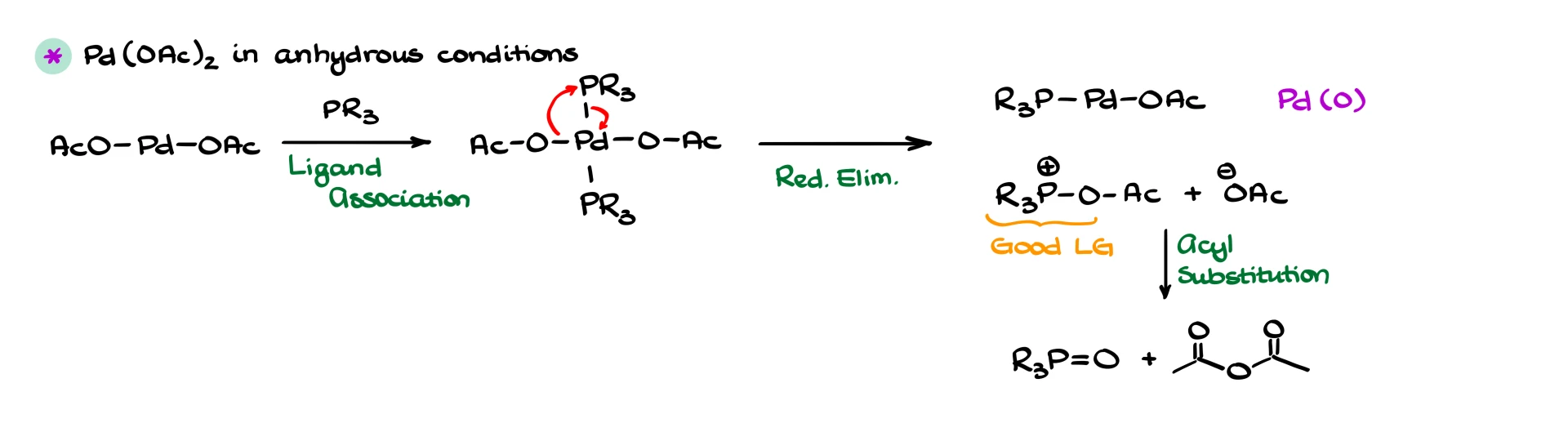
Let’s look at the first pathway: reduction by phosphine. If we’re working under anhydrous conditions, we’d typically see palladium acetate as our catalyst of choice. Let’s schematically represent it as palladium connected to two acetates. Next, we’re going to have a ligand association step with our phosphine ligands, and as a result, we’ll end up with the tetrasubstituted complex. Next comes a reductive elimination, giving us the palladium species, which is Pd(0) at this point, along with a phosphine acetate structure. Here, the phosphine portion acts as an excellent leaving group on the acetate, so if we take another acetate from solution, we can get a simple acyl substitution, making the corresponding phosphine oxide and acetic anhydride as our products.
Aqueous Conditions
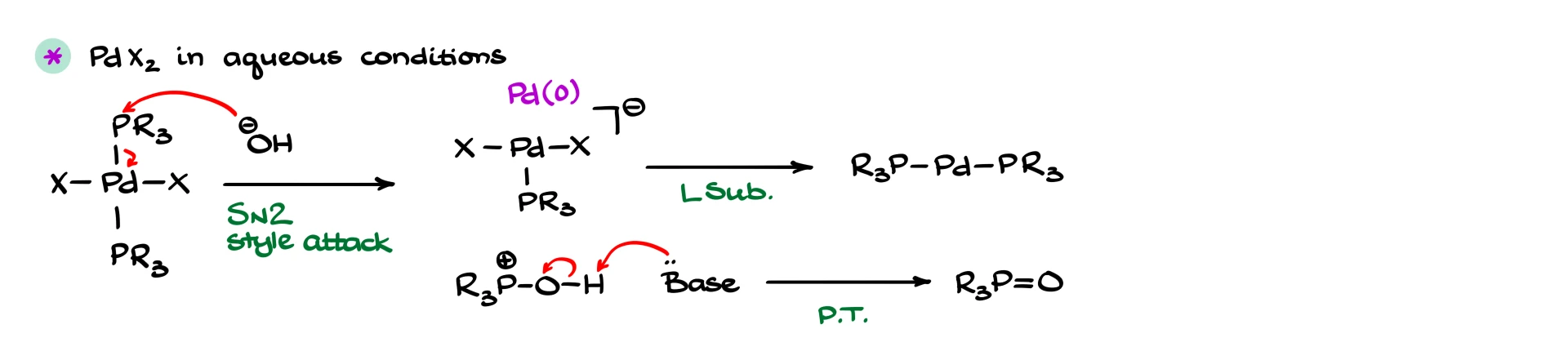
Now, if we’re working in aqueous conditions, we can have almost any palladium salt get reduced by phosphines. Typically we see palladium acetate or chloride, but other salts occasionally show up as well. In this case, I’ll skip the ligand association step and start with the complex containing phosphine ligands right away.
Since we’re working in basic aqueous conditions, we’re going to have some quantity of hydroxide floating around. This hydroxide can do an SN2-style attack on our phosphine, knocking it off the palladium and making this negatively charged complex, where we already have Pd(0), so that was our reduction step. Now we can do a simple ligand substitution with another phosphine and get the neutral Pd(0) complex, if you’d like to see it in that form. Although, I do have to mention that there are quite a few reports showing a very high likelihood of the negatively charged palladium complex I have here going into the catalytic cycle as is; it doesn’t have to be the neutral version.
As for the other product we get in this reaction, the phosphine hydroxide, well, we’re working in basic media, so a base, whatever that base might be, is going to come in, pull that proton off, and make the corresponding phosphine oxide.
These two are the most common reduction pathways when we’re working with phosphine-based systems. But we’re not always going to see those, so if we don’t have phosphine around, we can turn to an amine instead.
Reduction by Amine
We can see a reduction by an amine, which is a common base for many palladium-catalyzed reactions. In this case, our product is going to be either an imine or an iminium ion salt, depending on the nature of the amine we’re using.
Secondary Amines
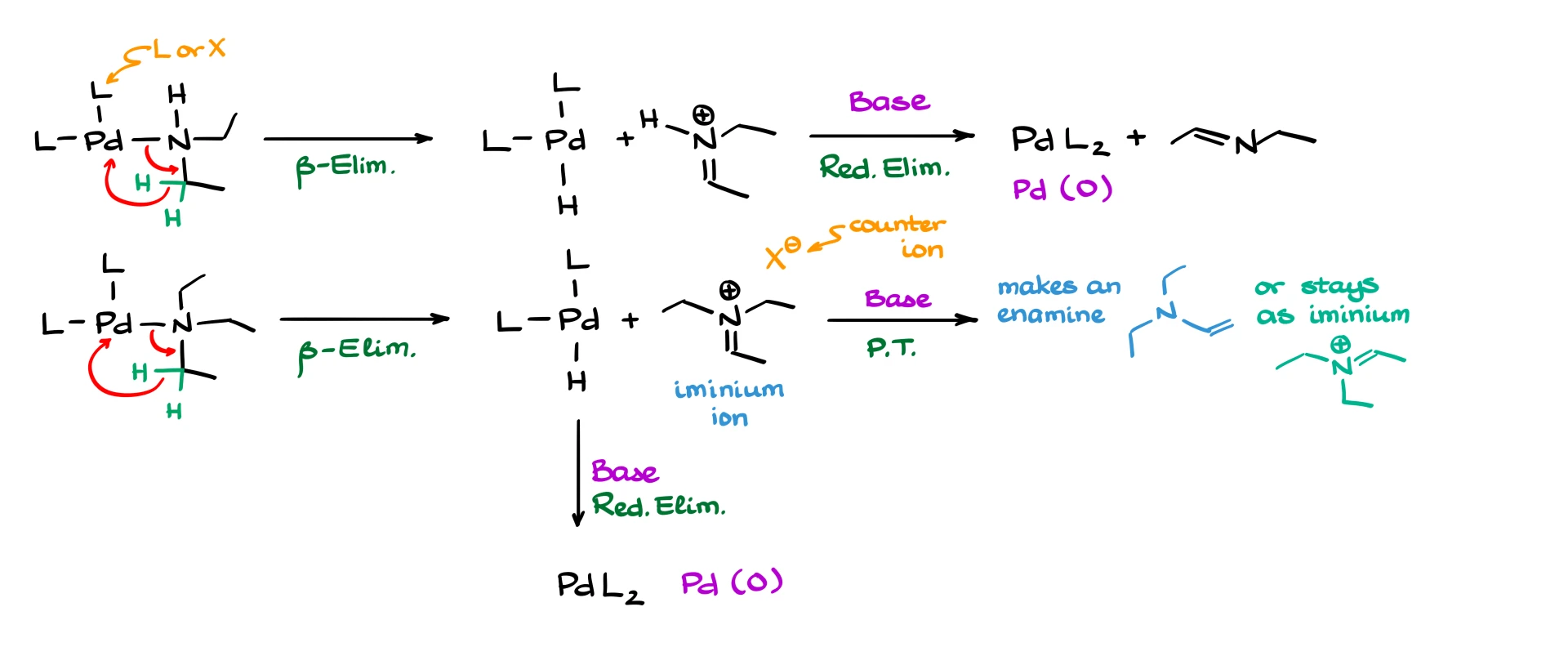
Let’s start with the generic complex with an amine already coordinated to our palladium. Here, I’m first looking at a secondary amine, so we have a hydrogen sitting on our nitrogen atom. The L’s here are either neutral ligands of some sort (maybe a solvent or something else) or even an X that was an original counterion to our Pd(II); it doesn’t really matter what those are.
What does matter, however, is that we should have at least one hydrogen on a carbon connected to the nitrogen in the amine, because now we can do a β-elimination, moving a hydride onto palladium and expelling the iminium ion, which, in the presence of the base, will undergo reductive elimination and proton transfer correspondingly, giving us the reduced Pd(0) complex and an imine co-product.
Tertiary Amines
Now, if we have a tertiary amine in our reaction, the main requirement is still the same: we’ve got to have that hydrogen on the carbon connected to the nitrogen in the amine. Like in the previous case, we’re going to do the β-elimination, making our Pd-H complex and an iminium ion, where we’d have some sort of counterion pairing up with our iminium ion, making a salt. Alternatively, our iminium salt might break up, forming a corresponding enamine, and, of course, palladium is going to reductively eliminate the hydride, giving us the Pd(0) complex, ready for our catalytic cycle.
Reduction by Alkene
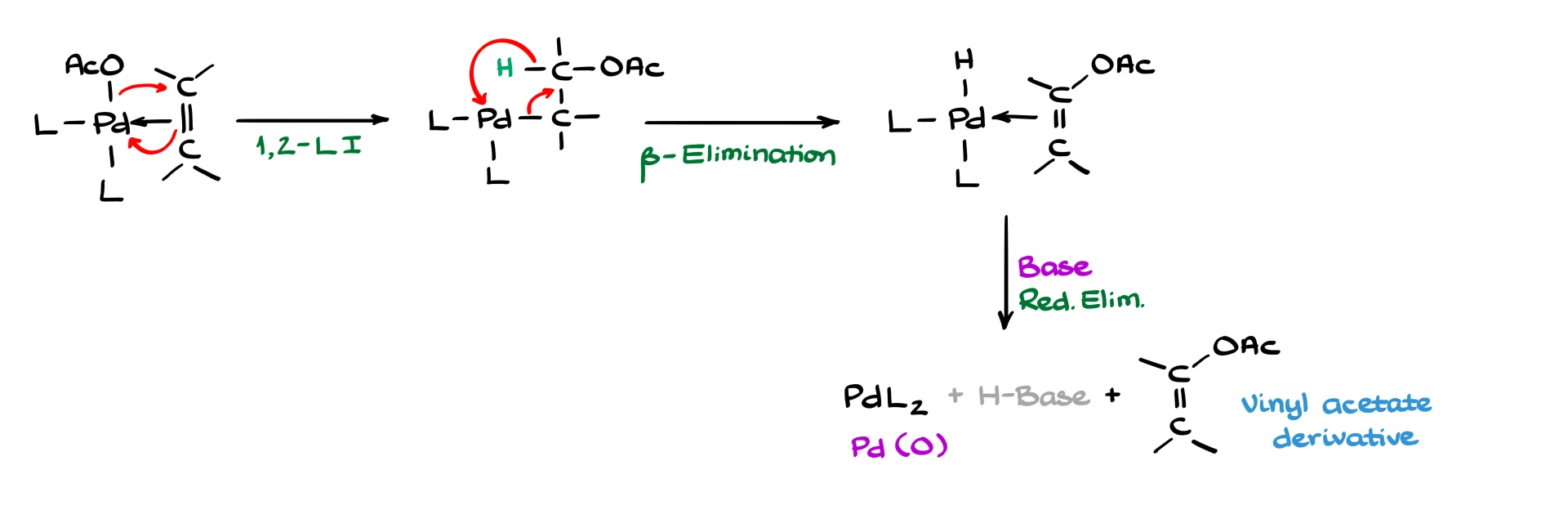
Finally, if everything else fails or is unavailable for whatever reason, we can do a reduction by the alkene itself. So let’s imagine a complex where I have my alkene coordinated to my palladium center, and I’ll show one acetate here as well. The nature of the other ligands doesn’t matter too much here; it can be an acetate or a chloride. I’ll show the process for the acetate in this example, but chlorides behave very similarly.
Step one here is going to be a 1,2-ligand insertion, or migratory insertion if you want to call it that, giving us the complex with palladium and acetate attached to the carbon chain. While there are some speculations that this might happen intermolecularly, the vast majority of the papers I’ve seen describe this step as migratory insertion, so I’m inclined to believe that this is likely the case.
Now, we’ve got to have a hydrogen in the β position, because we’re going to do a β-elimination, moving the hydride onto the palladium atom and reforming the alkene. Once we do our reductive elimination, we’ll get the new palladium complex, where our palladium is Pd(0), the corresponding conjugate acid from base scavenging the proton, and, of course, the vinyl acetate co-product.
Wrap-Up
So now, when your textbook or a paper you’re reading says there was an in situ reduction of Pd(II) to Pd(0), you’ll know how it typically happens and be able to figure it out for the system you’re looking at.