
Intro to Transition Metal Complexes

In this tutorial, I want to talk about transition metal complexes. We’ll talk about what transition metal complexes are, the ligand classifications, oxidation states and how to find those, the d-notation, and also the importance of the 18- and 16-electron rules.
What Are The Transition Metal Complexes?
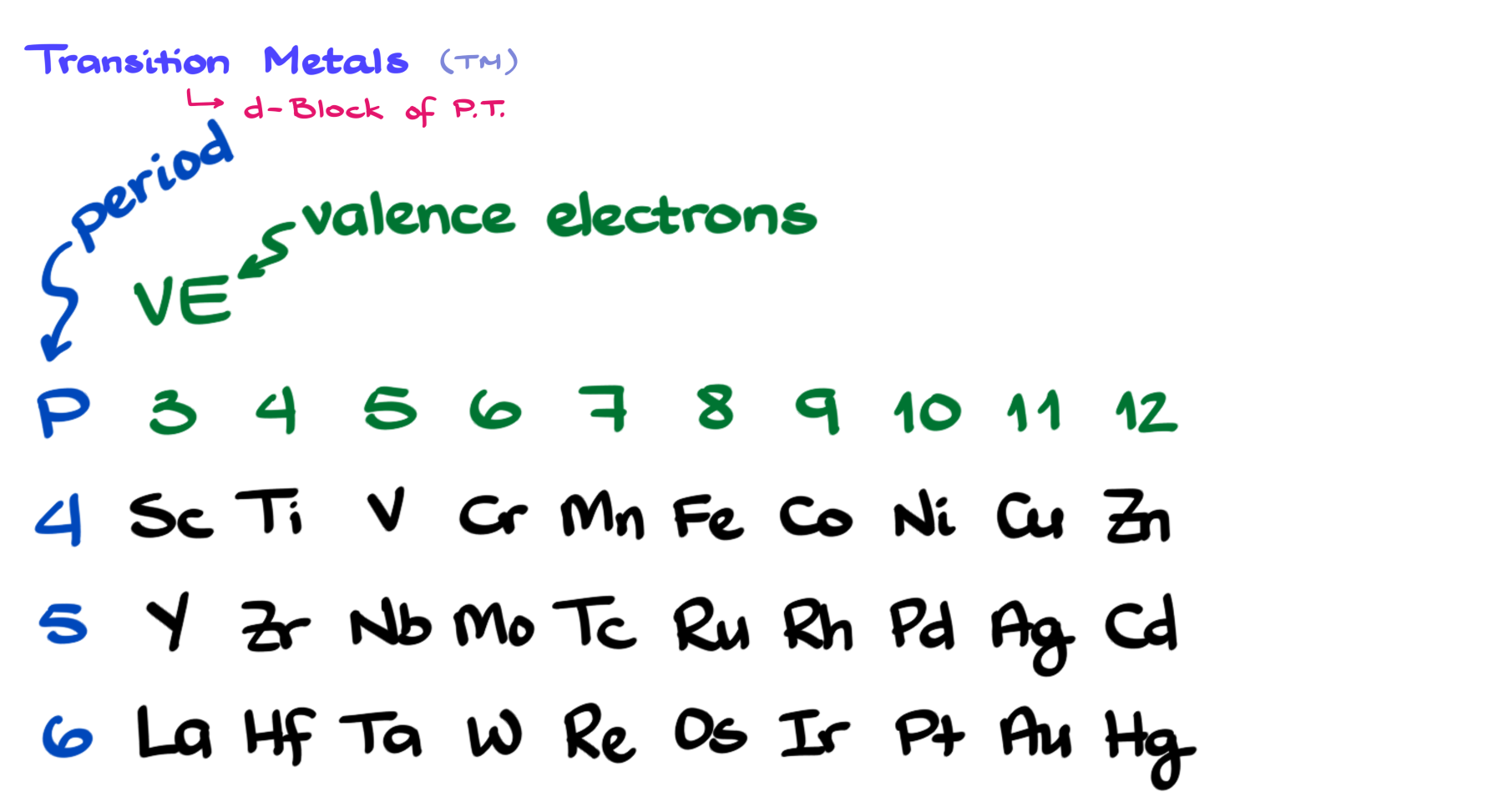
Alright, so, transition metals are the d-block of the periodic table, which is all these guys. I’m only including the 4th, 5th, and 6th periods of the periodic table here, as the 7th period with transuranium elements has no practical applications for our purposes due to their extremely low stability.
A really cool thing about the transition metals is that they can coordinate ligands around them. When I use this word “coordinate” here, I mean the formation of a specific type of chemical bond, which is not your typical covalent bond, but neither is it an ionic bond. Essentially, if we take some sort of metal and a ligand, the ligand will always be the source of electrons. So, we can draw a curved arrow showing the electrons going from the ligand to the metal, which is essentially going to give us complexation similar to the Lewis acid-base complexation. We typically refer to those bonds as donor-acceptor bonds, and sometimes you can even see people use an arrow instead of a simple line to indicate those bonds.

Now, this is an extremely simplistic explanation of this bonding. The true nature of the bonding in transition metal complexes goes beyond the scope of this tutorial, and frankly, beyond the scope of the organic chemistry course itself, as it can involve complex interactions of molecular orbitals.
Ligand Classification
When it comes to the ligands, there are many different classifications that we use for those. I’m only going to go over a few most useful for our purposes.
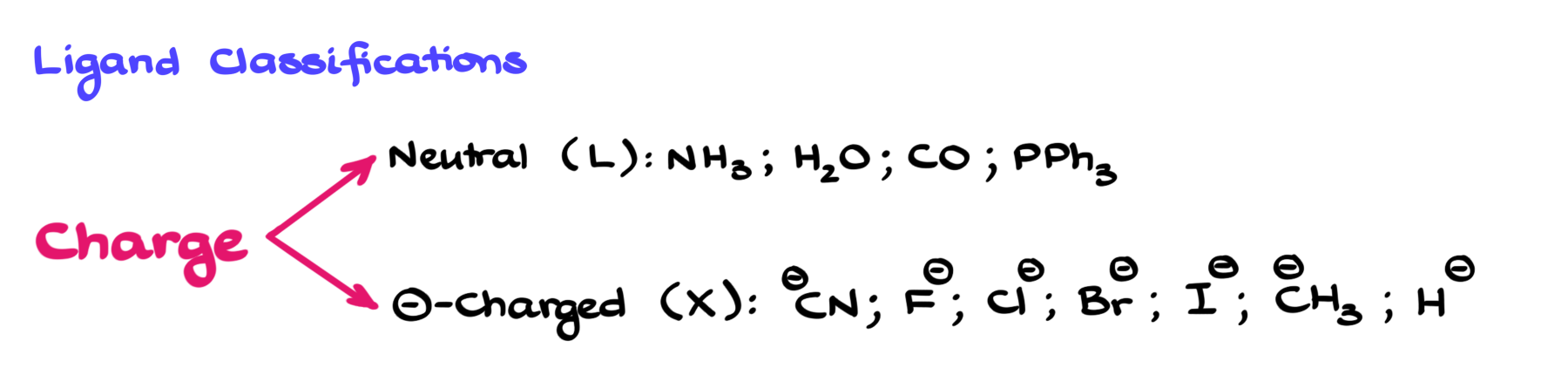
First, we can classify ligands by charge into neutral ligands, like ammonia, water, carbon monoxide, triphenylphosphine, etc., and charged ligands, like cyanide, halides, alkyls, hydrides, etc. And while there are a few ways those are abbreviated depending on the textbook you’re using and your instructor’s preferences, I’m going to use “L” for neutral ligands throughout my tutorials, and “X” for charged ligands.
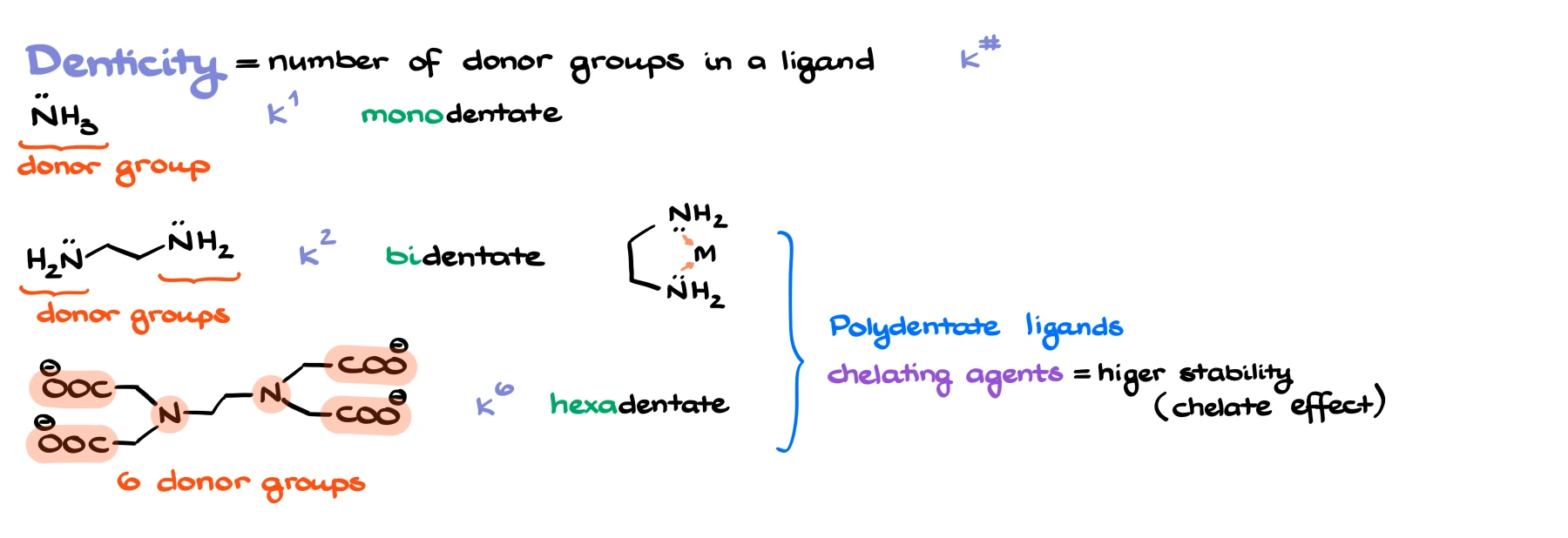
Next, we have “denticity.” Denticity is the number of donor groups that you have in your ligand that can participate in bonding. Since we’re dealing with organic molecules, some of those can get quite large and have multiple places where the bonding can occur at the same time. Denticity is typically abbreviated with the Greek letter kappa with a superscript number. For instance, ammonia only has one donor group, therefore we’ll say it’s a κ1 ligand, or in other words, it’s a monodentate ligand.
Or, here’s another example with two nitrogens. In this case we have two donor groups, hence it’s a κ2, or a bidentate ligand. So, when it binds to a metal center, it’s going to make essentially a cycle. And similarly, we can have tri-, tetra-, pentadentate ligands, and so on.
Here’s a classic ligand used all over the place in analytical chemistry, EDTA (ethylenediaminetetraacetate). This guy has 6 donor groups, so we’re going to abbreviate it κ6 and call it a hexadentate ligand.
Also, when we have ligands that have two or more donor groups, we call them polydentate ligands. Another term you’ll hear is “chelating agents,” which is very popular in analytical chemistry. And a really cool thing about the chelating or polydentate ligands is that they make very stable complexes, which is actually not a very good thing for our purposes, but I thought I’d mention that nonetheless so you know what the fuss is all about if you hear that polydentate ligands are out of this world amazing.
Now, can you have ligands with higher denticity? Absolutely! The trick, though, is that those complexes require a rather large metal atom and a ton of empty orbitals to accommodate all those electrons. So, when it comes to the transition metals, 6 is pretty much a hard ceiling with very few exceptions.
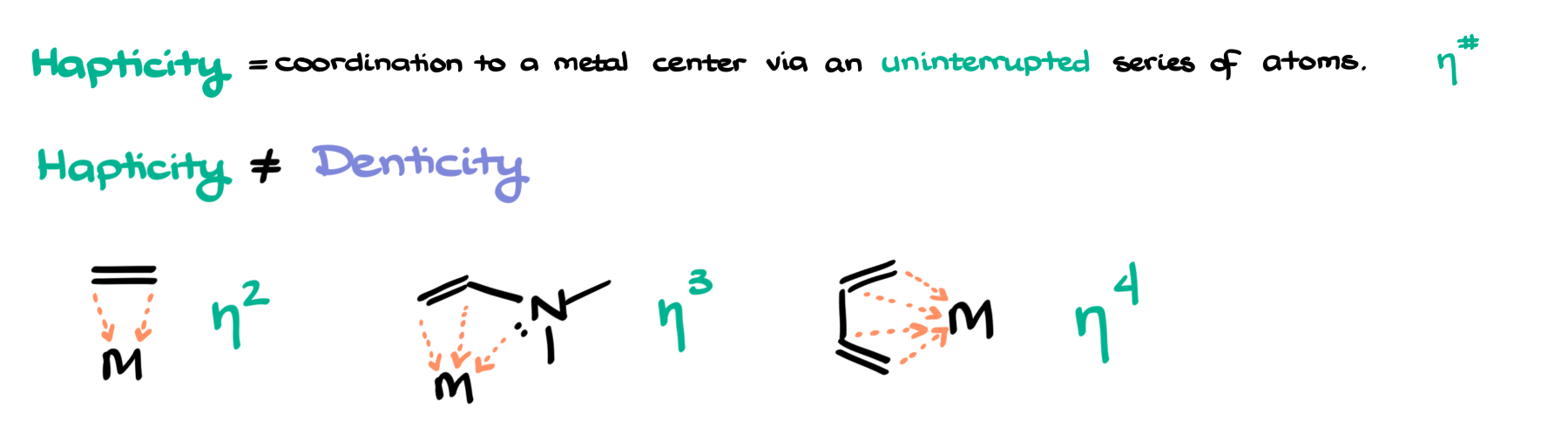
And before we move on, there’s one more classification we’ve got to talk about, and that is hapticity, which we use when we’re describing ligands that bind to our metal center via an uninterrupted or contiguous series of atoms. In this case we use the Greek letter eta (η) with a superscript, but we pronounce it as “hapta” and not “eta” because why make things easy, right?
Now, importantly, hapticity is not the same thing as denticity. Let me explain. Let’s say we have ethylene here. When this molecule binds to the metal, we have both carbons making a bond with the metal center. We’ll abbreviate it as η2. Or, let’s say we have this enamine structure as our ligand. If this guy binds to the metal center with each carbon of the alkene portion and the nitrogen, we have 3 contiguous atoms binding to the metal, making it an η3 ligand. Or, here’s a butadiene molecule. When binding to the metal center, this becomes an η4 ligand.
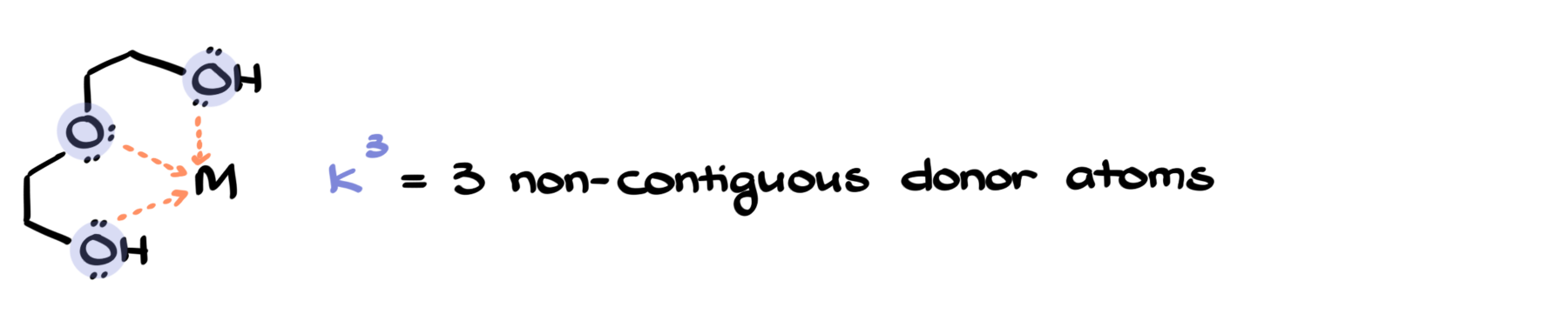
In contrast, when I have this molecule with three oxygens separated by carbon chains, when this ligand coordinates around the metal center, we end up with three separate donor groups, not uninterrupted atoms like in all previous examples. So, this one is a κ3 ligand, and not η3, because, as I said, we have 3 separate, non-contiguous atoms.
And if it sounds like a ton of terminology, it is. This is, essentially, a few pieces of nomenclature you’ve got to know, just like you would go over the nomenclature of a new functional group when you’re starting a new unit.
Transition Metal Oxidation States
Alright, moving on, we have the oxidation states. And when it comes to the oxidation states, the only thing that’s going to be important to us here is the oxidation state of the central metal atom.

Let’s look at this tetrakis(triphenylphosphine)palladium complex. The very first thing we’ve got to do here is look at the complex itself and note if it has any charge. Here, the complex is neutral. Next, we’re going to look at our ligands and classify them as neutral or charged. So, when I was going through the ligand classifications before, I did it on purpose. You can’t calculate your oxidation states without being able to classify your ligands first. It’s all connected. In this case, we have a neutral ligand, meaning the ligands are going to have an overall charge of 0 in this molecule. And since the molecule has to be balanced and have an overall charge of zero, the palladium oxidation state here would be zero as well. Always remember, your metal atom has to balance the molecule whether the complex is neutral, like in this case, or charged.

Here’s another example. In this case, I have 2 chloride ligands. Those guys are negatively charged. And we have two ammonia ligands, which are neutral, giving us 0 charge. So, in this case, platinum has to have an oxidation state of +2 to balance the complex and make it neutral.

Here’s another fun example. “Cp” is the common abbreviation for the cyclopentadienyl ligand. This is an η5 ligand that has a -1 charge, and since we have two of those, the overall charge they bring is -2, meaning that the oxidation state of iron in this complex has to be +2 to balance it all out.

And finally, I’ve been showing you neutral complexes, so let’s look at a charged one for a change. In this case, I have a charge of -3, so I’ll have to keep that in mind when deciding what the oxidation state of my iron is. Here, I have cyanide ligands, which are negatively charged, and I have 6 of those, which would constitute an overall -6 charge from my ligands. And since the complex’s charge is -3, the difference that I have to balance with iron is -3, meaning that the iron oxidation state must be +3 in this complex.

And if you absolutely have to have some sort of a formula to remember how to do this, you can remember that the complex charge equals the metal’s oxidation state plus the charged donor groups in your complex. So, depending on which two pieces of information you have, you can always reverse-engineer the other missing bit.
d-Notation
Next, we’re going to look at the d-notation. Transition metal complexes tend to have a ton of electrons in them, and we’re certainly not going to be showing them as dots around the metal. Instead, we’re going to use the d-notation, which can give us clues on the reactivity, geometry, and magnetic properties, help with electron counting, and ligand field splitting. Fun fact: you’re not going to need any of that in the scope of a typical organic chemistry course, but we still teach it, so you’ve got to know it for the test.
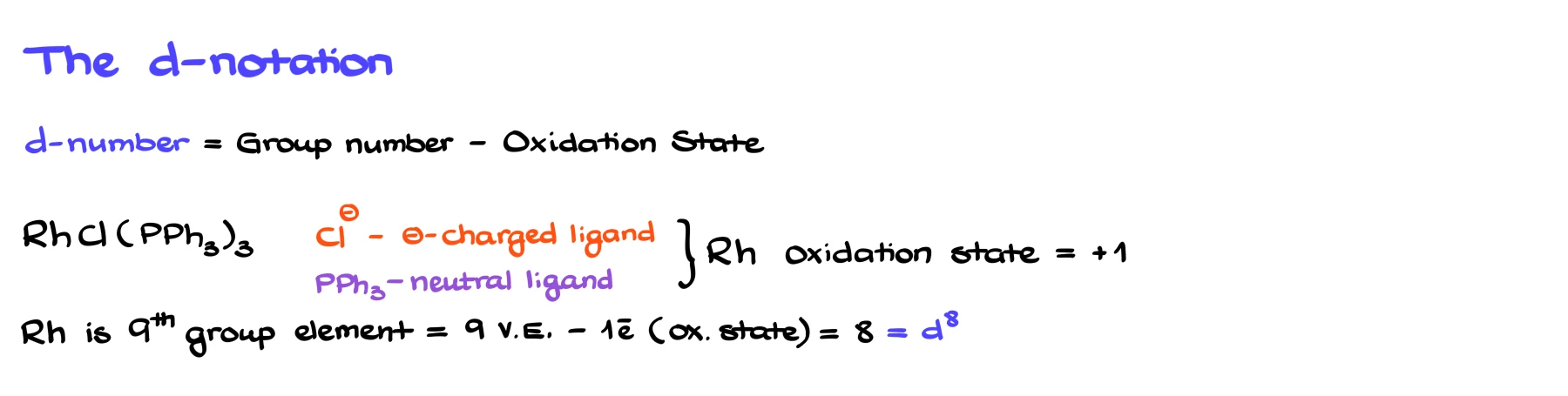
So, the way we calculate the d-number is by taking the group number where the metal is and subtracting its oxidation state. For instance, here’s a complex. This is Wilkinson’s catalyst used in homogeneous hydrogenation, by the way. But what we care about is the d-number of this complex. First, I look at my ligands. I have a single negatively charged chloride, and I also have the neutral triphenylphosphine ligands, meaning that my rhodium’s oxidation state in this complex is +1. Now, for the next part, I’ll need my periodic table. I like to keep mine on the cover of my reference table binder since I use it periodically. So, rhodium is right here in the 9th group, which means we have 9 valence electrons. Subtracting 1 (since the oxidation state of rhodium is +1) gives us 8, so this is a d8 complex.

Here’s another example. In this case, the oxidation state of iron is +2, and since iron is in the 8th group of the periodic table, we end up with 8 valence electrons. 8 minus 2 gives us 6, so this is a d6 complex.
Now, why do we need this information? Typically, the only place where we’re going to use it within the scope of intro organic chemistry is for the electron count. So, let’s talk about the 16- and 18-electron rule.
Electron Count and 16- vs 18-Electron Rule
The total number of electrons in the transition metal complex is going to be the d-number plus the ligand electrons. Neutral ligands give us 2 electrons per donor group. Like, for instance, this triphenylphosphine, or ammonia. Both provide 2 electrons for our complex. Or this diamine, which has two donor groups, provides 4 electrons. Similarly, the negatively charged ligands also give us two electrons. Like, for instance, this chloride gives two, or this cyanide, also two, and this hydride, you guessed it, also two.
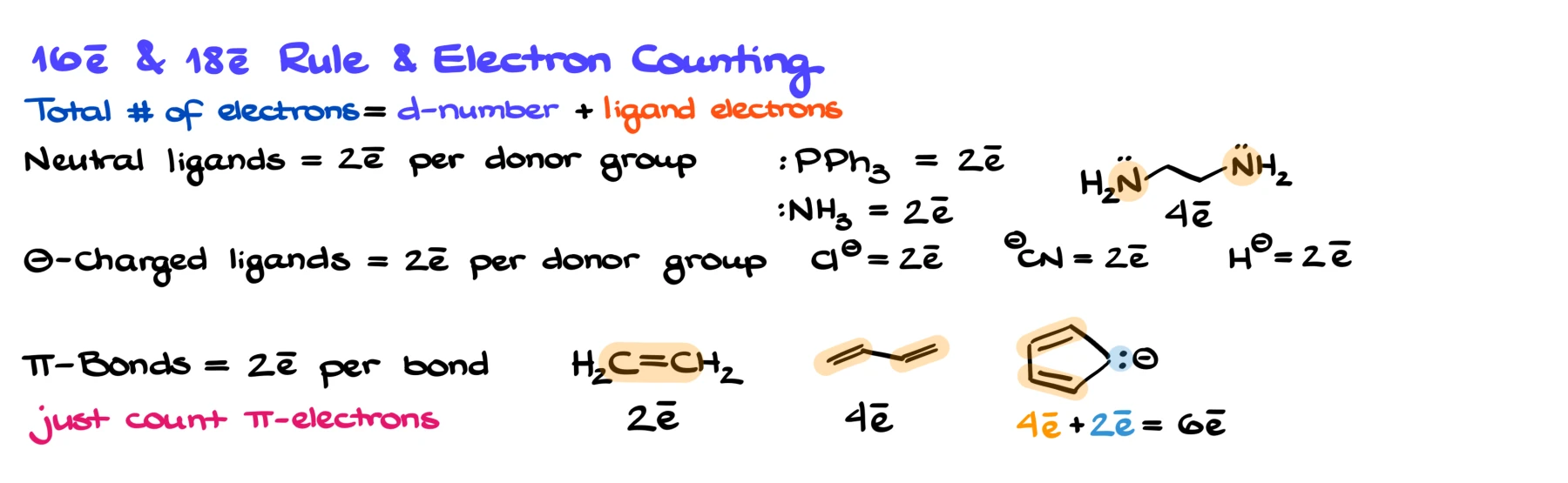
Now, where things become a bit more interesting is with the π-bonds. We get two electrons per π-bond. Like, for instance, this ethylene has one π-bond, thus it provides 2 electrons. Or, this butadiene has two π-bonds, so it can give 4 electrons. Or, this cyclopentadienyl that we’ve seen before. Here, we have two π-bonds and an electron pair, so in total, the cyclopentadienyl ligand can give up to 6 electrons. So, as a rule of thumb, you can just remember to count your π-electrons, and that’s what you’re going to get as the maximum number of electrons your ligand can provide.
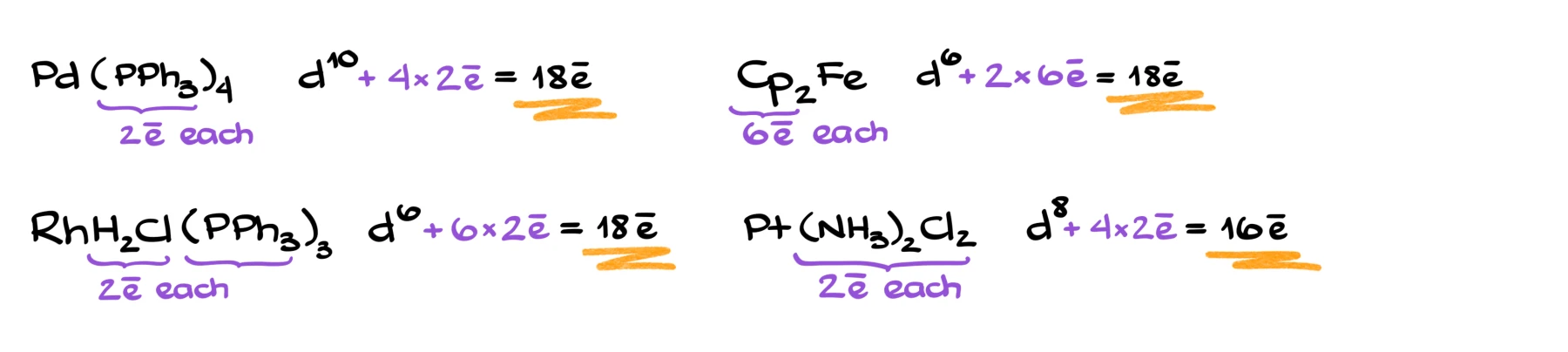
For example, let’s look back at the tetrakis(triphenylphosphine)palladium complex we’ve seen before. Using the information from earlier in this tutorial, you can calculate that this is a d10 complex. We have 4 triphenylphosphine ligands, each providing us with two electrons, meaning we have our d10 + 4×2, giving us 18 electrons total. So, this is an 18-electron complex.
Or, how about our ferrocene we’ve seen a few times today already. This is a d6 complex, and each cyclopentadienyl gives 6 electrons, so d6 + 2×6 gives me 18 electrons again.
Or, how about this next example. This is a d6 complex, and our ligands here provide 2 electrons each, giving us d6 + 6×2, resulting in 18 electrons again.
And let’s do just one more example. This is a d8 complex. Each ligand here gives us 2 electrons as per usual, so we get d8 + 4×2, giving us 16 electrons this time.
And I’m sure you’re sensing the trend here. We’re always going to get either 18 or 16 electrons. Most complexes obey the 18-electron rule. It’s like your octet, but it’s 18 and it’s for transition metal complexes. If you count the electrons in your complex and it’s not 18 (or in some cases 16), something is wrong. You either haven’t calculated things correctly, or you have a bigger problem. For instance, here’s the Ni(CO)4 complex. You can check for yourself that this is an 18-electron complex. If you got a different number, retrace your steps and try again.

I’ve mentioned 16-electron complexes a moment ago. The group 8-11 metals tend to make 16-electron complexes with square planar geometry. Because, of course, the platinum group metals had to be special. Like, for instance, this Cl2Pd(PPh3)2 complex is a 16-electron complex.
Concluding Thoughts
Phew! This was a ton of information. In this tutorial, we’ve learned about the ligand classifications, how to calculate the oxidation states, the d-notation, and the 16- and 18-electron rule. In the next tutorial, I’m going to go over the fundamental mechanistic steps we see in the reactions involving transition metal complexes.