
The Heck Reaction
A Brief History: Heck’s Original Discovery
In this tutorial, I want to talk about one of the cornerstone reactions of palladium-catalyzed chemistry: the Heck reaction.
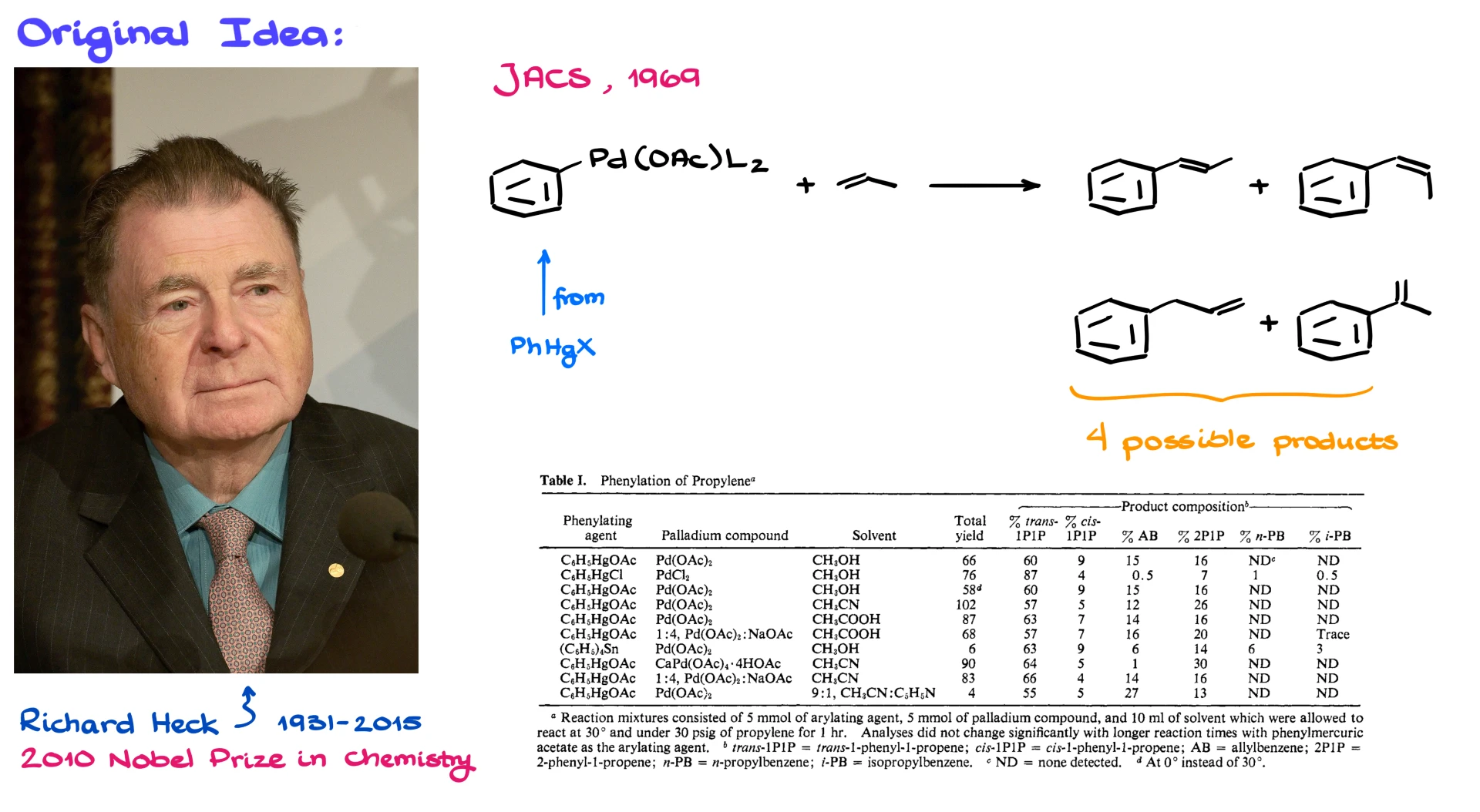
In the late 1960s, Richard Heck published a JACS article describing the reaction between an organopalladium compound and an alkene, achieving yields up to 90% depending on the conditions. In that original work, the organopalladium compound was obtained from an organomercury precursor.
Mizoroki’s Parallel Discovery and the Reaction’s Name
Right around the same time, Tsutomu Mizoroki published a very similar study describing the reaction of iodobenzene with styrene in the presence of palladium chloride as a catalyst, giving a respectable 90% yield of stilbene.
Heck, however, also published his own version of the reaction using palladium acetate as the catalyst under slightly different conditions from Mizoroki’s. He noted that adding phosphine ligands tends to improve the reaction outcome. Since both authors published their work independently around the same time, the reaction is often called the Mizoroki-Heck reaction.
The Catalytic Cycle: An Overview
So, how does the reaction work?
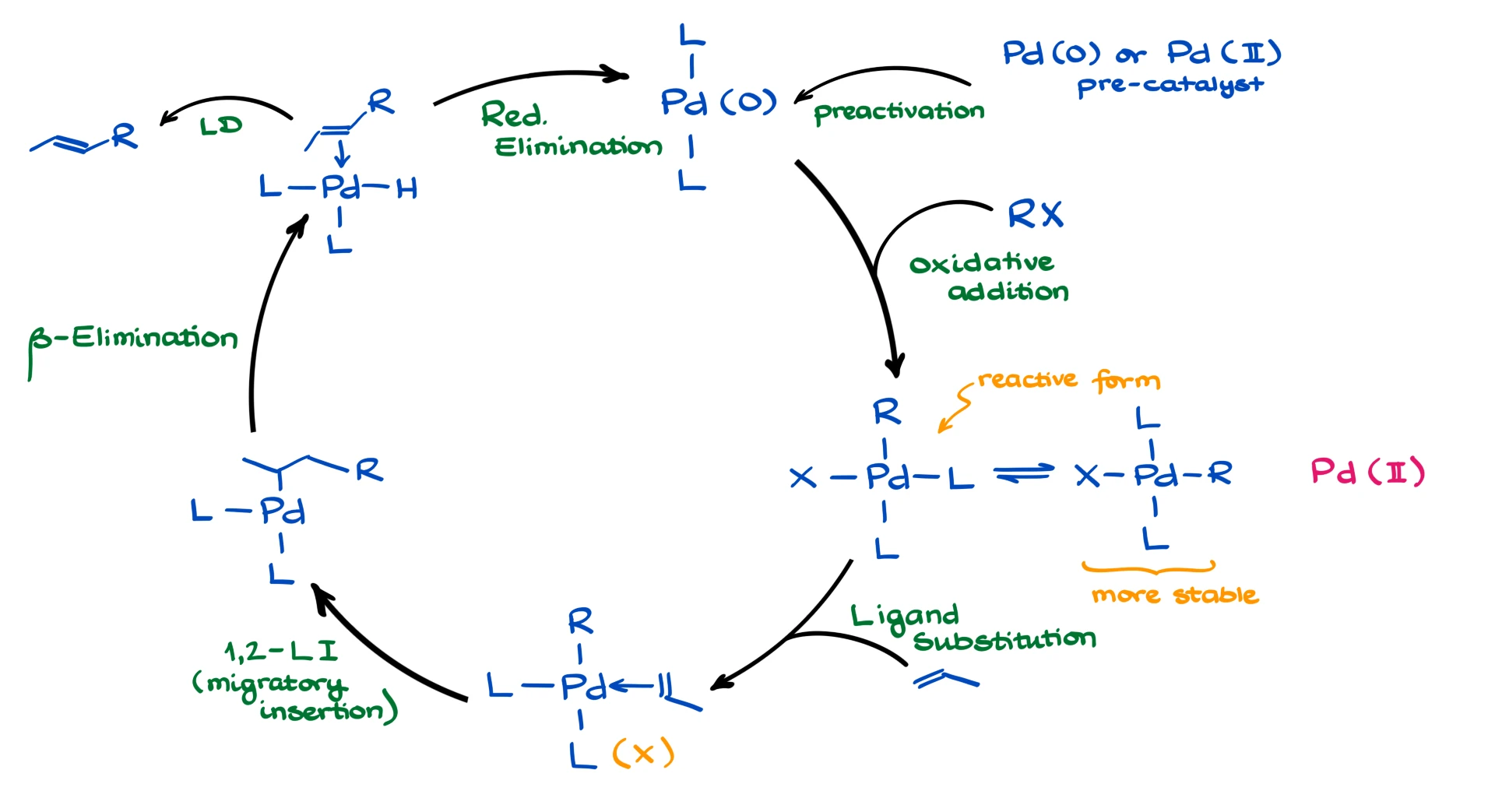
We typically start with a pre-catalyst, which can be either a Pd(0) or a Pd(II) compound. The pre-catalyst goes through an activation process, either in situ reduction or ligand dissociation depending on what we started with, to give us the active Pd(0) catalyst.
From there, we have an oxidative addition of our halide, typically a vinyl or aryl halide, making a new complex. Since this was an oxidative addition, our palladium goes from an oxidation state of 0 to an oxidation state of +2, or from Pd(0) to Pd(II).
Interestingly, this complex can undergo cis-trans isomerization, with the trans stereoisomer typically being more stable. However, it’s the cis stereoisomer that we actually need for our reaction.
Next, we have a ligand substitution where one of our ligands is replaced with the alkene. There are a couple of variations of how this can happen: either a neutral or a charged ligand can get substituted. While this does change the overall charge on our complex, it doesn’t really matter for the catalytic cycle itself or the final product which type of ligand the alkene replaces.
Once we have this intermediate, we move to the 1,2-ligand insertion, also called migratory insertion. If you hear that term, it’s just a different name for a step you already know. As a result of this ligand insertion, we make a new C-C bond, and palladium is now connected to the rest of our chain.
From this point, we have a β-elimination, giving us our alkene product, which dissociates from the complex. We lose the hydrogen from palladium via a reductive elimination step, regenerating our catalyst so the cycle can repeat.
Easy, right?
Walking Through an Example
Here’s an example. We’re reacting an aryl bromide with ethyl acrylate in the presence of some sort of Pd(0) catalyst and a base. What exactly those are isn’t important for the purposes of this example, but let’s quickly go over the mechanistic steps.
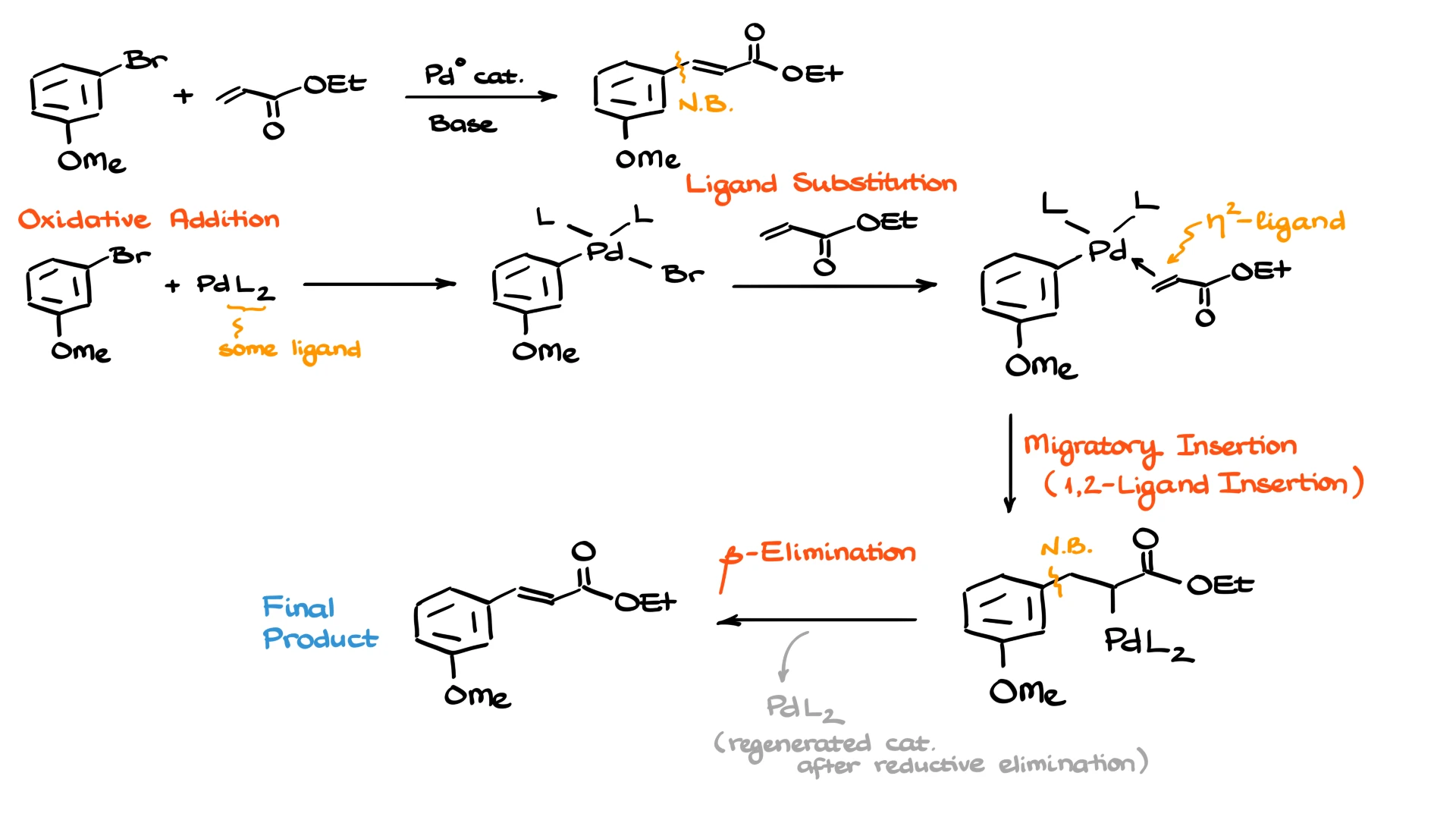
We start with oxidative addition, bringing together our aryl halide and our active palladium catalyst, where these L’s are just some sort of ligand that isn’t relevant for the mechanism. That gives us the following intermediate, where palladium has now inserted itself between the aromatic ring and the halogen.
Next, we bring in our alkene, ethyl acrylate in this case, and do the ligand substitution, replacing one of our irrelevant ligands with the alkene. This gives us the following complex. I’m showing the arrow from the alkene here to simplify the picture, since it’s an η2-ligand, and I’m not going to show the bonds to each individual carbon.
Next, we have the migratory insertion, or 1,2-ligand insertion, giving us the following intermediate, where we’ve made our new C-C bond and the palladium complex is now sitting on our chain.
Finally, we do the β-elimination, yielding our final product and regenerated Pd(0), which we get after the reductive elimination of the hydride.
Now, while this mechanism might seem quite straightforward, there are a few intricacies you need to know about each step, so let’s take a closer look.
Catalyst Activation: Getting to Pd(0)
First, our pre-activation step. There are two distinct pathways for this.

If we’re starting with a Pd(0) catalyst right away, we’re going to have a simple ligand dissociation. For instance, let’s take tetrakis(triphenylphosphine)palladium(0), Pd(PPh3)4. If we lose one triphenylphosphine ligand, and then a second one, we end up with the active form of our catalyst, ready to enter the catalytic cycle.
Interestingly, the first dissociation is very easy and quite favorable. The second dissociation, however, is problematic. So even if we start with a Pd(0) catalyst, we’re actually not going to have that much active catalyst in our system.
And here’s another problem: while the original Pd(PPh3)4 complex is somewhat stable, the complex with only two ligands is significantly less stable and tends to form an inactive palladium precipitate called palladium black. The worst part is that this process happens spontaneously, which means you can’t easily keep your Pd(0) catalyst on a shelf for an extended period of time, making it inconvenient to start from here.
The alternative is to use Pd(II) salts, which are stable but have to be reduced to Pd(0) in the reaction mixture before they can enter the catalytic cycle. There are many different ways this can happen. I have a dedicated tutorial on that, so I’ll just show one option here.
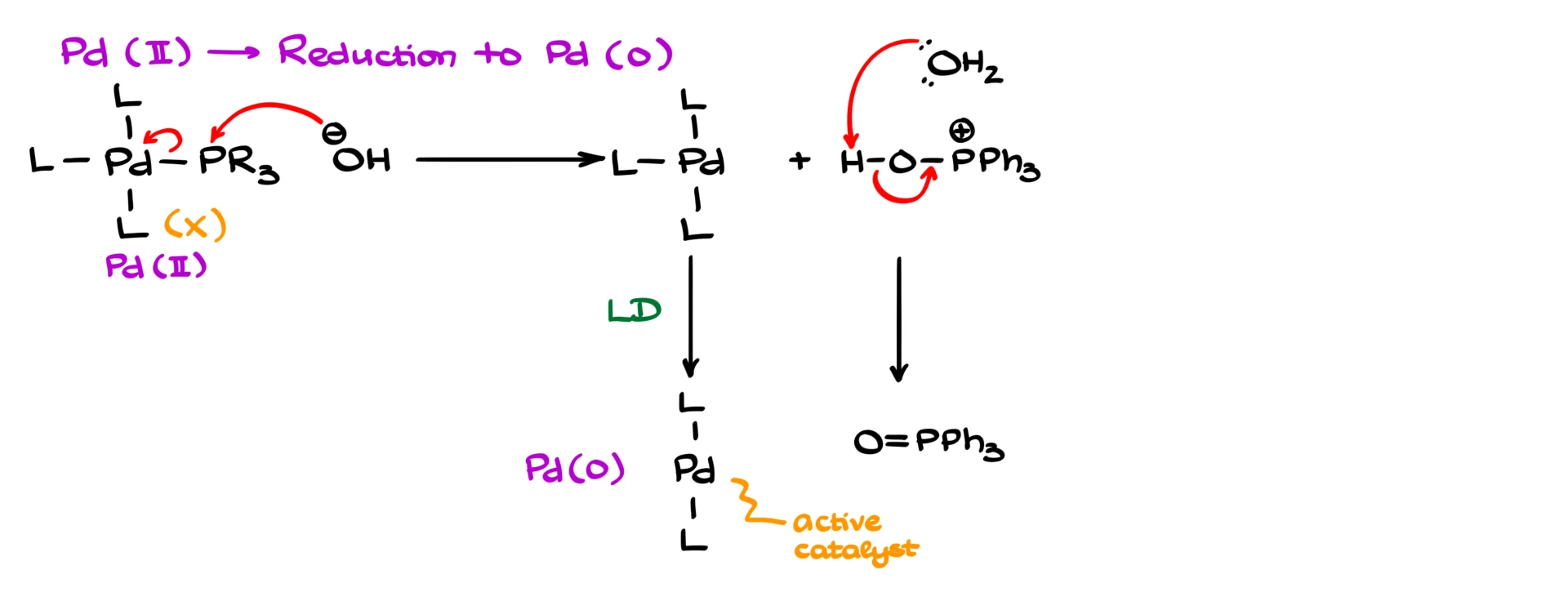
Let’s start with this complex. I’m going to focus on the triphenylphosphine ligand; what the rest of the ligands are isn’t very relevant to us. If we’re doing our reaction in aqueous basic media, the hydroxide ion can attack the phosphorus atom of the phosphine ligand, doing essentially an SN2-style substitution and making the following species. Then a water molecule can come in and pull off the proton from the OH, returning the electrons to oxygen and making triphenylphosphine oxide, along with the active form of our catalyst once it drops an additional ligand.
Here, we started with Pd(II) and ended up with Pd(0) at the end of the process, which is our active catalyst. Interestingly, the reduction step was that SN2-style attack by hydroxide on the phosphine ligand.
Oxidative Addition
Moving on, we have the oxidative addition step. This one is pretty straightforward: we take our activated complex and wedge the palladium between the R-group and the halide. The process is concerted, so everything happens in one step, and when it comes to halide reactivity, iodides and triflates tend to be the most reactive substrates for this step.
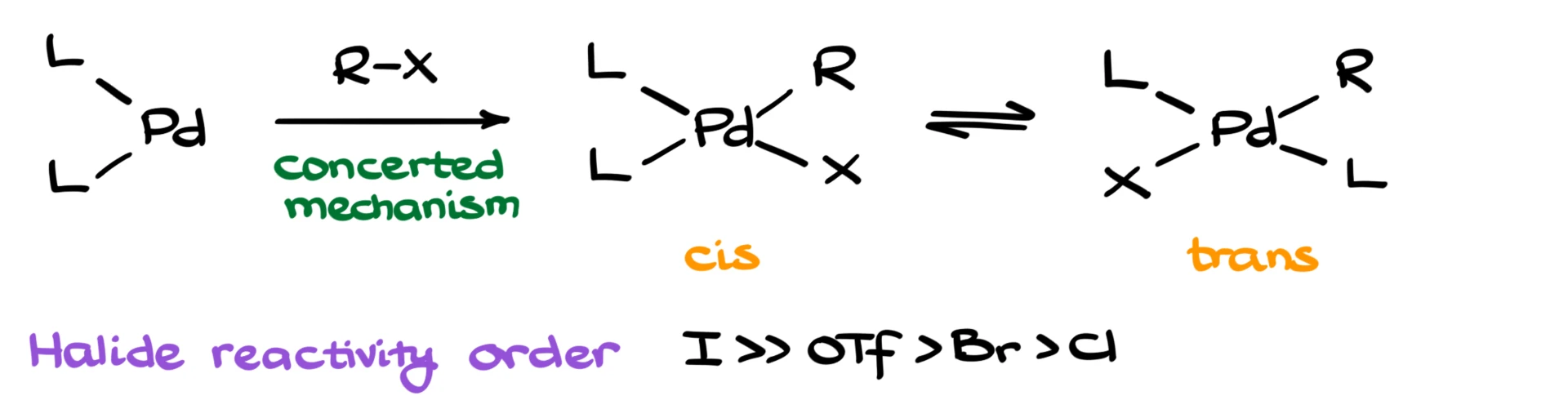
As I mentioned earlier, the cis form can easily isomerize into the trans form, but it’s the cis complex that we need for the further steps of this reaction. So while the trans complex is typically more stable, it’s not very useful for us.
Coordinating the Alkene: Migratory Insertion Pathways
Next, we have the fun part: the migratory insertion, or 1,2-ligand insertion step. This is our product-forming step, meaning we’re going to make our key C-C bond here. But before the insertion can happen, we have to coordinate the alkene around the palladium center, and there are two different ways this can happen.
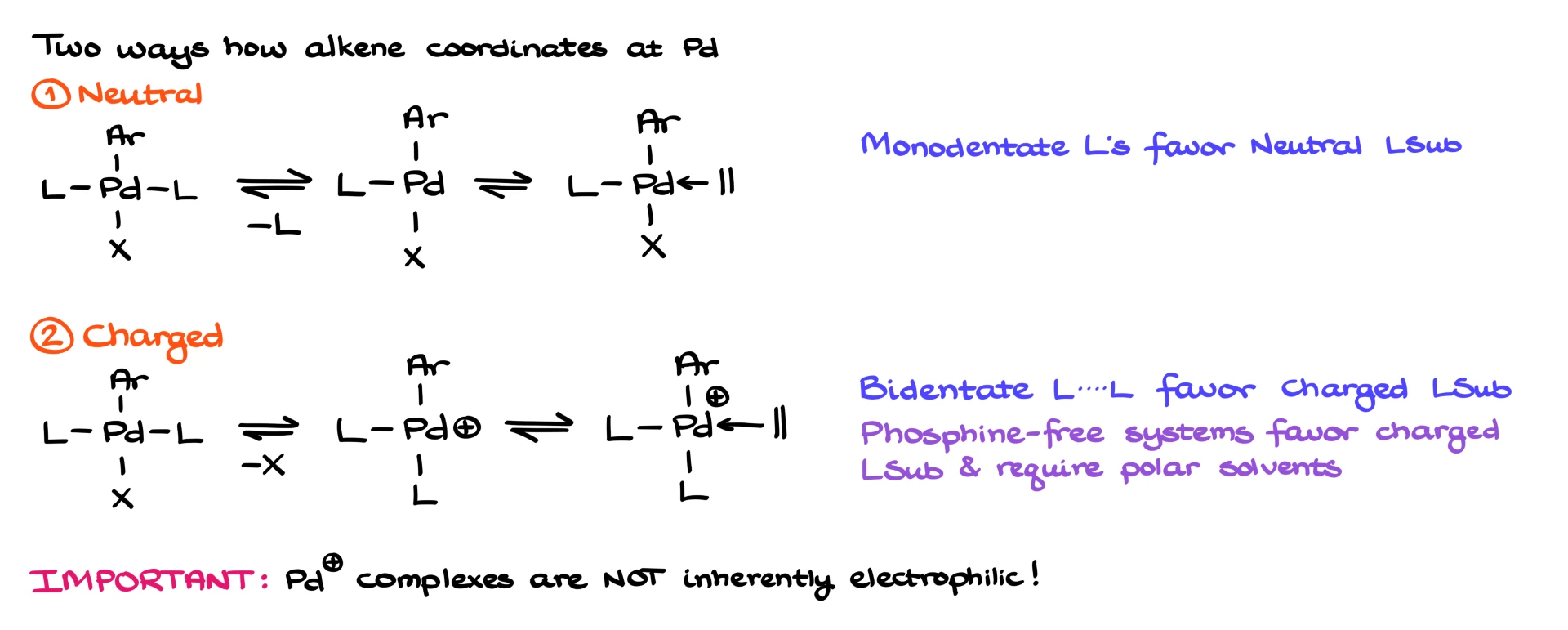
The first pathway is neutral. Here, we start with our complex (I’m showing a generic version for simplicity) and lose one of our neutral L ligands, making an intermediate that can now coordinate the alkene. Alternatively, we have a charged pathway: we start with the same complex, but this time lose the negatively charged ligand, making a positively charged intermediate that, like in the previous case, can coordinate the alkene.
Monodentate ligands tend to favor the neutral pathway, while bidentate ligands tend to favor the charged pathway. Phosphine-free systems tend to favor the charged pathway as well. I do want to mention one important thing, though: Pd+ complexes are not intrinsically more or less electrophilic than the neutral ones, and in many cases, reactions that follow the neutral pathway proceed much more favorably than ones following the charged pathway. Ultimately, it’s only marginally relevant how the alkene coordinates, but since both pathways show up in different textbooks, I wanted to show both here so you know they both exist and don’t make any difference to the outcome.
Regioselectivity of the Insertion Step
Now, the ligand insertion itself is a concerted mechanism. There’s no evidence of either carbocationic or carbanionic intermediates forming in this step, and the sterics of the molecules play the major role in determining the stereo- and regioselectivity.
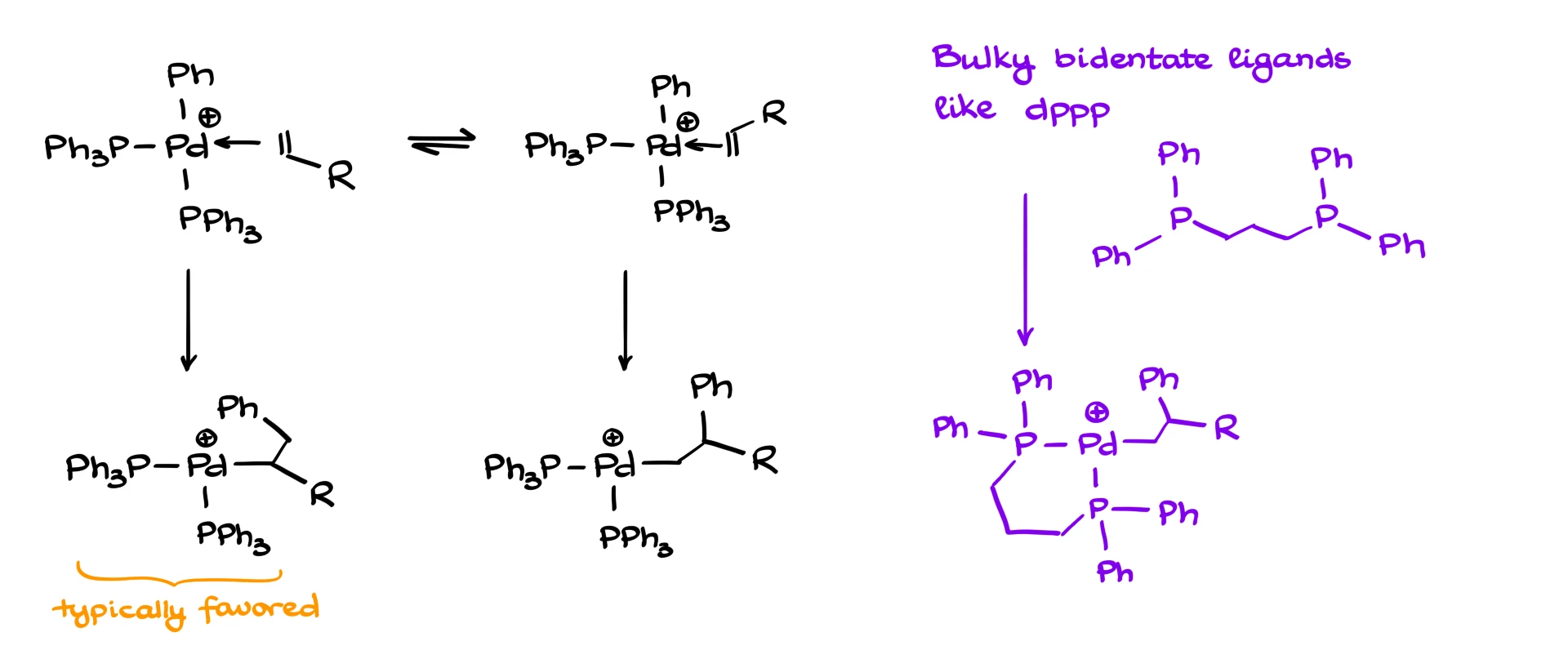
Let’s say we have this complex: triphenylphosphine ligands, which are just there for company, a phenyl group, which is the one we want to attach to the alkene, and, of course, the alkene itself. This complex can exist in two conformations: one with the R-group pointing away from the phenyl ligand, and one with the R-group pointing toward it. Importantly, the two are at equilibrium with each other, which will come in handy in a moment.
If we do the 1,2-ligand insertion from the first conformation, we end up with the R-group and the phenyl group two carbons apart from each other. If we do the insertion from the second conformation, we end up with the R-group and the phenyl group on the same carbon. The former outcome is typically what we observe, but here’s the caveat: the outcome depends on the size of the R-group and the other ligands in the complex.
The original conformation, with the R-group pointing away, is typically more stable. But is there a way to force the other conformation, where the R-group points in the same direction as the phenyl group? It turns out, yes. If we use bulky bidentate ligands like dppp, they create so much more steric hindrance compared to typical triphenylphosphine ligands that the conformation with the R-group toward the phenyl becomes more favorable, leading to the product with the phenyl and R-group on the same carbon.
This might feel counterintuitive, so let me explain. The bond angle in phosphines is actually quite small, close to 90°, which makes triphenylphosphine groups comparatively compact. Because of that, they can comfortably occupy their spots without causing too much steric hindrance compared to the phenyl group sitting directly on the palladium center. In contrast, a bidentate ligand forces the phosphines to open up, adopt a wider P-Pd-P angle, and occupy more space. This causes significant steric hindrance, and now having the R-group point in the same direction as the phenyl ligand isn’t as big a deal by comparison.
But, as I said, typically the R-group points away from the ligand you’re trying to attach to the alkene, making the “anti-Markovnikov”-style product, if you want to think about it that way.
Intramolecular Insertions and Ring Size Effects
Another notable exception to this general anti-Markovnikov trend comes up in intramolecular insertions. Say we have a complex with palladium coordinated to the alkene intramolecularly, with a tether (some carbon chain) connecting them. What exactly that chain is doesn’t matter much, as long as it can freely turn and twist.
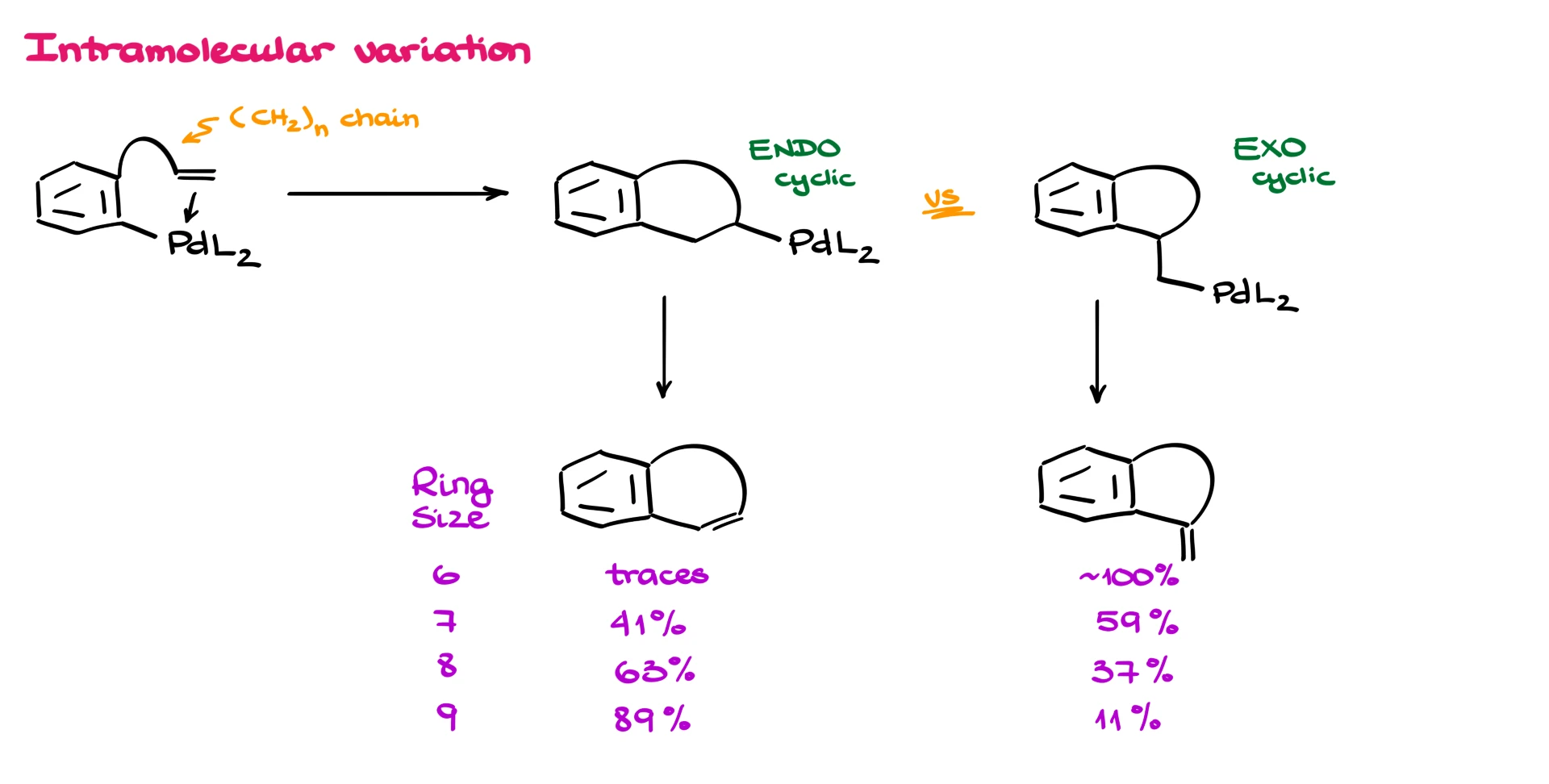
Now we can have two possible insertions: the endocyclic insertion, where we connect to the terminal carbon of the alkene, resulting in the larger ring, and the exocyclic insertion, where we make a new C-C bond to the more substituted carbon of the alkene ligand. The former yields a ring with the alkene inside it, while the latter makes an exocyclic alkene.
It turns out you need a rather long tether to make a connection to the terminal carbon. For a six-membered ring, you basically don’t see any terminal endocyclic product at all. A seven-membered ring gives about 40% endocyclic product. An eight-membered ring gives roughly a 60-40 split. Only when we get to a nine-membered ring do we start seeing a significant portion of the endocyclic alkene product, just as we’d expect for the intermolecular version of this reaction.
So, in short, sterics govern the regiochemistry, and we typically favor forming the new C-C bond at the less substituted carbon of the alkene.
β-Hydride Elimination
Okay, we have our new C-C bond, so now we need to get rid of the palladium and get our final product. This is where we see the β-elimination step, which has two common flavors.
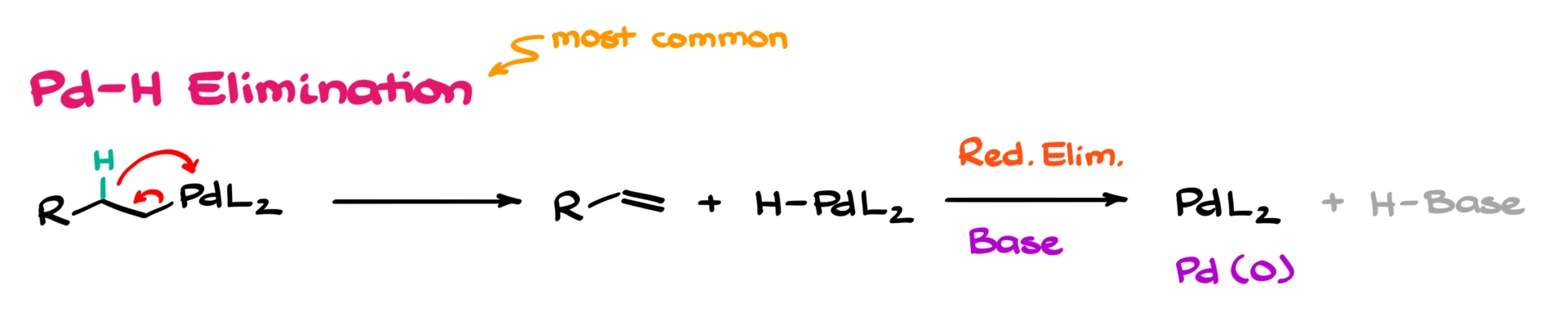
The first is the typical Pd-H elimination. Here, palladium is sitting somewhere on our molecule; we take the β-hydrogen, pull it onto palladium, and release the electrons back from palladium onto carbon, making the double bond, with the hydrogen now sitting on palladium. I’ve mentioned this before, but it bears repeating: this is not an E2-style reaction. The electron flow here is completely reversed, so keep that in mind if you’re drawing a stepwise mechanism.
From there, we do the reductive elimination to release that hydrogen from palladium, regenerating our catalyst and bringing us back to Pd(0). Whatever base is floating around in solution scavenges the resulting proton.

The other style involves β-elimination with other groups, typically alkylsilanes, where the silicon group leaves instead of a hydrogen. Since hydride elimination is the more common pathway, I’ll focus on that one here.
The Palladiotropic Shift: Why the Heck Reaction Can Be Unpredictable
While this is the last part of the mechanism, it’s where the biggest issues with this reaction surface. The problem is that β-elimination exists in a very fast equilibrium with the reverse addition.
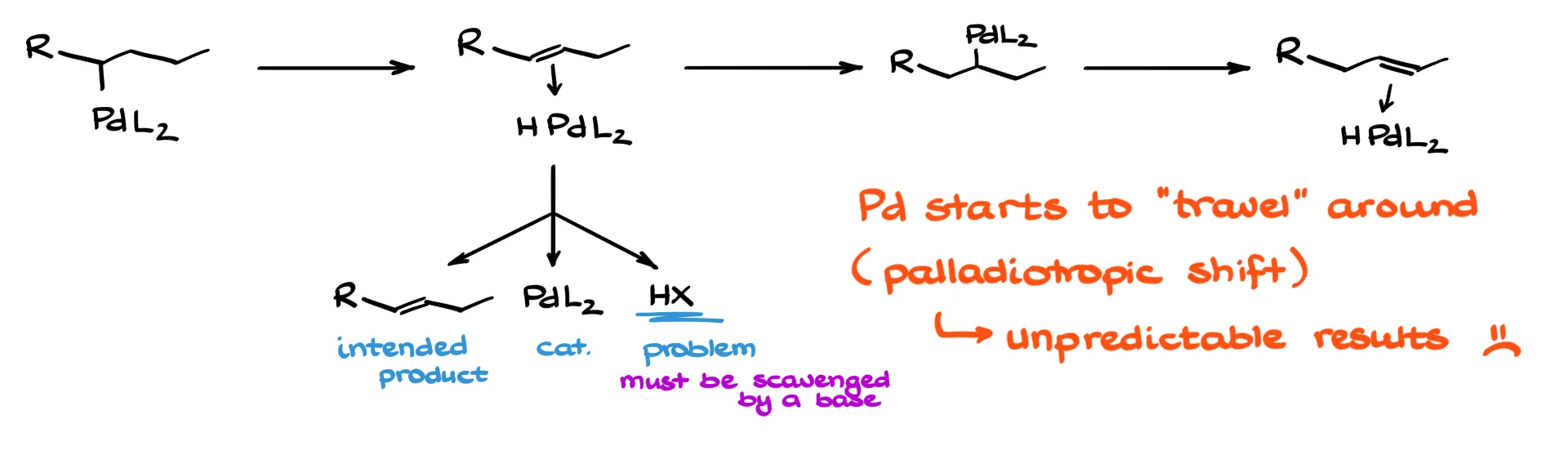
Say we take a compound and do our β-elimination: the complex can fall apart, giving us our intended product, our catalyst, and an equivalent of acid, which must be immediately scavenged by a base. If the acid isn’t neutralized, though, the complex can just as easily reassemble, giving back the intermediate with the alkene coordinated at palladium, and the Pd-H can re-add to the alkene. This can regenerate the original intermediate, or it can produce a new regioisomer, since palladium, being sensitive to sterics, has no interest in cozying back up to the R-group. This can ultimately shift the C=C to a completely different position in the molecule.
Because of this fast equilibrium, palladium can end up “traveling” along the chain of your molecule, sometimes called a palladiotropic shift. It can yield unpredictable results, scrambling the regiochemistry and stereochemistry of your compound. So what do we do about it?
Controlling Selectivity with Base Choice: The Curtin-Hammett Principle
Luckily, these equilibria typically obey the Curtin-Hammett principle, which in practice means the less substituted C=C typically forms faster, so the base’s “speed” can control the outcome. Slower, bulkier bases give the equilibrium enough time to reach the more substituted C=C, while faster, smaller bases quench the system immediately, stopping the re-addition in its tracks and giving the less substituted C=C.
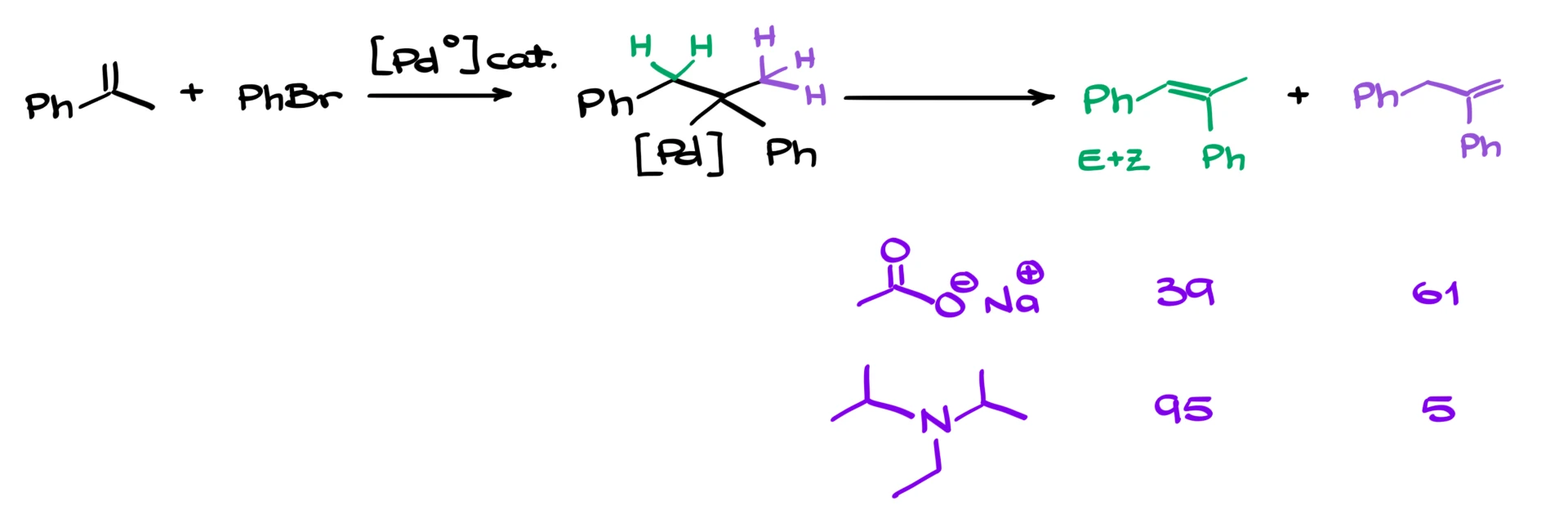
For instance, let’s look at this reaction: 2-phenylpropene reacting with bromobenzene gives us our intermediate. Here I have these hydrogens next to the phenyl group, shown in green, which give one alkene after elimination, and these hydrogens on the methyl group, shown in purple, which give a different alkene. The base choice influences which becomes the major product. When we use a smaller base like acetate, we get roughly a 40-60 split favoring the terminal alkene, while a much slower, bulkier amine gives almost exclusively the internal alkene.
So if you assumed a bulky base means the less substituted product, it’s actually the opposite here. The Heck reaction seems to violate just about every typical rule of thumb from introductory organic chemistry.
Stereochemistry of β-Elimination
The stereochemistry of the β-elimination step is another sore point in this reaction. This is a syn elimination, meaning the hydrogen and palladium must be on the same side of the molecule.
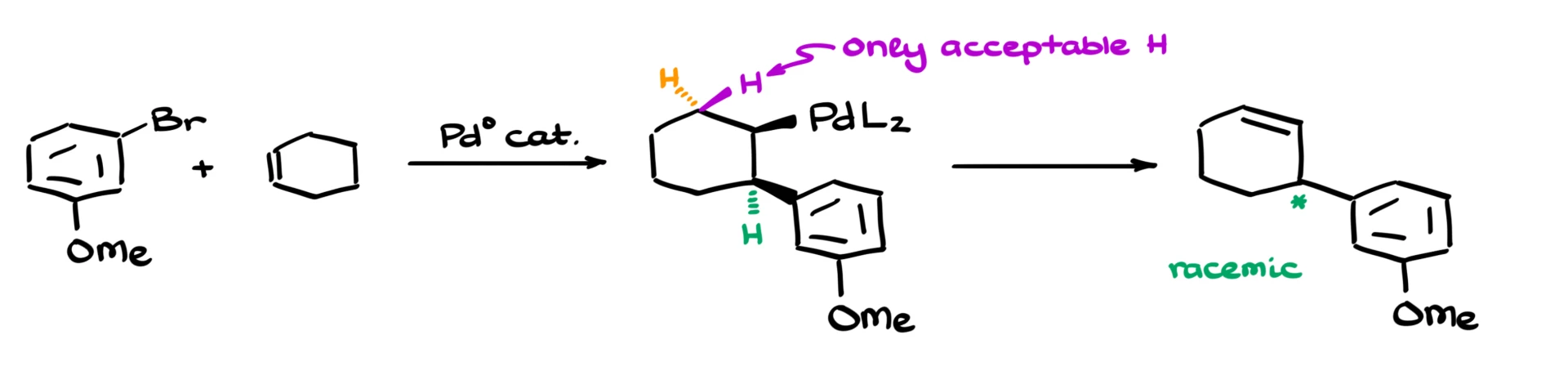
Take this example of our aryl bromide reacting with cyclohexene. Our intermediate, after the 1,2-ligand insertion, has both palladium and the aryl group sitting cis on the ring. Looking at the available β-hydrogens, we have one shown in green, one in purple, and one in orange, and only the purple one is positioned correctly for syn elimination. This means our final product has the double bond shifted by one carbon relative to where you might first expect it. In this particular example, the product is a chiral molecule, so we end up with a racemic mixture of the final product.

This analysis becomes even more important with a more complex substrate, like this one, where I have a methoxy group sitting next to the double bond. My intermediate after the ligand insertion looks like this, giving the major product with the double bond forming next to the methoxy group.