
Should Organic Chemistry Be Taught as Science?
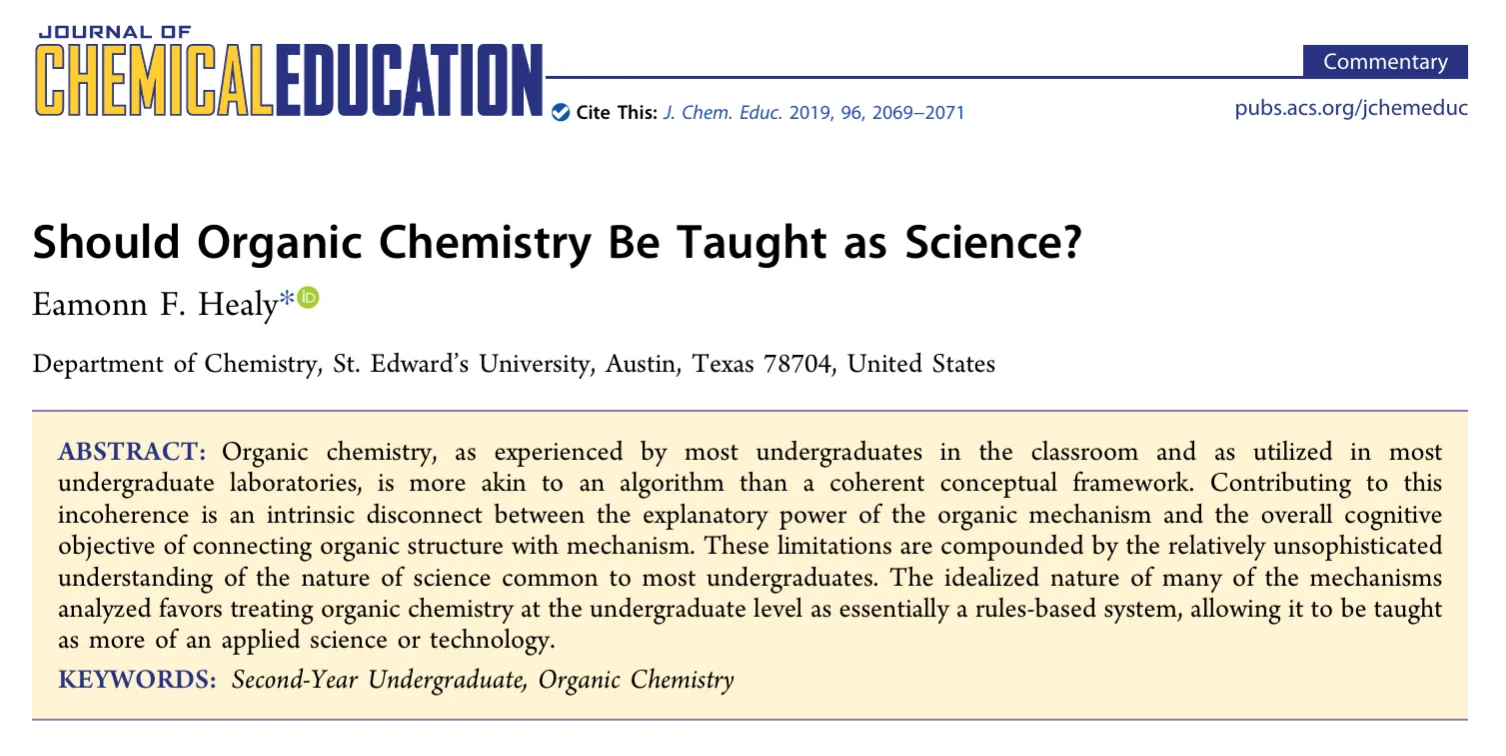
Here’s my unpopular opinion on Eamon Healy’s “Should Organic Chemistry Be Taught as Science?”
The central claim in Eamon Healy’s paper is that the traditional mechanistic approach used in teaching organic chemistry is fundamentally inductive rather than deductive. According to the author, mechanistic theory (especially as expressed through curved-arrow formalism) relies on trends and inferred patterns rather than precise predictive understanding. This, the paper argues, can be frustrating and does not properly equip students with the tools needed to investigate reactions or develop deeper insight into organic chemistry.
The article further suggests that the modern use of curved-arrow notation, originating from Robinson’s work in 1934, has largely gone unchallenged and unrevised. In the author’s view, this framework is somewhat archaic and does not accurately reflect the modern understanding of chemical reactivity.
A related argument concerns the way mechanisms are established. Mechanistic proposals are typically inferred from experimental evidence (often kinetic data) and therefore arise through an inductive process. Because of this, the author claims that mechanisms provide only a limited picture of chemical reactivity. A mechanism may describe a pathway for a reaction, but it does not necessarily predict the full distribution of products observed experimentally.
From this observation, the paper makes a stronger claim: because mechanisms sometimes fail to account for all experimentally observed products, the mechanistic framework itself is fundamentally flawed.
I strongly disagree with this conclusion.
When chemists analyze organic reactions mechanistically, we do not assume that a single pathway explains every possible outcome. Instead, we consider a range of possibilities at each step. Using our understanding of reactive intermediate stability, orbital interactions, steric effects, and other chemical principles, we evaluate which pathways are more plausible and which are less likely.
This reasoning allows us to make meaningful predictions. We may not predict the exact experimental product distribution. There are simply too many variables for that! But we can often predict which products will be major, which will be minor, and which are unlikely to form at all. Even in introductory organic chemistry courses, students are taught to evaluate competing pathways and reason about relative outcomes.
For that reason, the argument that mechanistic thinking is flawed simply because it does not provide exact quantitative predictions seems misplaced. Chemistry is not a perfectly deterministic system. Many reactions involve multiple competing processes occurring simultaneously. If an observed product cannot be predicted from the proposed mechanism, that does not necessarily mean the mechanistic framework is wrong. It may simply mean that additional pathways or interactions were not considered.
The paper also discusses several well-known reactions whose textbook mechanisms have been challenged by more recent research, emphasizing that the true mechanistic picture is often more complex than what appears in introductory texts. From this observation, the author concludes that textbook presentations are “stylized” descriptions that may bear limited resemblance to the underlying experimental reality.
While there is some truth to the claim that textbook mechanisms simplify reality, this criticism overlooks the purpose of an introductory course. Organic chemistry is already a complex and demanding subject. If we attempted to present every mechanism using the full framework of molecular orbital theory, quantum chemical calculations, and detailed kinetic analysis, the material would quickly become overwhelming.
An introductory course must necessarily rely on simplifications. These simplified models are not intended to represent the complete modern understanding of every reaction. Instead, they provide a conceptual framework that allows students to reason about reactivity and develop chemical intuition.
Without such simplifications, teaching the subject would become nearly impossible. One could easily spend an entire semester analyzing a single reaction in full theoretical detail. While such depth may be appropriate in advanced courses or research contexts, it is not practical or pedagogically useful for students encountering the subject for the first time.
For this reason, I find it puzzling that the paper suggests replacing simplified mechanisms with explanations requiring advanced mathematics, quantum mechanics, and detailed computational analysis in an introductory course. That approach would likely make organic chemistry far less accessible rather than more scientifically accurate in practice.
Toward the end of the paper, the author argues that textbook mechanisms often present reactions as deterministic and predictive, thereby encouraging an overly simplistic view of science. According to this critique, the mechanistic framework itself promotes a naïve understanding of chemical processes.
However, if mechanisms are being taught in that rigid or deterministic way, the issue lies with the teaching, not with the tool itself.
Mechanistic reasoning is a powerful framework for thinking about chemical transformations. Like any tool, its effectiveness depends on how it is used. A poor explanation does not invalidate the method any more than a poorly built table proves that a hammer is a bad tool.
Mechanisms are models. They are approximations designed to help us reason about complex systems. They are not meant to be perfect representations of reality. Recognizing their limitations is part of scientific thinking, but that does not mean the framework should be discarded.
The most puzzling conclusion of the paper is the suggestion that if mechanisms cannot be taught in their fully “correct” form, they should perhaps not be taught at all. Instead, the author proposes presenting reactions as essentially black boxes: inputs leading to outputs without mechanistic explanation.
To me, that approach would be far more damaging to students’ understanding of chemistry. Mechanistic thinking is precisely what allows chemists to move beyond memorizing reactions and toward understanding why reactions occur.
tl;dr: discussing the limitations of mechanistic models is valuable and worthwhile. But rejecting mechanistic reasoning altogether because it simplifies reality seems misguided. Simplified models are an unavoidable and necessary part of teaching complex science. The goal is not to eliminate them, but to use them thoughtfully and responsibly as stepping stones toward deeper understanding.
