
Taking Summer Organic Chemistry? Read This First!
Summer organic chemistry is not a faster version of the regular class.
That distinction matters more than most students realize before they sign up. The material is the same. The exams are the same. The standard you’re held to is the same. What changes is everything around the material: the timeline, the pace, the recovery window, and the margin for error.
Most students who struggle in summer organic chemistry don’t struggle because the content is impossibly hard. They struggle because they walked in expecting a compressed version of something familiar and found out too late that it isn’t.
This is the briefing most students don’t get until it’s too late.
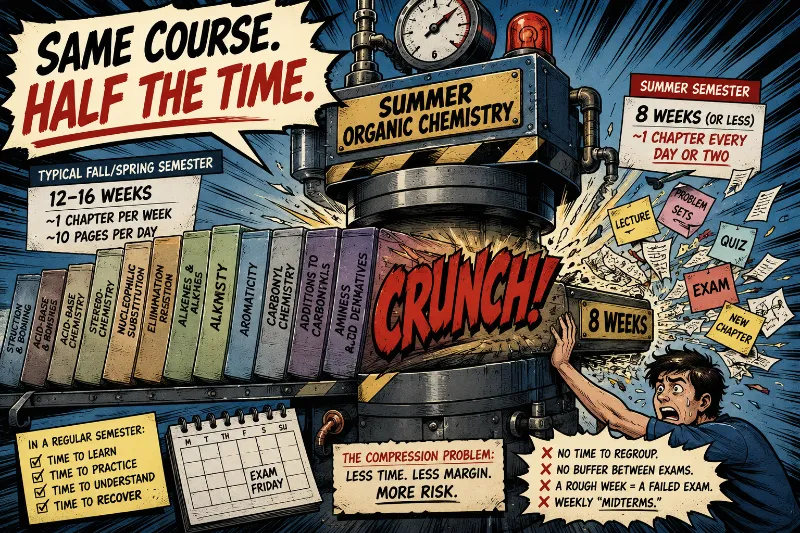
Same Course. Half the Time.
A typical fall or spring organic chemistry semester runs 12 to 16 weeks. In the summer, you’re covering the same curriculum in 8 to 10 weeks, sometimes less. That’s not a minor scheduling adjustment. That’s a fundamentally different workload structure.
In a regular semester, you cover roughly one chapter per week. Depending on your textbook, that’s 50 to 70 pages of dense science content. And these aren’t history textbook pages. They require you to work problems, understand mechanisms, and build on everything that came before. At normal pace, that’s about 10 pages a day.
In the summer, you’re covering close to a chapter every day or two.
Every lecture, every problem set, every concept your fall counterpart gets a week to absorb — you have a day or two. And unlike a regular semester, there’s no week where things slow down. There’s no buffer between a bad exam and the next one. No time to regroup after a topic that didn’t click.
This is what I call the compression problem and it isn’t just about volume. It’s about what that volume does to your margin for error. In a regular semester, you can have a rough week and recover. In summer organic chemistry, a rough week often means a failed exam at the end of the week. And yes, your “midterms” are likely going to be a weekly occurrence.
The Approach Problem
The compression problem explains why summer organic chemistry is harder. It doesn’t explain why students who work constantly still fail it.
That’s a different problem entirely.
Most students entering summer organic chemistry bring the approach that worked before: memorize the reactions, learn the rules, repeat until it sticks. That strategy carries people through general chemistry. It even holds up in the early weeks of a regular organic chemistry semester. In summer organic chemistry, it fails fast and it fails hard.
Organic chemistry is built on understanding, not memorization. The mechanisms, the reactions, the patterns — they all connect to each other through underlying logic. If you understand why something happens, you can work through a problem you’ve never seen before. If you’ve memorized what happens without understanding why, you’re fine until the exam asks something slightly different. In summer organic chemistry, slightly different is every exam.
The deeper issue is timing. In a regular semester, students who realize their approach isn’t working around week four or five still have time to change course. In the summer, by the time the first exam tells you something is wrong, you’re already behind on the next two topics. The format doesn’t give you time to diagnose the problem and fix it mid-semester.
The approach you start with is largely the approach you finish with.
This is worth naming directly, whether you’re taking summer organic chemistry for the first time or retaking it after a difficult semester. The subject punishes the wrong approach under normal conditions. The summer format punishes it faster.
Where You’re Starting From
The students who show up for summer organic chemistry arrive from very different places. And that matters, because where you’re starting from shapes what the course actually requires of you.
Some are taking it for the first time, usually on an aggressive academic timeline. Pre-med students, students trying to stay ahead of a competitive program, high achievers who decided the summer was the right window to get it done. They’re motivated and fully intend to get the grade they need. The risk for this group isn’t effort. It’s assuming that what worked in every other hard class will work here too.
Some are retaking it after a difficult first attempt. They’ve seen the material before, which can feel like an advantage — and in some ways it is. But prior exposure also creates a specific trap: the belief that familiarity with the material is the same as understanding it, and that trying harder this time will produce a different result. Effort wasn’t the problem the first time. Approach was.
And some aren’t enrolled yet. They’re using the summer to get ahead before fall begins. The instinct is sound. The challenge is that without the structure of actual enrollment, preparation is harder to sustain than it looks on a calendar. The students who benefit most from summer preview work are the ones who treat it as the beginning of a semester-long process, not a standalone project.
Different starting points. Same subject, same format, and the same core challenge waiting for all of them.
Foundation Over Coverage
If there’s one thing that separates students who do well in summer organic chemistry from those who don’t, it’s this: the successful ones prioritize understanding over coverage.
That sounds obvious. It isn’t, because the compression problem creates enormous pressure to cover material. When you have a chapter a day, it’s easy to move through content as fast as possible just to stay current — watching lectures, taking notes, marking things done — without stopping to ask whether you actually understood what you just covered.
Coverage without understanding is a trap that’s hard to detect in real time. You feel productive. You’re keeping up. But organic chemistry is cumulative. Every topic builds on what came before. A gap in understanding at week two becomes a wall at week four. In summer organic chemistry, by the time that wall appears, there’s no week to spare.
The students who succeed share a few things in common. They build understanding before they build speed. They know which topics are load-bearing, the ones everything else rests on, and they make sure those are solid before moving on. They don’t treat every topic as equally important, because in a compressed format, that’s a losing strategy.
The other thing they get right is sustainability. Summer organic chemistry is 8 to 10 weeks of sustained high-intensity work. Students who go in at full sprint in week one are often running on fumes by week four, precisely when the material gets harder and the exams get less forgiving. Consistent, well-paced daily effort outperforms intensity every time in a format this long.
None of this is about working less. It’s about making sure the work you’re doing is the right work, applied to the right things, in the right order.
How to Structure Your Summer
The principles in the previous section only work if the day-to-day structure supports them. Here’s what that looks like in practice.
Treat your schedule like a job.
Summer organic chemistry doesn’t have the built-in rhythm of a regular semester. That flexibility is a trap. The students who do well impose their own structure and hold to it.
Schedule your study blocks the same way you’d schedule a class. Put them on a calendar and show up to them. A chapter a day isn’t going to cover itself, and the catch-up math gets brutal fast. Miss a day and you’re not behind by one day. You’re behind by one chapter.
Know your dates from day one.
Get your syllabus as early as possible and add every exam date, quiz, and assignment deadline to your calendar immediately. In a regular semester, a forgotten due date is an inconvenience. In summer organic chemistry, it’s a grade hit you may not have room to recover from.
If your syllabus doesn’t include specific dates, dig them out of your course management system or online homework platform. If there are no hard deadlines and everything is due at the end of the course, set your own and treat them as real. The end-of-course pile-up is one of the most reliable ways to fail a summer class.
Line up support before you need it.
This is the advice most students ignore and later regret. In a regular semester, you can recognize that you need help, find it, and get traction before too much damage is done. In the summer, that window is much shorter.
If you’re considering any kind of structured support, the time to set it up is before the course starts, not after the first exam tells you something isn’t working. By then, you’re already behind on a schedule that doesn’t leave much room for it.
Never Go Into Lecture Blind
In a regular semester, walking into lecture without preparation is manageable. You take notes, review them later, and piece things together over time. In summer organic chemistry, you don’t have “later.”
Every lecture is carrying more content and moving faster than you’re used to. If you arrive with no context for what’s being covered, you spend the first portion of class just orienting yourself: figuring out what the topic is, how it connects to what came before, what the terminology means. By the time you’re oriented, the lecture has moved past the point where you needed to be paying closest attention.
The fix is straightforward and doesn’t require much time.
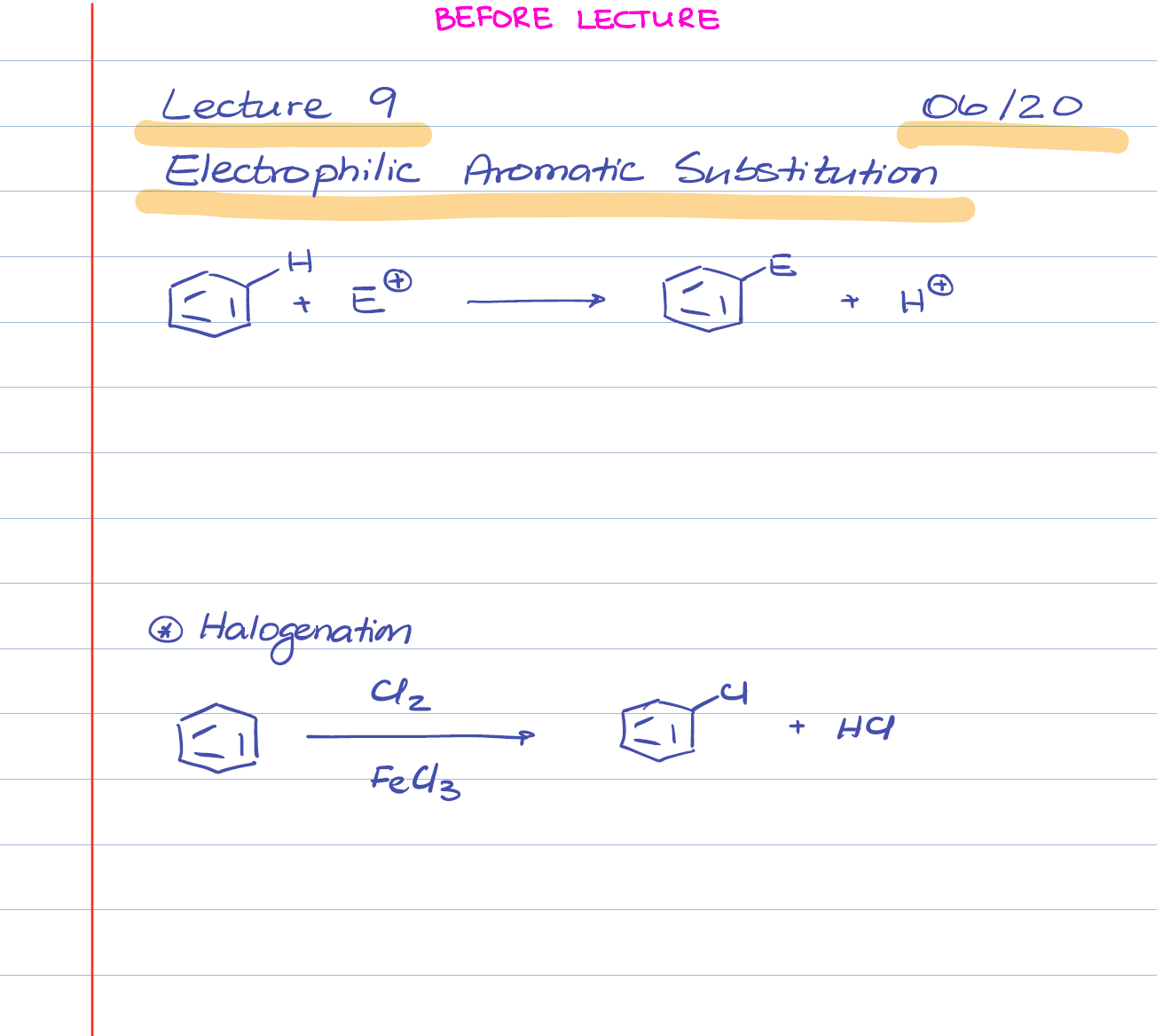
Before each lecture, skim the relevant section of your textbook or notes. You’re not reading for full understanding. You’re building a skeleton: the key reactions, the mechanisms, the concepts that are about to be covered, with space between them for what’s coming. Fifteen to twenty minutes. What it buys you is context.
When you walk into lecture now, you’re not encountering the material for the first time. You already know the shape of it. Instead of transcribing everything your instructor says, you’re annotating what you already have: adding explanations, filling in the reasoning, connecting the pieces the textbook left vague. You’re not building from nothing. You’re filling in gaps.
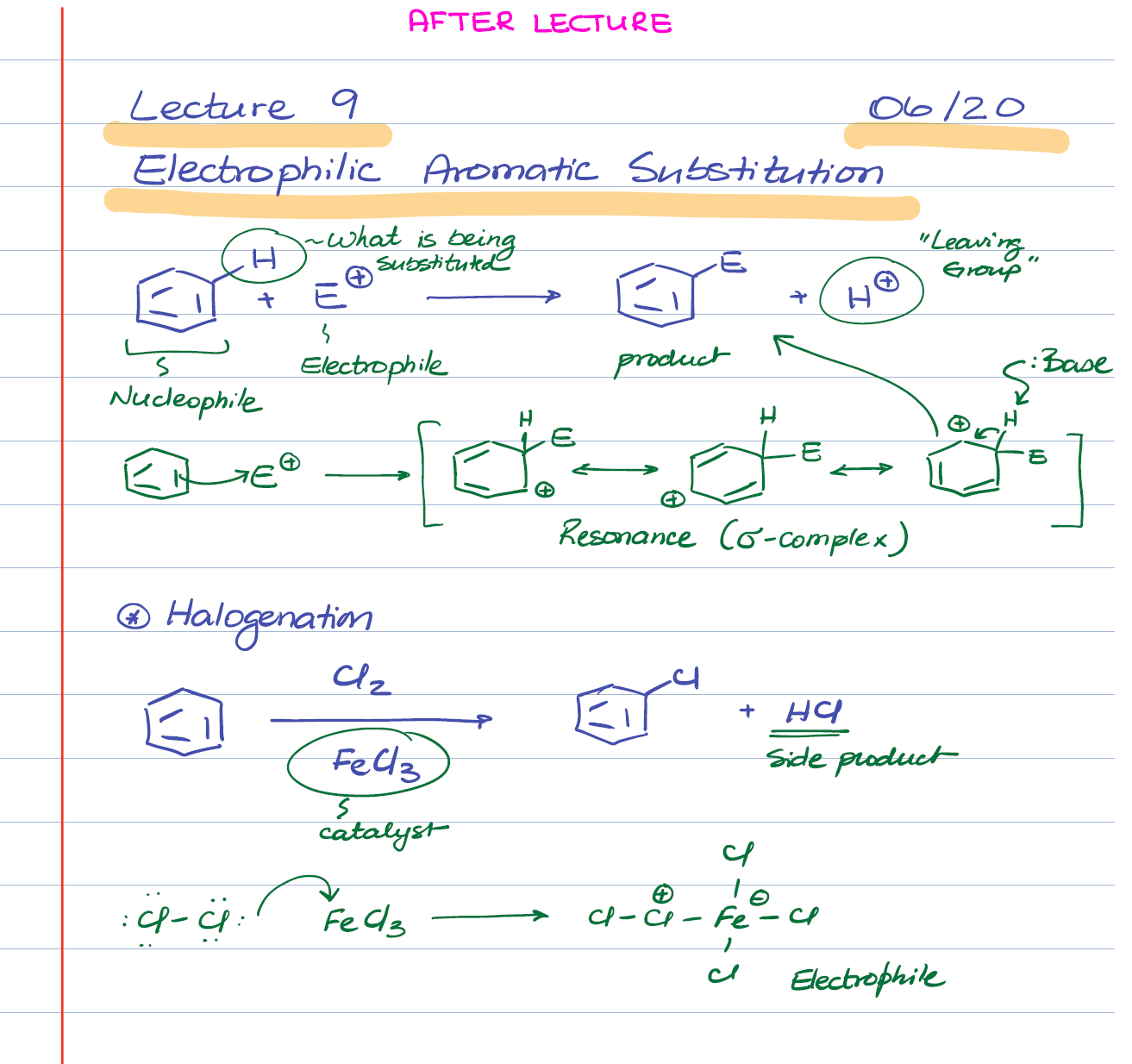
This shifts what lecture does for you. Instead of being your first exposure to the material, it becomes the moment where the material starts to make sense. In a format where there’s no time to go back and figure things out later, that distinction matters more than most students expect.
Where to Go From Here
Summer organic chemistry rewards students who take its structural demands seriously before day one. Not the ones who work the most hours, or the ones who’ve seen the material before, or the ones who feel most confident walking in. The ones who understand what the format actually requires and adjust accordingly.
The compression problem is real. The approach problem is real. Neither is insurmountable but both require honest preparation, not just good intentions.
Depending on where you’re starting from, here’s what that preparation looks like.
Taking it for the first time this summer? The highest-value move you can make is getting structured support in place before the course begins. Guided Membership gives you expert direction, accountability, and feedback throughout the semester — starting before the format has a chance to get ahead of you.
Retaking it after a difficult semester? More effort applied to the same approach won’t produce a different result. The goal is to understand what actually went wrong and correct that specifically. Guided Membership gives you the structured support to approach it differently this time, not just more intensely.
Not enrolled yet, but thinking about using the summer to prepare? Self-Study Membership gives you access to foundational content at your own pace. If you’re looking for something more structured, the Summer Foundations Program is a 6-8 week individual preparation built around exactly what this post has been describing: the foundations that make everything in the semester make sense, regardless of what your syllabus looks like.
Are you taking organic chemistry this summer? Let me know in the comments below and tell me what you’re most excited about!




Hello Victor,
It feels like a miracle that I stumbled on your site. I am in the last week of what has been the most excruciating class of my life! Yes, I am not exaggerating. I am in General Chemistry and have scored only in the mid 60’s for tests. This is normal? I have studied, done every problem in the textbook, worked with an online tutor. I have been so diligent and great at the labs that I will probably pull out a high C (never have I ever) or low B. I am cutting my losses though and will take Chem II at another community college and then organic chemistry online….your article is terrifying! Thank you for the advice. I will look for the David Klein book and no doubt will need to engage your tutoring services in the future. Maybe there is hope after all .
Hey Heidie,
Thanks for your comment. I’m just being realistic here. Summer organic chemistry classes are tough. I wrote this piece when we were in a COVID lockdown so most students were taking online classes. Those are still quite popular, so most of this information will be still useful for you as well. In-person summer organic chemistry is just as hard to pull off. You’ll also see that general chemistry and organic chemistry are quite different from each other. I’ve talked about the differences extensively in my social media but I think it might be a good idea to actually put together a post outlining all the differences and the best approaches to organic.
It also does seem like you’re putting a ton of work to succeed in your class. In my experience, if you’re putting in so much work and not getting the result you want it because of some sort of mismatch. I suspect that the textbook questions are not the same style or complexity that you’re seeing on your tests. Thus, you may not be adequately preparing yourself to your tests. But I’m just guessing here. An experienced tutor will definitely be able to provide you with the practice materials that would be in-line with your class material level and complexity.
Hi I am looking for summer online organic chemistry courses to get ready for next academic year
Please let me know about details
Thanks
Alex
Hi, Alex. There aren’t that many organic “prep” courses per se, let alone online ones. I know of the summer organic prep course at Duke university, which starts mid May. You may wanna check with them if they have a spot to accept you in or what their requirements are. There used to be some very decent courses on Coursera for organic chemistry. Not sure if they still exist though.
Another option would be to do some self-paced study and prep for the class. I highly recommend David Klein’s “Organic chemistry as a second language” books which are easy to digest yet give a decent foundation for the material. They are not as exhaustive or detailed as a typical textbook, but they are a good place to start.
I also offer summer organic chemistry “preview” individual and group tutoring where I work with students to review some fundamental general chemistry concepts that map onto organic chemistry curriculum and do a preview of the fundamental organic chemistry topics that students struggle with at the beginning of organic chemistry sequence. If you’re interested in something like that, send me a message.