
Heck Reaction Examples: Making Sense of Surprising Products
In this tutorial, I want to go over a few interesting Heck reaction examples to show you the scope of the reaction, and how seemingly strange and unpredictable products are actually quite reasonable once you look at the details of the mechanism.
Classic Example: Reviewing the Heck Mechanism
Let’s start with a classic Heck example so we can quickly review the reaction mechanism for future reference.
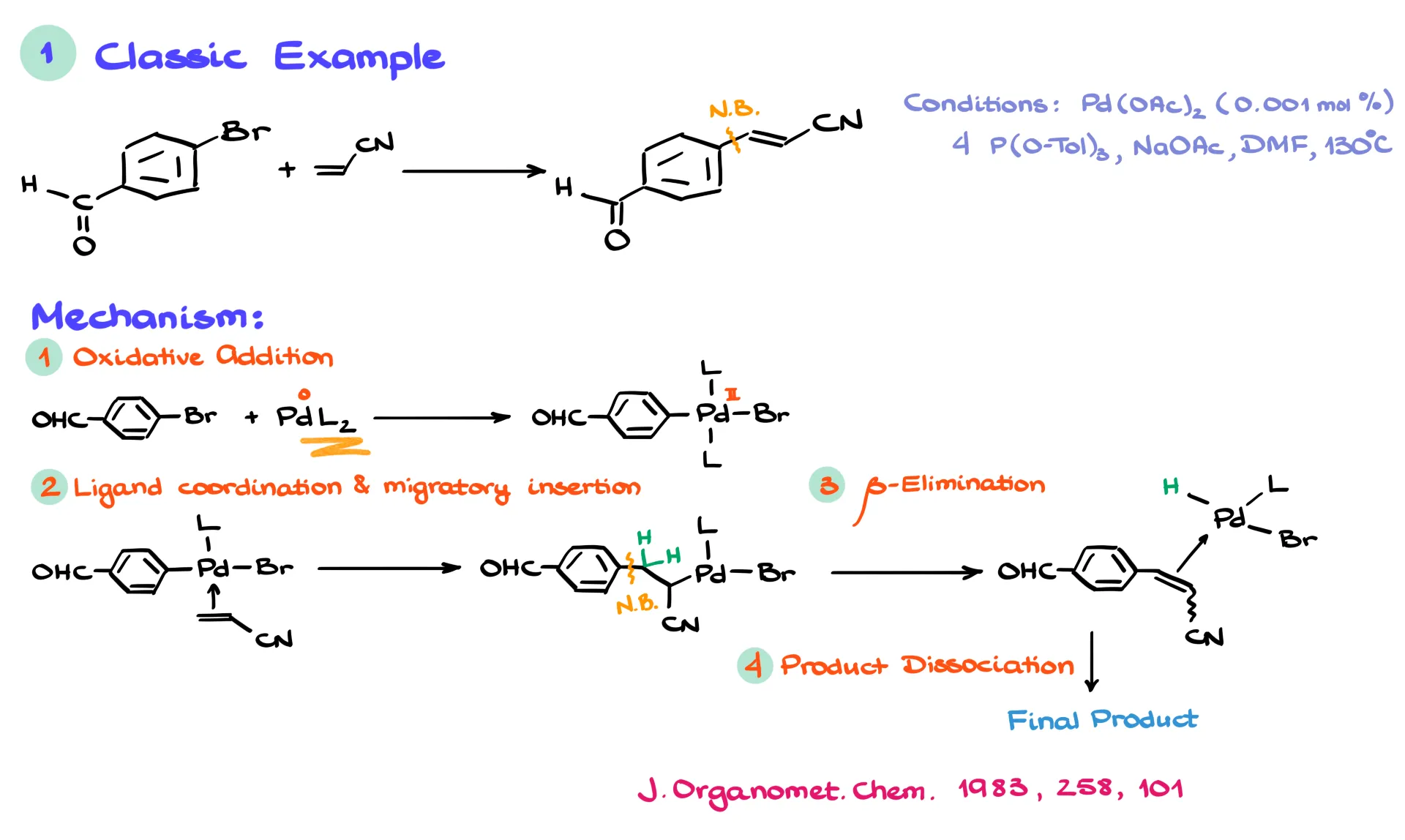
Oxidative Addition
Mechanistically speaking, step number one is the oxidative addition. Here, I’m assuming that we’ve already made the active Pd(0) form of our catalyst. The “L” groups I’ve drawn just represent ligands sitting on the palladium core that aren’t relevant to us right now. They can be acetates, phosphines, halides, or even solvent molecules. It doesn’t matter for our purposes.
Once we do our oxidative addition, we end up with a new complex with the aryl group now sitting on our palladium. I also want to point out that we started with Pd(0), as I mentioned a moment ago, and we ended up with Pd(II) at the end of this step. Since the oxidation state of the palladium core increased, this is the oxidative step, because we focus on the oxidation state of the metal for these classifications.
I assume you’re familiar with all of these steps, but if you need a refresher, I have a dedicated tutorial on the typical steps involved in reactions catalyzed by transition metals, so check it out if you need to.
Alkene Coordination and Migratory Insertion
Coming back to our mechanism, the next part is the alkene coordination, which can happen either as a direct ligand substitution or through dissociation of the old ligand first. That’s followed by the migratory insertion. I’m going to start by showing the species where my alkene is already coordinated to the palladium.
From here, we do the migratory insertion (or 1,2-insertion, if you like that term better), giving us the intermediate where we’ve created our key C–C bond, right here.
β-Hydride Elimination and Catalyst Regeneration
Now, from this point, we need to get rid of the palladium and regenerate our catalyst. We’ll do that with a β-hydride elimination, pulling off one of these green hydrogens together with the palladium. This gives us the following intermediate, with our product still coordinated to the transition metal.
The last bit is to have our newly formed alkene dissociate from the catalyst, then do a reductive elimination of HBr, with the base neutralizing that HBr byproduct. This regenerates our Pd(0) catalyst, which then repeats the steps from the beginning for the next cycle of the reaction. I’m not showing these last steps since they aren’t directly relevant to our product, but you should still remember that they’re technically necessary to complete the catalytic cycle.
Ketone from an Allylic Alcohol
Let’s take a look at a rather interesting example where our alkene is an allylic alcohol. In this case, we end up with a ketone as our product rather than the allylic alcohol we would normally expect. But once we look at the mechanism, it’ll become abundantly clear why this is the product.
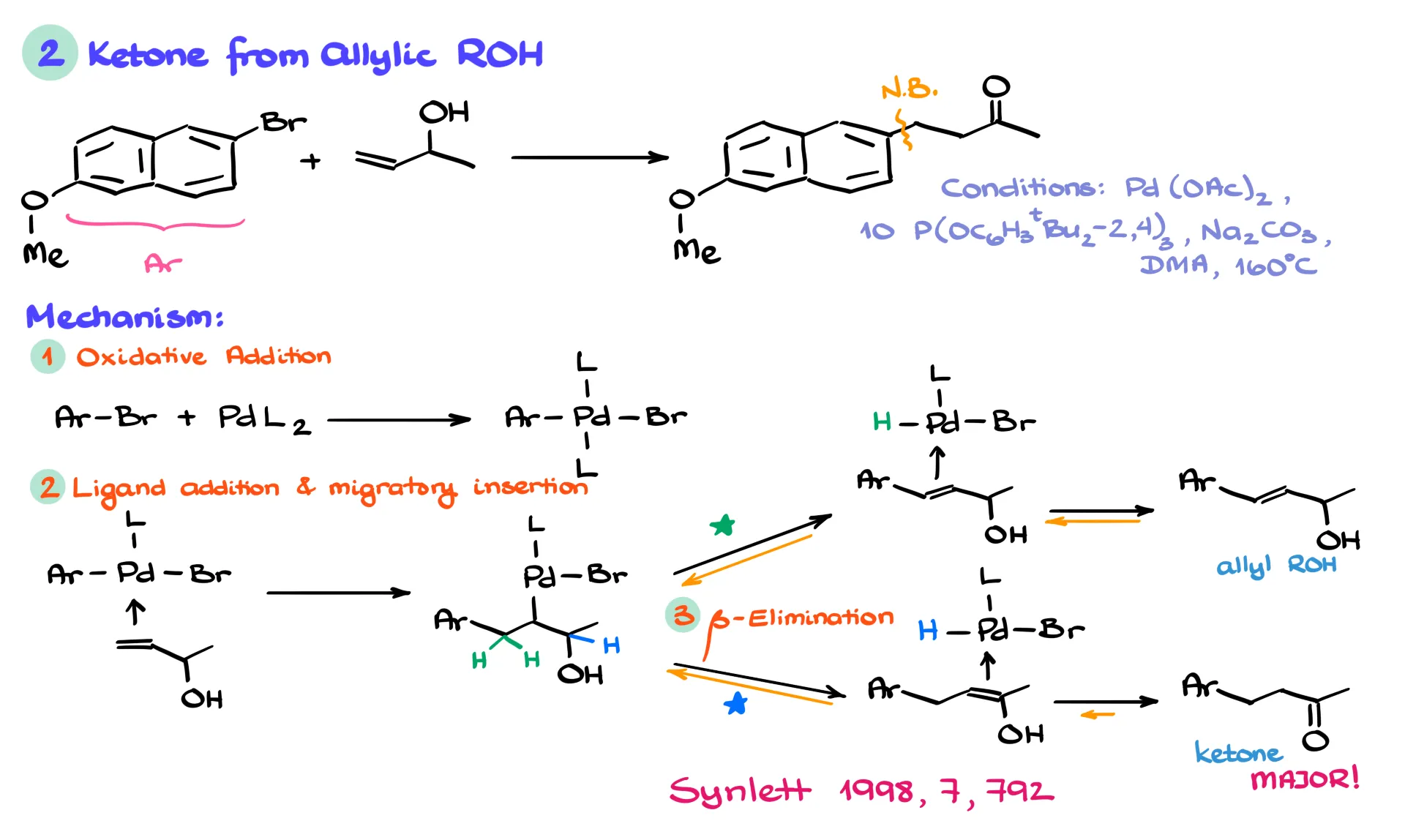
For simplicity’s sake, I’m going to abbreviate the naphthyl group in the starting material as “Ar” for arene, so I don’t have to redraw it over and over again.
Like in the previous case, we start with the oxidative addition, where we take our starting bromide and the Pd(0) catalyst and insert the palladium between the aryl group and the halide. From this point, we do our ligand exchange and migratory insertion. I’m going to start with the complex where the alkene (our allylic alcohol) is already coordinated to the palladium core, then do the insertion step, making the following intermediate with the palladium now sitting on our carbon.
From here, we’ll look at the β-hydride elimination step, and here’s the fun part. We can do the β-elimination using the green β-hydrogen next to the arene, giving us this intermediate with the alkene next to the aromatic ring system. Or we have another option: the blue hydrogen on the carbon bearing the –OH group. In this case, we end up with the corresponding enol.
Once our alkene intermediate dissociates from the palladium, we end up with the allylic alcohol product through the green pathway and a ketone through the blue pathway. The ketone, of course, is the result of the keto-enol tautomerization that the blue enol intermediate undergoes.
Now, the important thing to remember about β-hydride elimination is that it’s easily reversible. As I explained in my other tutorial on this topic, if we don’t quench the hydride fast enough, we often end up with a soup of products with the double bond traveling all around the molecule. If we do allow the equilibrium to run its course here, however, we end up with the ketone as the major product. The ketone is more thermodynamically stable and is less likely to tautomerize back to the corresponding enol and get dragged back into the whole equilibrium ordeal with palladium. That means that if we carefully control the reaction conditions, we can take advantage of the equilibrium and make a product that looks nothing like a typical Heck reaction outcome.
The cool part is that this reaction has been developed as an industrial route. The molecule I have here on the screen is called nabumetone, a nonsteroidal anti-inflammatory drug (NSAID) that’s sold under several different brand names.
Reductive Trapping of the Pd Intermediate
Now, in a typical Heck reaction, we start with an alkene and we make an alkene product. Typically. But what if we don’t want an alkene in our target molecule?
In that case, we can actually trap the intermediate with a reducing agent, as was done in the synthesis of epibatidine. If we look closely at our conditions, we’ll see that among the typical bits and pieces, we have formic acid, which is a very common reducing agent in many organic reactions.
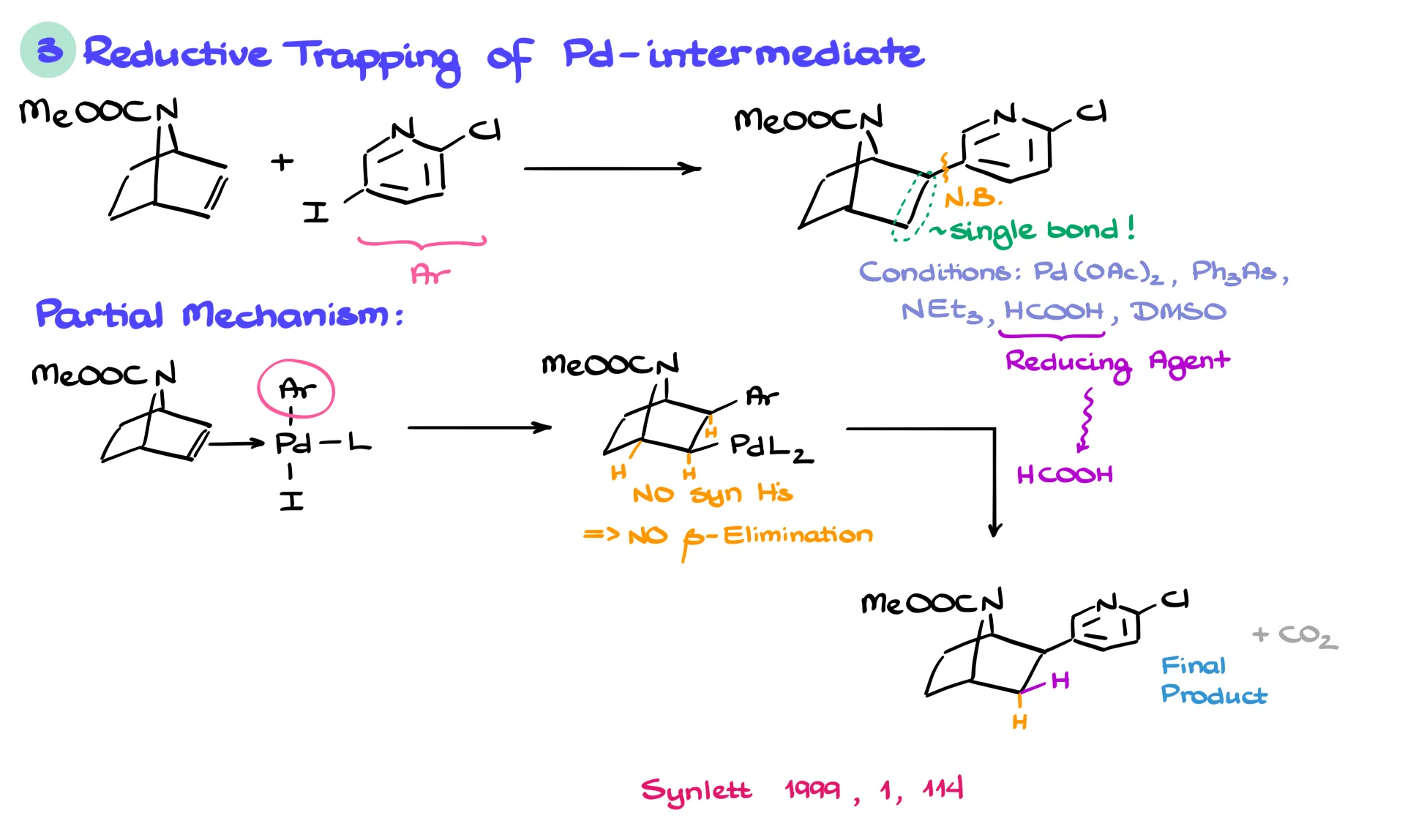
Since I don’t want to sound like a broken record going over the same mechanistic steps again and again, let’s jump right to the point where our alkene is already coordinated to the palladium core. I’m also abbreviating the pyridine ring here as an arene (Ar) for simplicity’s sake, so it doesn’t make the scheme too crowded.
Once we do our migratory insertion, we get the following intermediate, with the aryl group and the palladium cis to each other, since this step is a syn addition. Normally, our next step would be a β-hydride elimination, which requires a syn hydrogen. In this case, however, there are no syn hydrogens available. The molecule is locked in place since it’s a bicyclic structure, so there are no conformational changes that can give us the hydrogen either. That means a typical β-hydride elimination is simply not possible.
When we put a molecule in this type of situation, the only ways to meaningfully progress the reaction would be to go back, which isn’t productive, or to start breaking nearby bonds, which is equally unproductive.
That’s where our formic acid comes into play. As I mentioned a few moments ago, formic acid is the reducing agent. By reacting with our palladium complex, it helps kick the palladium off, effectively replacing it with a hydrogen atom, regenerating our catalyst, and making CO2 gas, which just bubbles away. So by using a reducing agent in our reaction mixture, we managed to insert it into the mechanism of the reaction and make a product that otherwise would not be possible.
Silane Elimination
So, by now we’ve seen a classic Heck reaction, then a reaction where we ended up with a ketone instead of an alkene, and a reaction where we got rid of the double bond altogether by never forming it in the first place. Another tweak we can make to this mechanism is in the β-elimination step. Instead of a hydrogen, we can eliminate other groups.
The most common example here is the use of vinylsilanes. Like with any chemistry involving silicon, we can easily and reliably get rid of it if we have a source of fluoride (F–) ions, which we see in conditions “B” in this example.
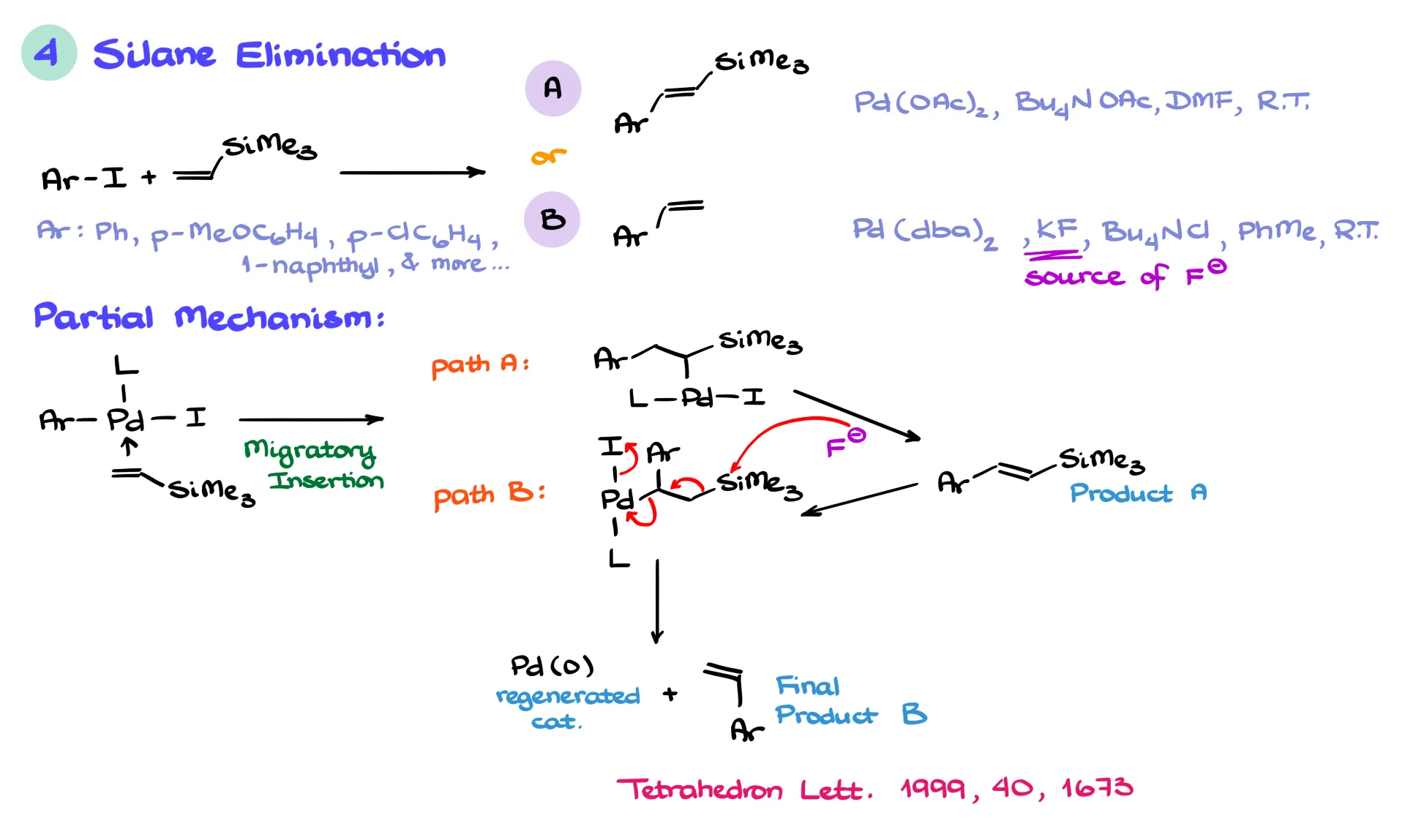
Like before, I’m only going to look at a partial mechanism, starting at the point where our alkene is coordinated to the palladium core. From here, we do our migratory insertion, and just like in a typical Heck reaction, the aryl group adds to the less hindered end of the alkene, putting the palladium, with the rest of its bells and whistles, right next to the silicon. Under conditions “A,” we simply do our β-hydride elimination and get our path A product with the silicon still attached.
So, how do we get path B? Here’s the wrinkle: remember how β-hydride elimination is reversible? The palladium hydride can add back across our new double bond, but this time the other way around, putting the palladium on the carbon next to the aryl group and the hydrogen next to the silicon. And now our silicon is β to the palladium.
So now we can bring in the fluoride ion (F–) and have it attack the silicon. That causes a cascade of electron density that ultimately kicks the palladium out, regenerating our Pd(0) catalyst and giving us our styrene. So the real switch here isn’t the catalyst, it’s the fluoride: with acetate and no fluoride, we keep the silicon, and with fluoride under dry conditions, we lose it. Pretty cool, right?
The Blaser–Heck Reaction
Now, up to this point, we’ve seen examples with various aryl halides. But can we use other “leaving groups” in the Heck reaction? Well, of course!
Probably the most interesting one here is the acid chloride, in the so-called Blaser–Heck reaction. The fun part of this reaction is that the carbonyl is lost, so we end up with one less carbon in the final product.
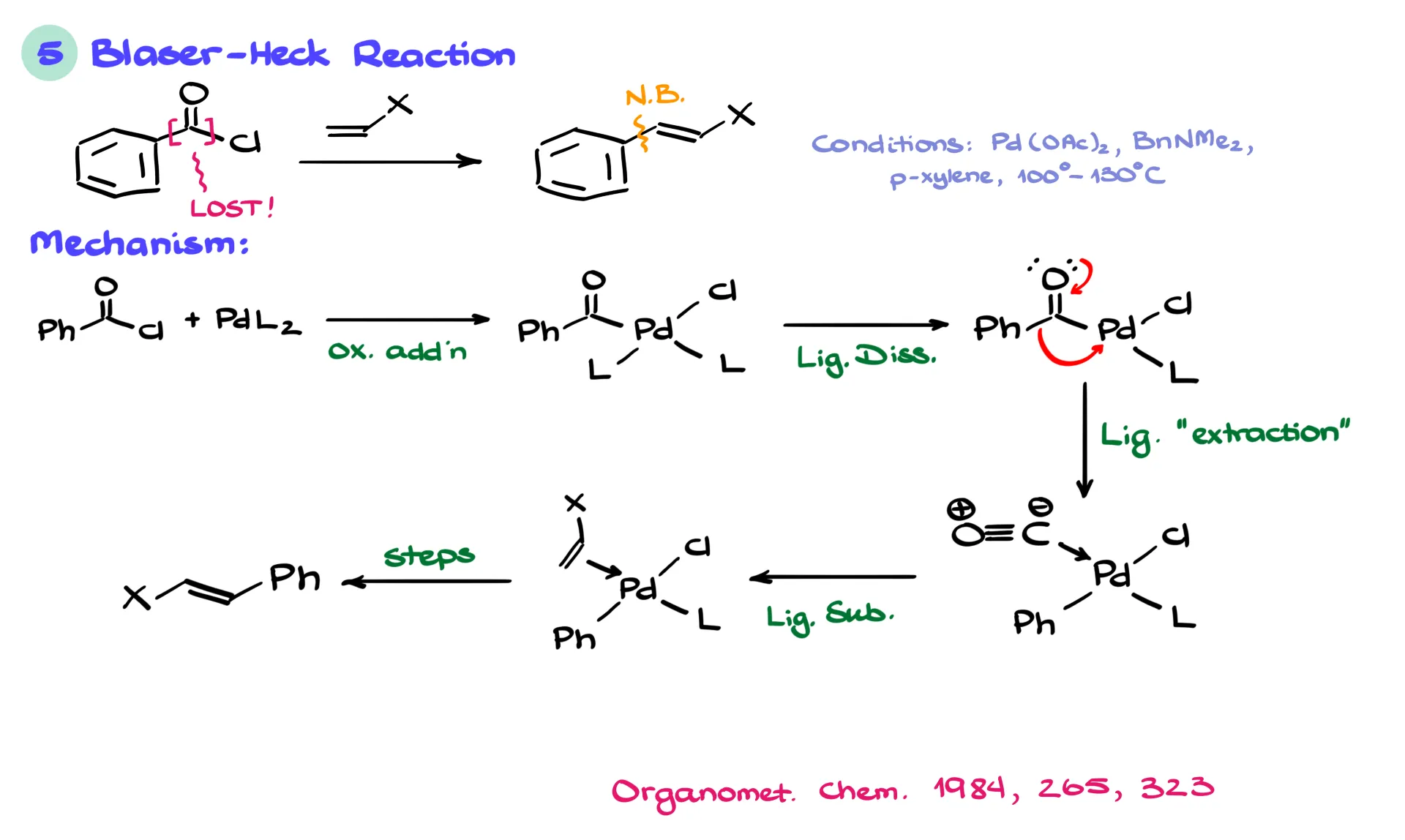
Mechanistically speaking, we start with our acid chloride reacting with our activated Pd(0) catalyst through a standard oxidative addition, making the following intermediate where the organic piece is now sitting on our palladium core, connected through the carbonyl.
Now, the next part is fairly important. The ligands around our palladium must be loosely bound to it and should be able to dissociate easily. Once we do this ligand dissociation, we end up with an empty parking spot on the palladium, so we can migrate the phenyl group onto it. This essentially releases the carbonyl as a free CO ligand in a step I like to call ligand “extraction” (more formally known as CO extrusion or deinsertion), which is essentially just the reverse of a 1,1-insertion.
If we didn’t have this free parking spot on our palladium, this step would not be possible. As a matter of fact, this part of the mechanism is favored in the opposite direction, meaning that it’s easier to insert the carbonyl than to pull it out. And if we have any ligands with substantial binding ability, like our typical triphenylphosphine (PPh3), the reaction just won’t work in the direction we want it to.
From this point, we have a simple ligand substitution where either the CO or another ligand is replaced by the alkene, and by following the rest of the typical Heck reaction steps, we get our final product. It’s not the most useful reaction of the bunch, but I thought I’d still include it for style points.
Heck with Ketones
Now, the Heck reaction is typically done with alkenes. So, can we do it without an alkene? Well, don’t be silly! Of course we can!
Check out this reaction. We have a ketone starting material, and using typical-ish Heck conditions, we end up adding a group at the α position of our carbonyl. So, what’s going on here?
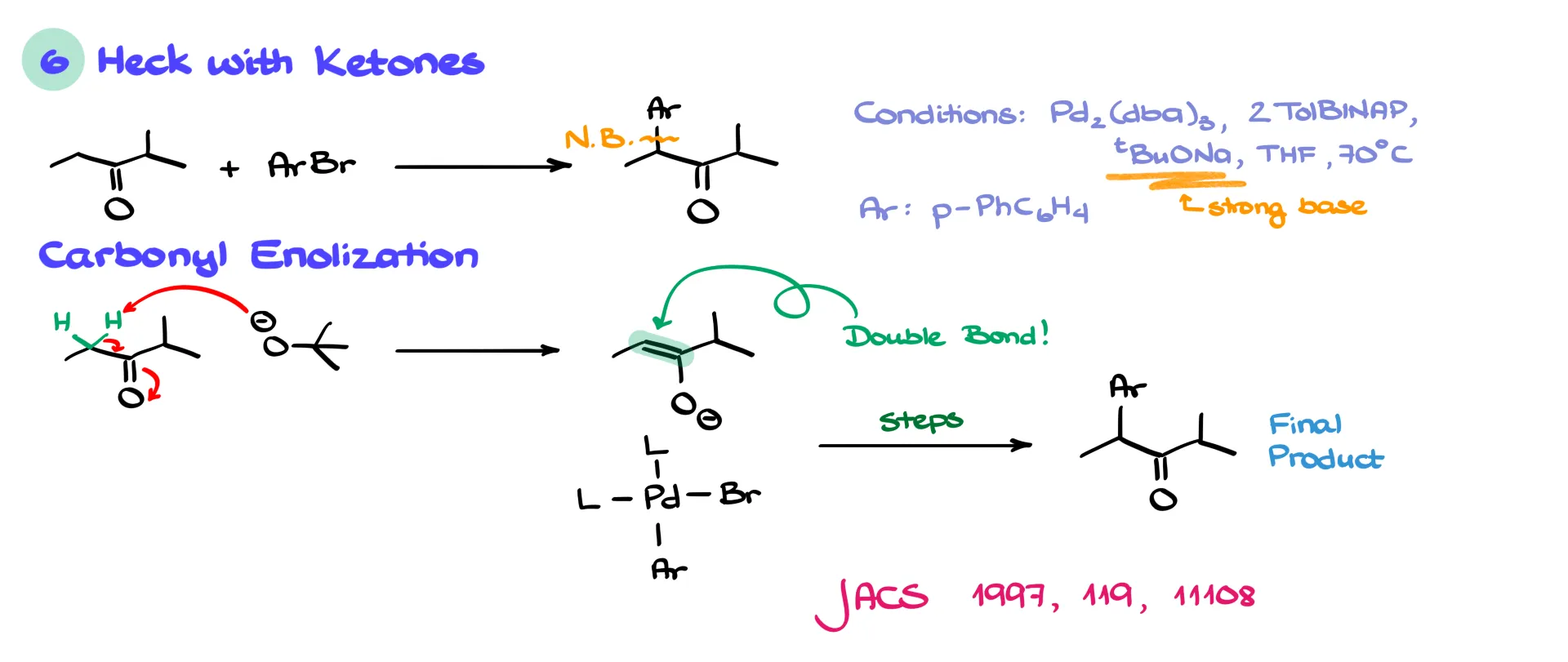
If you take a look at the conditions, you can see that we’re using sodium tert-butoxide. While a typical Heck reaction does require a base, this one is a bit too strong for what we’d normally see. And what do carbonyls do with strong bases? They make enolates!
So our base comes in and snatches the less sterically hindered proton, like so, making the corresponding enolate. And look at that! We have a double bond! Sure, it’s not your classic alkene π bond, but it’s a π bond nonetheless.
Now we can bring in our palladium, go through the rest of the mechanism, and get our final product. This tutorial is already long enough, so I’m not going to go through the intricacies of this mechanism here. This one is actually the least Heck-like reaction on the list, and it deserves a separate discussion, so I’ll talk about it some other time.
In a nutshell, though, this reaction looks almost like a typical α-substitution, but with a bit of a twist! Notably, the product we have here would be simply impossible to make through an α-substitution of carbonyls. So this is an interesting workaround when classic chemistry doesn’t offer a transformation you might need for your synthesis.
So, which of these reactions surprised you the most? Let me know in the comments below!