
Nomenclature of Amines
In this tutorial, I want to talk about the nomenclature of amines, focusing on the IUPAC nomenclature, since for the amines, the common names and the IUPAC conventions are surprisingly similar. We’ll also briefly talk about the aromatic and heterocyclic amines.
Amine Classification
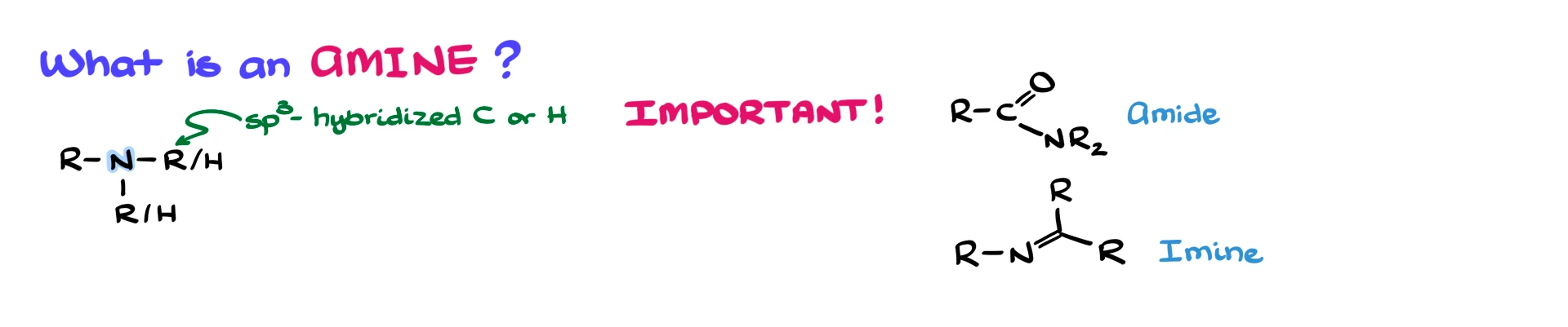
So, what exactly is an amine? An amine is a compound where you have a direct C–N bond, and importantly, both carbon and nitrogen must be sp3 hybridized. It’s an important distinction because you’re going to see (and likely have seen) a bunch of other nitrogen-containing compounds within the scope of your course. For instance, if you have a carbonyl, this is an amide. Or, if you have a C=N bond, this is an imine. There are many other examples, and I’m not going to go over all of them here, but keep in mind that not everything with a nitrogen is an amine.
We also have to talk about the classification of amines. We can have primary, secondary, tertiary, and quaternary amines.
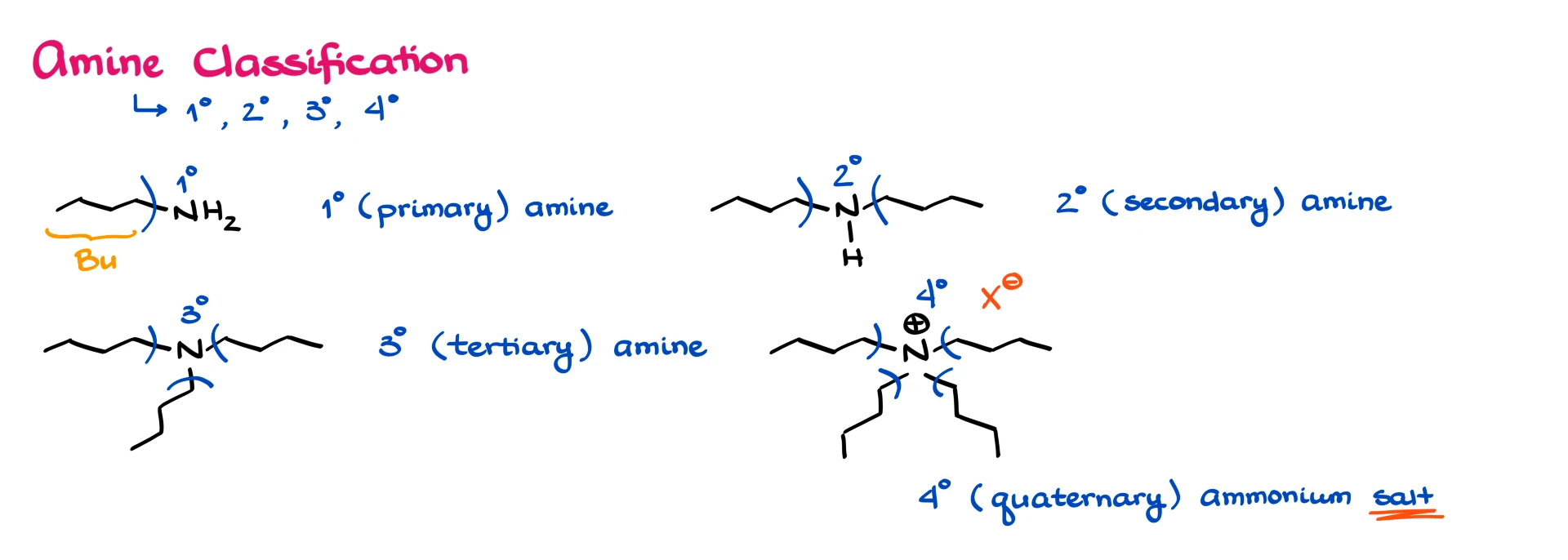
Unlike many other functional groups, we classify amines by the number of carbons that the nitrogen is attached to. For the primary amine, we have nitrogen attached to just one carbon-containing chain, a butyl group in this case. The secondary amine has two carbon chains. The tertiary amine has three chains. And finally, the quaternary amine has four carbon chains. Notice how I call the quaternary amine here a “salt,” and this is because the nitrogen in these compounds is positively charged and will always have some sort of a counterion (an anion) with it. These guys are ionic pairs, hence, they are technically salts.
IUPAC Rules
Alright, we’re finally ready to get to the IUPAC rules. Here’s the funny part: there are two official systems. We’ll start with the simpler one first. Let’s say we have this compound. Step number one is to number your carbon chain starting with the carbon that’s connected to the nitrogen atom. Here, I have a 1-2-3-4-5-6 carbon chain, meaning that our compound is hexylamine. The naming formula here is quite easy: you name the carbon chain as a substituent with the -yl ending and slap “amine” onto it. Done.
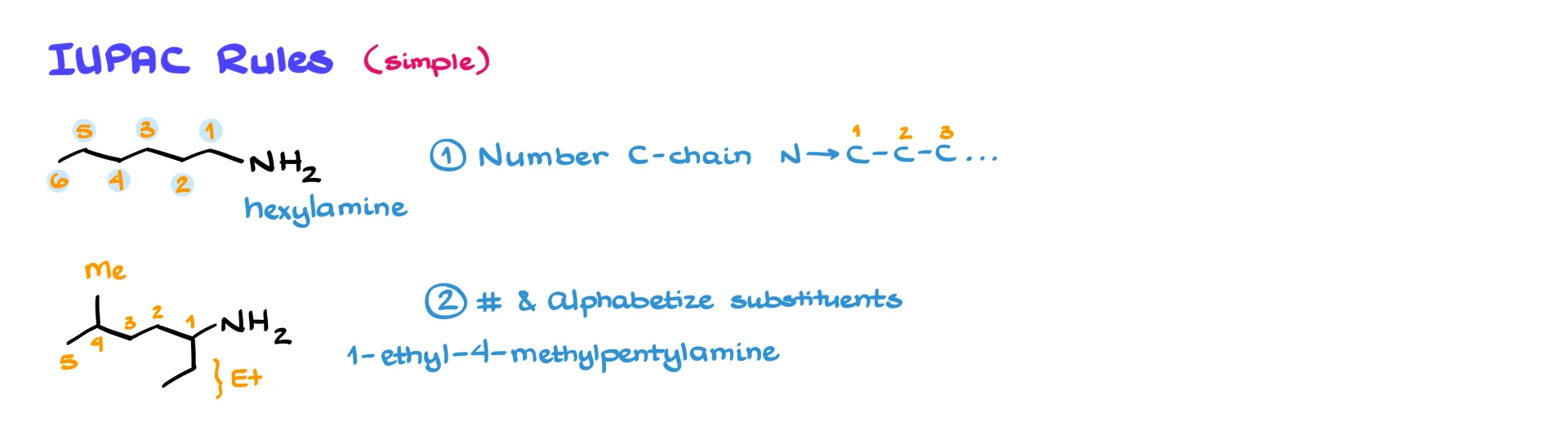
How about the other molecule here? Same idea, we start by numbering our chain beginning with the carbon that’s connected to the nitrogen, a five-carbon chain in this case. We have an ethyl group, and we have a methyl group. We naturally alphabetize the substituents in the final name, like we would normally do for any name, giving us 1-ethyl-4-methylpentylamine. Easy!
Now, unfortunately, it’s not going to be that simple all the time. When we have a more complex molecule, it might be more convenient to use a slightly different nomenclature convention. For more complex structures, we can use the formula where we name the parent chain as a regular alkane and add the “amine” ending to it. This also changes how we pick our parent chain and how we number it, though!
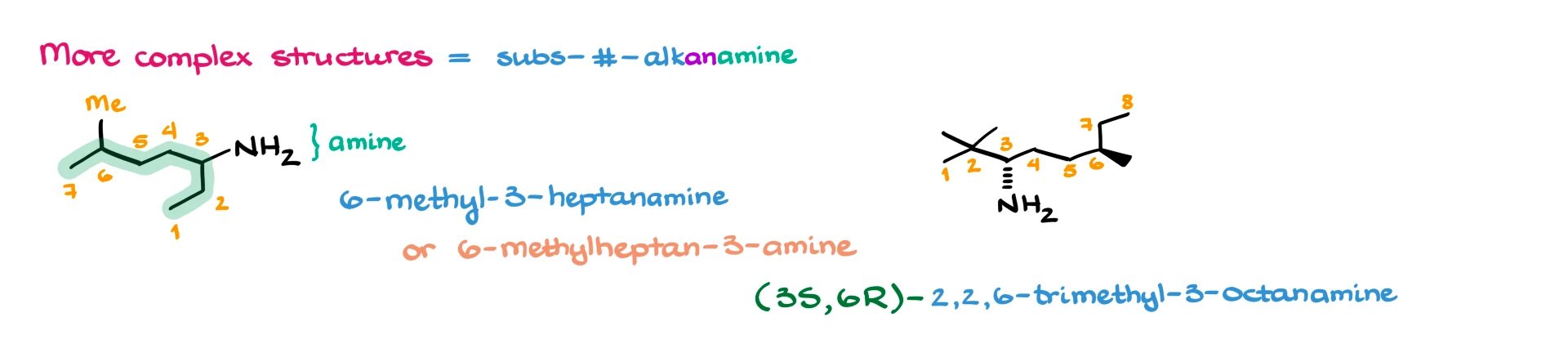
Let me demonstrate it on the same molecule we just looked at a moment ago. We start by finding the longest continuous chain regardless of where the nitrogen is. We then number it, giving the carbon with the nitrogen atom the lowest possible locant. In this case, we’ll have to number our molecule from the right, and the amine is now sitting on the 3rd carbon. We also have a methyl group substituent. Notice how the parent chain absorbed the ethyl group in this case and ended up two carbons longer. So, the name here would be 6-methyl-3-heptanamine. Since we no longer assume that the nitrogen is attached to the first atom, we need to identify its position. That’s why I’m saying 3-heptanamine, to point out that the nitrogen is on the 3rd carbon. Alternatively, we can name it by adding the locant directly before the “amine” suffix, so it would be 6-methylheptan-3-amine.
Or, here’s a more complex example. Like before, I’ll start by finding my longest continuous chain and numbering it in the way that gives my nitrogen the lowest number. I have three methyl groups here, so the name starts with 2,2,6-trimethyl. Then I have the rest, 3-octanamine. And of course, since this molecule does have a specific stereochemistry given to us, I’m going to add the 3S and 6R stereodescriptors at the beginning of the name.
Now, which naming convention should you use? Both are correct. You can use whichever fits your molecule better and whichever makes your life easier. Some instructors and textbooks have a preference towards one or the other, but from the IUPAC perspective, both are good. Even though the IUPAC does seem to favor the latter system a bit more based on the most recent edition of the Blue Book. I said opposite in the video. It was a slip of tongue, oops 😬
Multiple Groups on N-Atom
Alright, moving on. What are we going to do if multiple groups are sitting on the nitrogen atom?
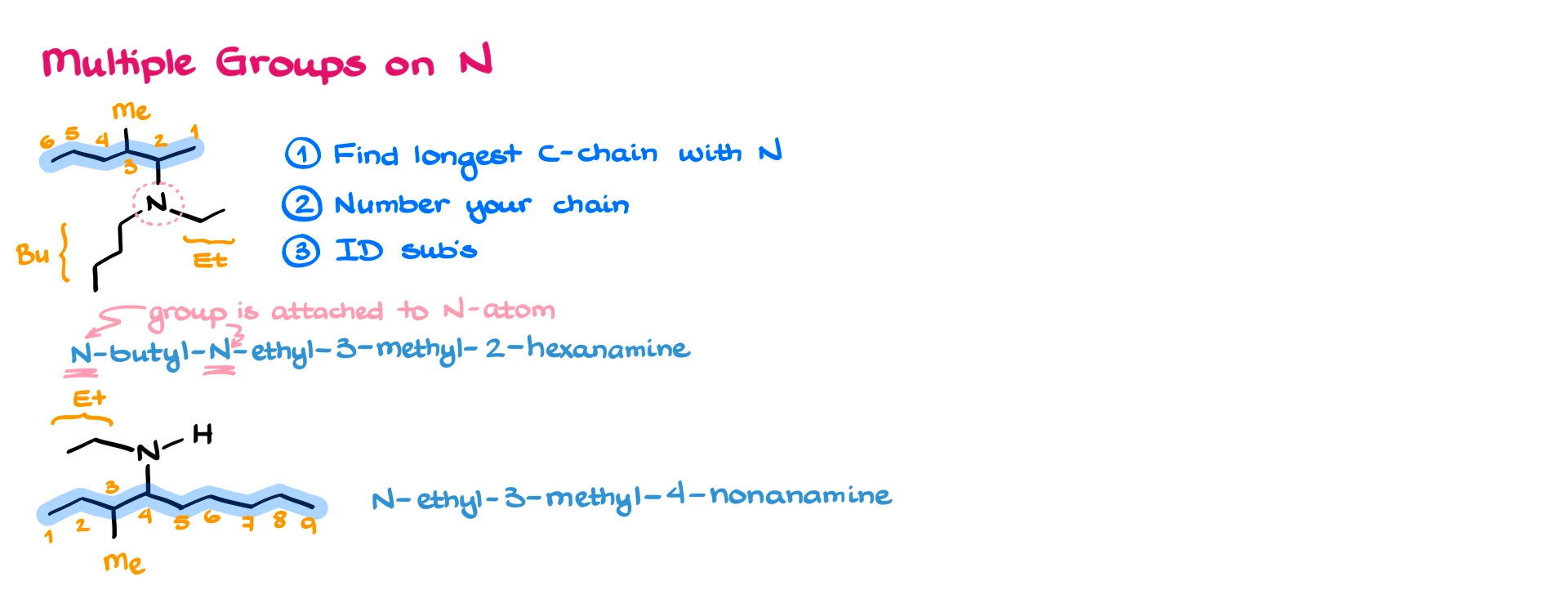
That’s where things get a bit more interesting. Let’s look at this molecule. Step one is to find the longest continuous chain, like before. In this case, it’s going to be this 6-carbon chain. Then, we number it, of course, and as before, we do it to give the nitrogen the lowest number. Then, we identify our substituents. We have a butyl group, an ethyl group, and a methyl group. So, putting it together, we get N-butyl-N-ethyl-3-methyl-2-hexanamine. And here’s the important thing you’ve probably already noticed: we use the capital letter N to show the groups that sit on the nitrogen atom. The capital N here works just like a number.
Here’s another example. Same deal as before, we find the longest chain, 9 carbons in this case. We number it to give the nitrogen the lowest number. We have a methyl group sitting on our principal chain, and we have an ethyl group on the nitrogen atom. So, we get N-ethyl-3-methyl-4-nonanamine. Easy peasy!
Other Functional Groups
But of course, we can have molecules with other functional groups in addition to the amine.

In this case, you’ve got to remember that amines are actually quite low in the functional group hierarchy, and if we have a higher priority group, the amine suffix becomes the “amino” prefix. For instance, in this compound, we have an amine and we have an alcohol. The alcohol has a higher hierarchical priority, so this is an alcohol, not an amine, and I’ll have to number it to prioritize the alcohol, not the amine, giving us 6-amino-2-hexanol. So, make sure you keep the functional group hierarchy in mind when naming compounds with multiple functional groups.
Aromatic Amines
Alright, let’s briefly talk about the aromatic amines, like this one.
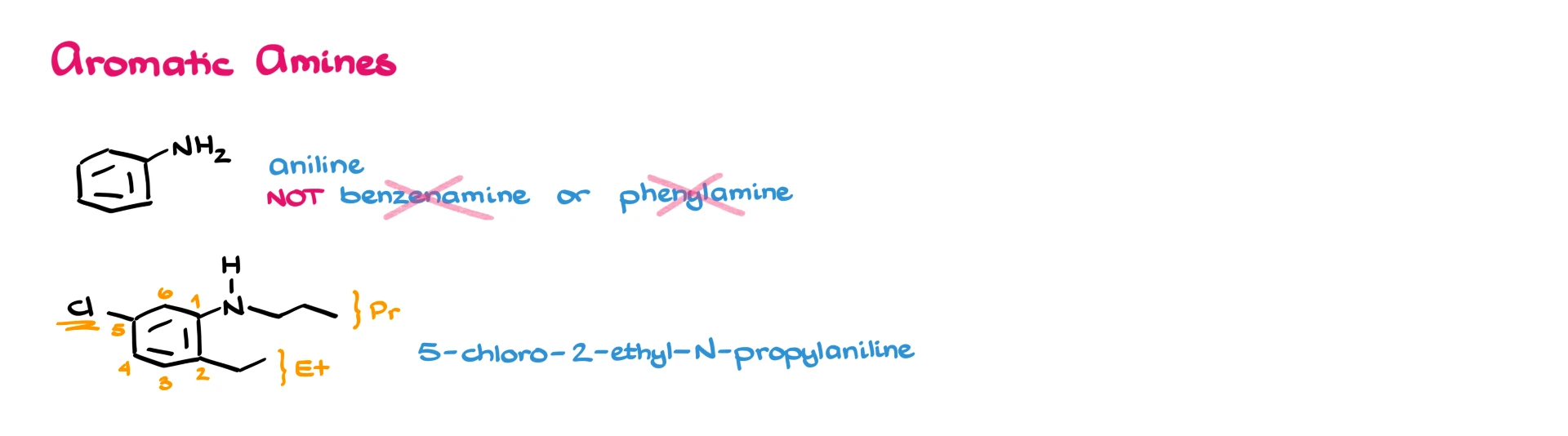
We call aromatic amines anilines (provided the amine is the highest priority group, of course), not benzenamine or phenylamine. And although it’s not incorrect to call them benzen- and phenylamine depending on the situation, we typically recommend the use of “aniline” in a sophomore organic chemistry class whenever possible.
So, if I have a molecule like this, I have an ethyl group, I have a propyl group, and I have a chlorine. I’ll number my molecule starting with the carbon that is attached to the nitrogen, since this is my highest priority functional group, and number it clockwise towards the closest substituent, giving me 5-chloro-2-ethyl-N-propylaniline. Notice that we still have to alphabetize our groups. That’s why I have chloro before ethyl here.
Heterocyclic Amines
And let’s talk about the heterocyclic amines while we’re at it.
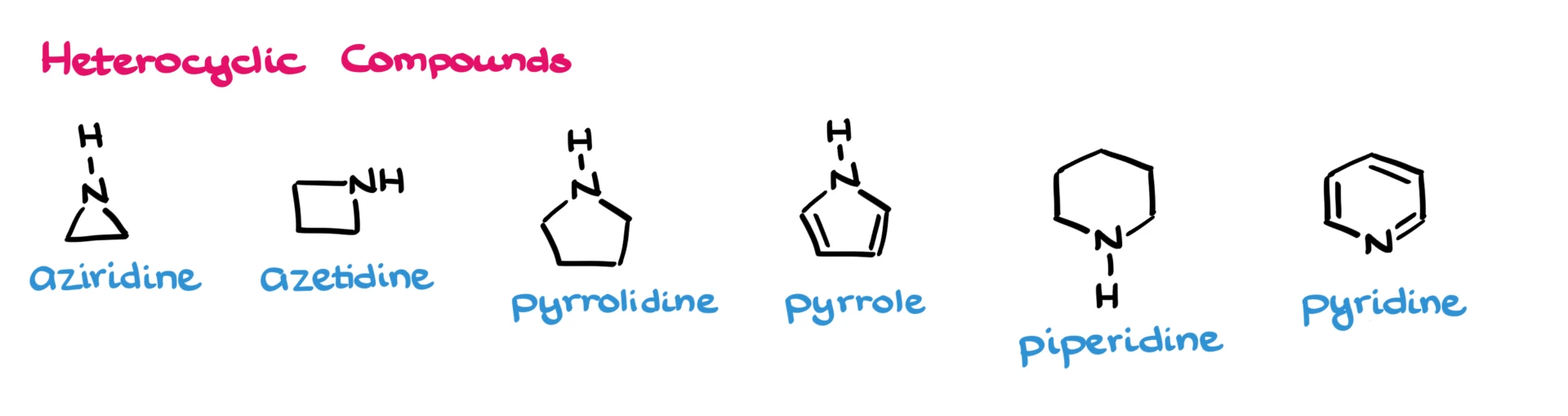
The 3-membered ring is aziridine. The 4-membered ring is azetidine. The 5-membered non-aromatic ring is pyrrolidine, while the 5-membered aromatic ring is pyrrole. The 6-membered non-aromatic ring is piperidine, and finally, the 6-membered aromatic one is pyridine. These ones you just have to memorize. And the numbering in these guys always starts at the nitrogen. That’s all you typically need to know about the nomenclature of amines!