
The R/S Challenge Most Students Get Wrong
This molecule has three chiral atoms. The question is: can you assign all of the stereodescriptors in this molecule?
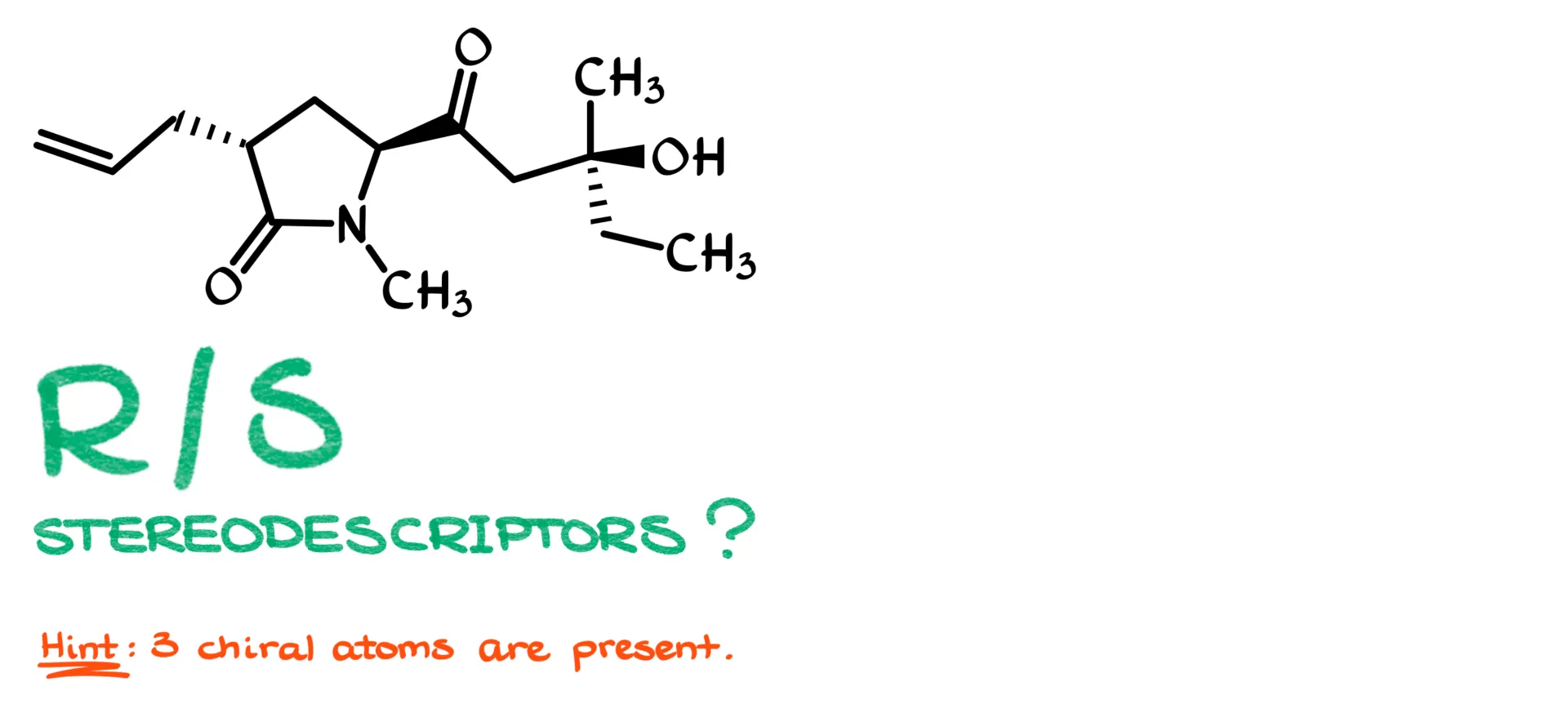
Let’s get back to our molecule. As mentioned, we have three chiral carbons here: this one, this one, and finally this one. I’m going to call them atom A, atom B, and atom C. Pause this tutorial right now and try assigning the stereodescriptors yourself, then keep going to see how you did.
Starting with atom A: this carbon’s implicit hydrogen is facing us directly. Whenever an implicit atom like this falls on a wedge or a dash, make sure your wedges and dashes stay on the same side of the molecule. As a rule of thumb, never cross your plane lines, and never draw wedges and dashes on opposite sides of them. They always need to be on the same side.
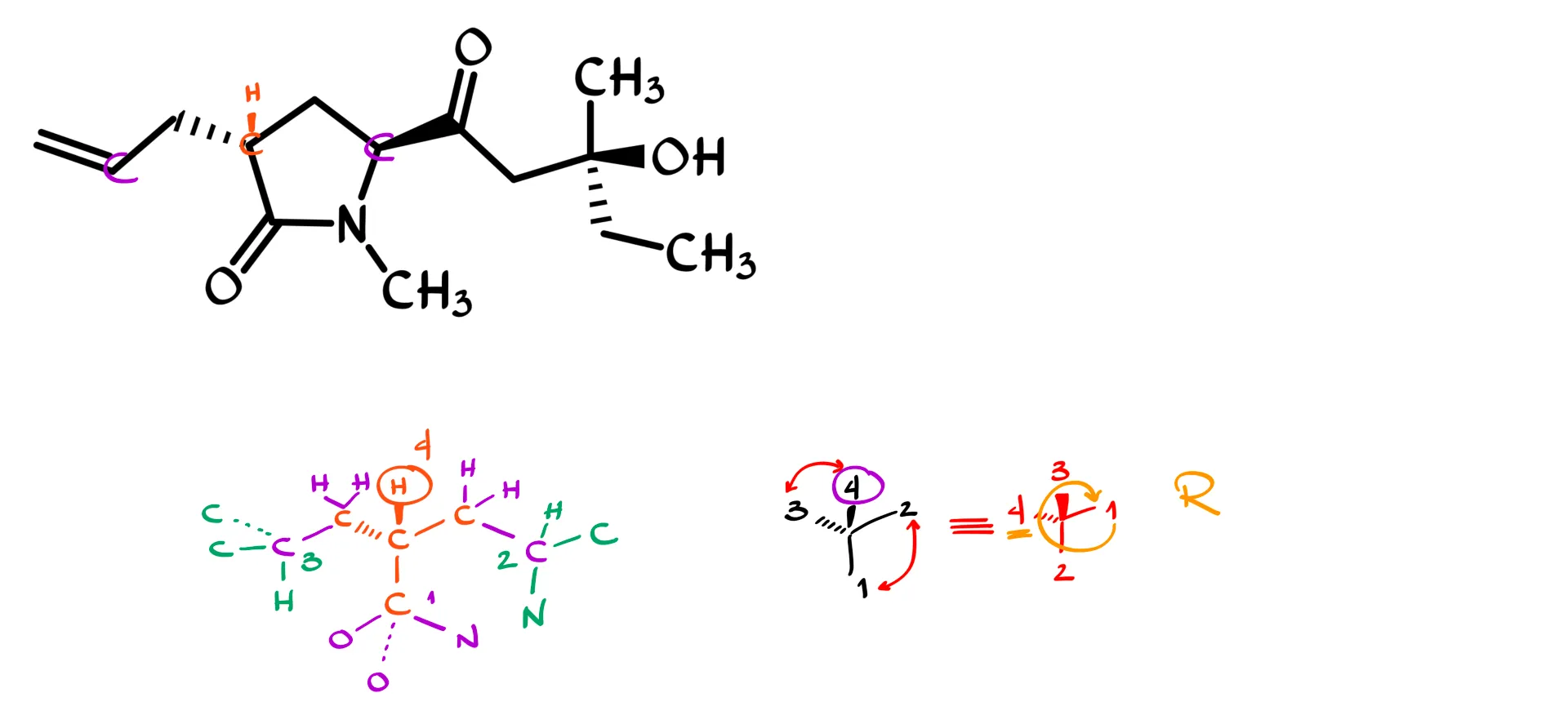
This carbon’s implicit hydrogen is automatically the lowest priority, group four. Of the three carbon substituents, one connects to a real oxygen plus a phantom oxygen (from the carbon-oxygen double bond) and a nitrogen, and that combination beats plain carbon right away, making it priority one. The other two carbons tie at the first shell, so we look one level further out: the carbon that connects to nitrogen outranks the one that only connects to another carbon, giving us priority two and priority three. Since the hydrogen, our lowest priority, points toward us instead of away, a double-flip rotation, swapping groups 3 and 4, then 1 and 2, lets us view the center correctly. Once it’s reoriented, tracing 1 to 2 to 3 goes clockwise, making atom A the R stereocenter.
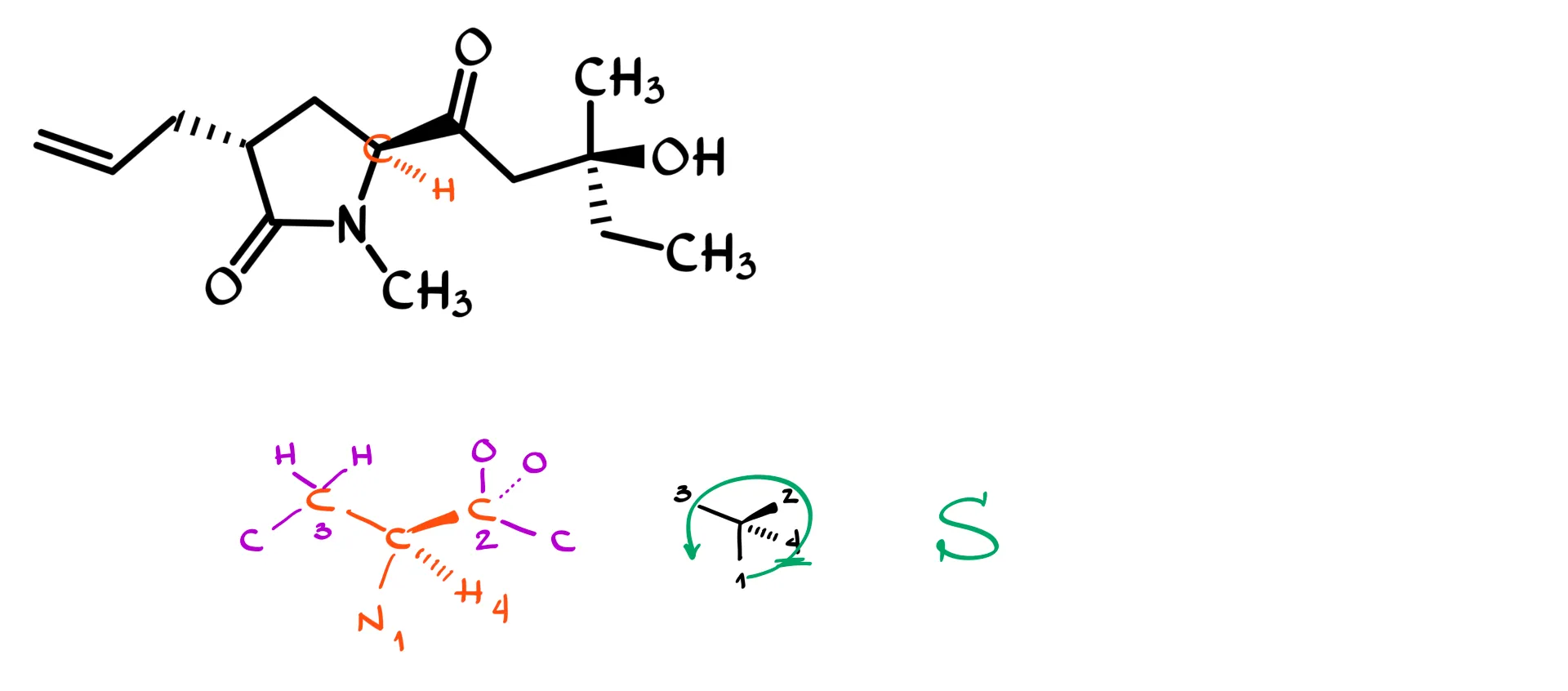
Moving on to atom B: the implicit hydrogen here already points away from us, which simplifies things. Nitrogen is immediately the highest priority, and hydrogen is the lowest. Between the two remaining carbons, the one bonded to a real oxygen plus a phantom oxygen (again from a double bond) outranks the one bonded only to hydrogens, making it priority two, with the other carbon at priority three. Since the lowest-priority group is already oriented correctly, we can read the order directly: 1 to 2 to 3 goes counterclockwise, making atom B the S stereocenter.
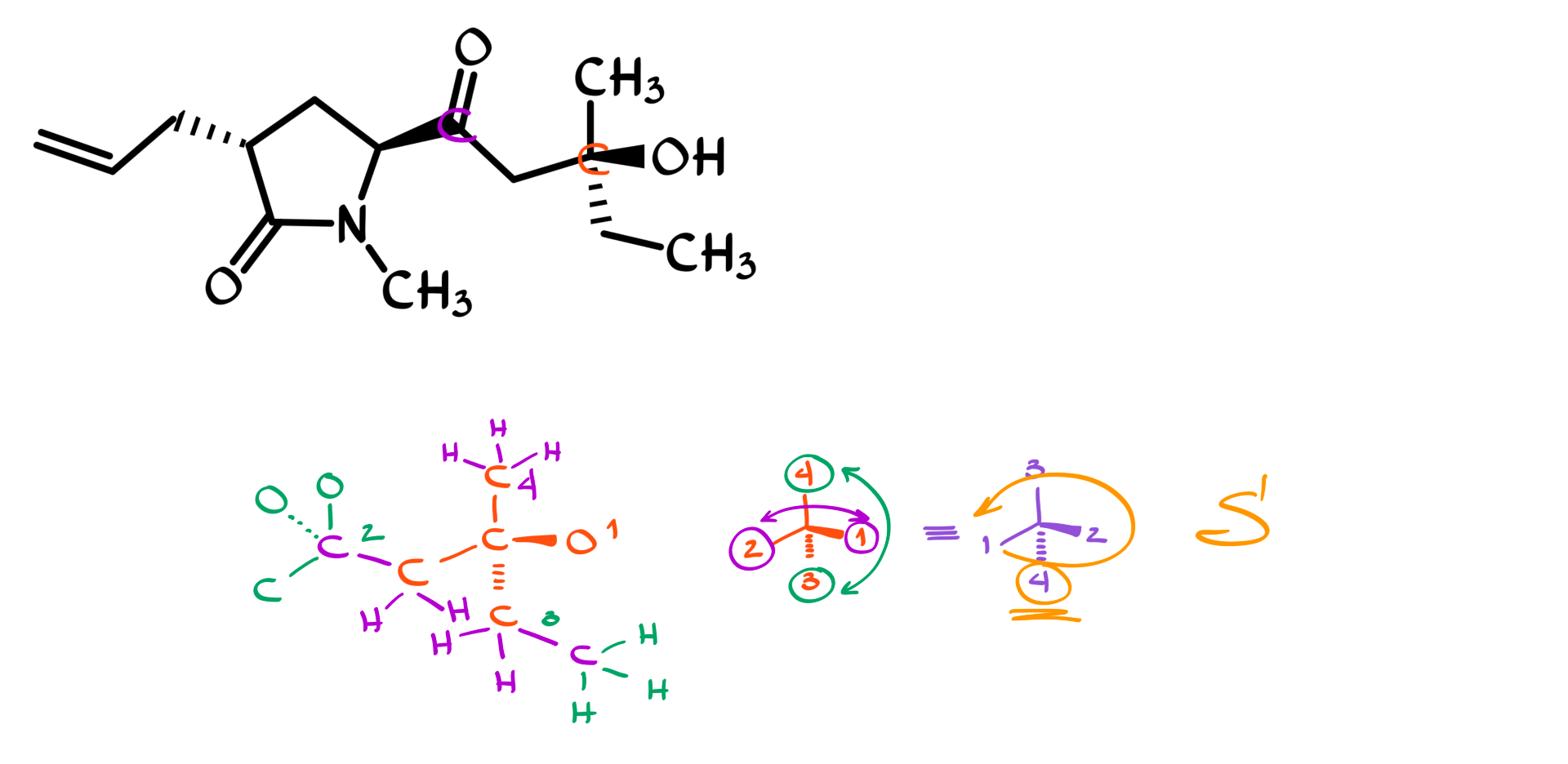
Last is atom C, which has no implicit hydrogens since every substituent here is drawn explicitly. The oxygen sits on the wedge and is immediately priority one. Among the three carbon substituents, the one bonded only to hydrogens ranks lowest, at priority four. Of the remaining two, the one connected to a real oxygen plus a phantom oxygen outranks the one connected only to hydrogens, putting them at priority two and three. Because the lowest-priority group still isn’t pointing away from us, another double-flip rotation is needed; once it’s corrected, tracing 1 to 2 to 3 again goes counterclockwise, making atom C the S stereocenter as well.
There’s an important trap built into this example, one designed to test whether you’re using shortcuts rather than understanding the actual method. Here’s the trick some students fall into: when the lowest-priority group doesn’t point away from you, they assign the stereodescriptor as if it does, then simply flip the letter at the end. Try that shortcut here, and it gives you the wrong answer. Instead of relying on tricks like that, it’s worth understanding the double-flip method covered in this tutorial series, a reliable way to rotate a stereocenter properly in space without depending on shortcuts. Understanding why a method works, rather than applying rules mechanically, is what leads to the correct assignment every time.