
Synthesis of Amines
In this tutorial, I want to go over the various synthetic approaches you might want to use when you’re trying to synthesize an amine. I do have dedicated tutorials on each of the methods I’m going to talk about here, so if you want more details on a specific reaction or synthetic sequence, you can always go to those tutorials. This one is going to be an overview to give you a solid idea of what you should know, what you should have in your synthetic arsenal, and which methods to avoid.
So, let’s get to it!
Substitution Reactions
First, let’s take a look at simple substitution reactions. These are reactions where an alkyl halide (or another molecule with a leaving group) reacts with ammonia or an amine. The X in the general scheme represents the leaving group, which, as I’ve mentioned, might be a halide or another leaving group. These reactions are also done in a huge excess of ammonia. Typically, we’re looking at a 10x excess or larger.
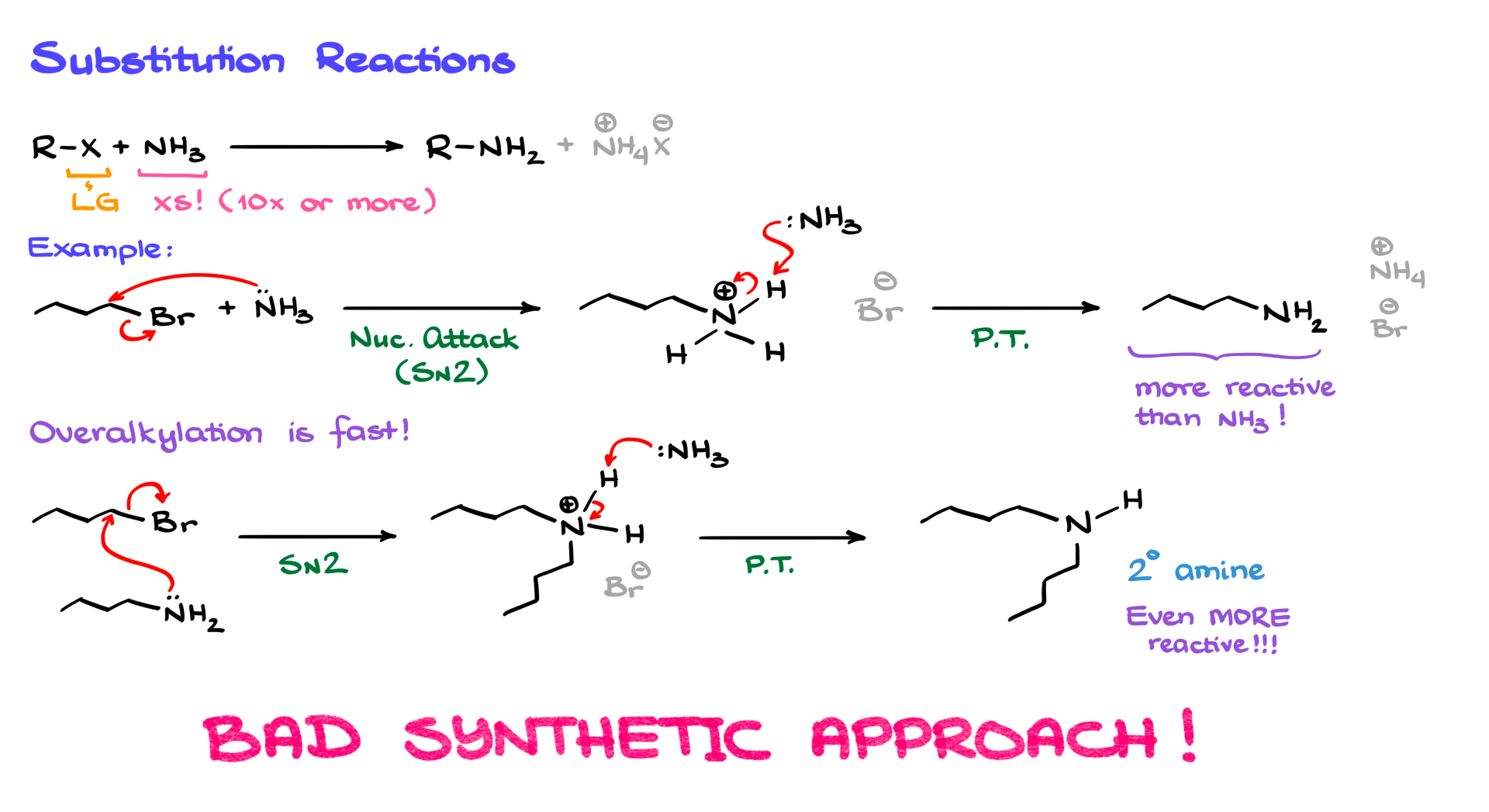
For instance, if we take butyl bromide and treat it with ammonia, we’re going to get a simple SN2 reaction, which gives us the corresponding protonated intermediate. From there, we bring in the next equivalent of ammonia to deprotonate it, giving us our final product, the free amine. In this case, that’s butylamine.
Now, the issue with this reaction is that the amine we just made is actually more reactive than the original ammonia. This means that overalkylation, where the product keeps reacting, is very likely, and that reaction is also quite fast. So, we still have the original starting material, butyl bromide, and the newly formed butylamine, and boom! These two are going to react with each other, giving us a new protonated intermediate. Like in the previous case, another molecule of ammonia comes in to deprotonate it, and now we have a secondary amine. And guess what! This one is even more reactive! So, the reaction can happen again and again.
This reaction only works on paper and in industry. Do not ever write it in your synthesis on the test or in your homework. This is NOT a lab method. Avoid it at all costs!
Reduction of Azides and Nitriles
Now, what does work pretty well in the lab is the reduction of azides and nitriles.
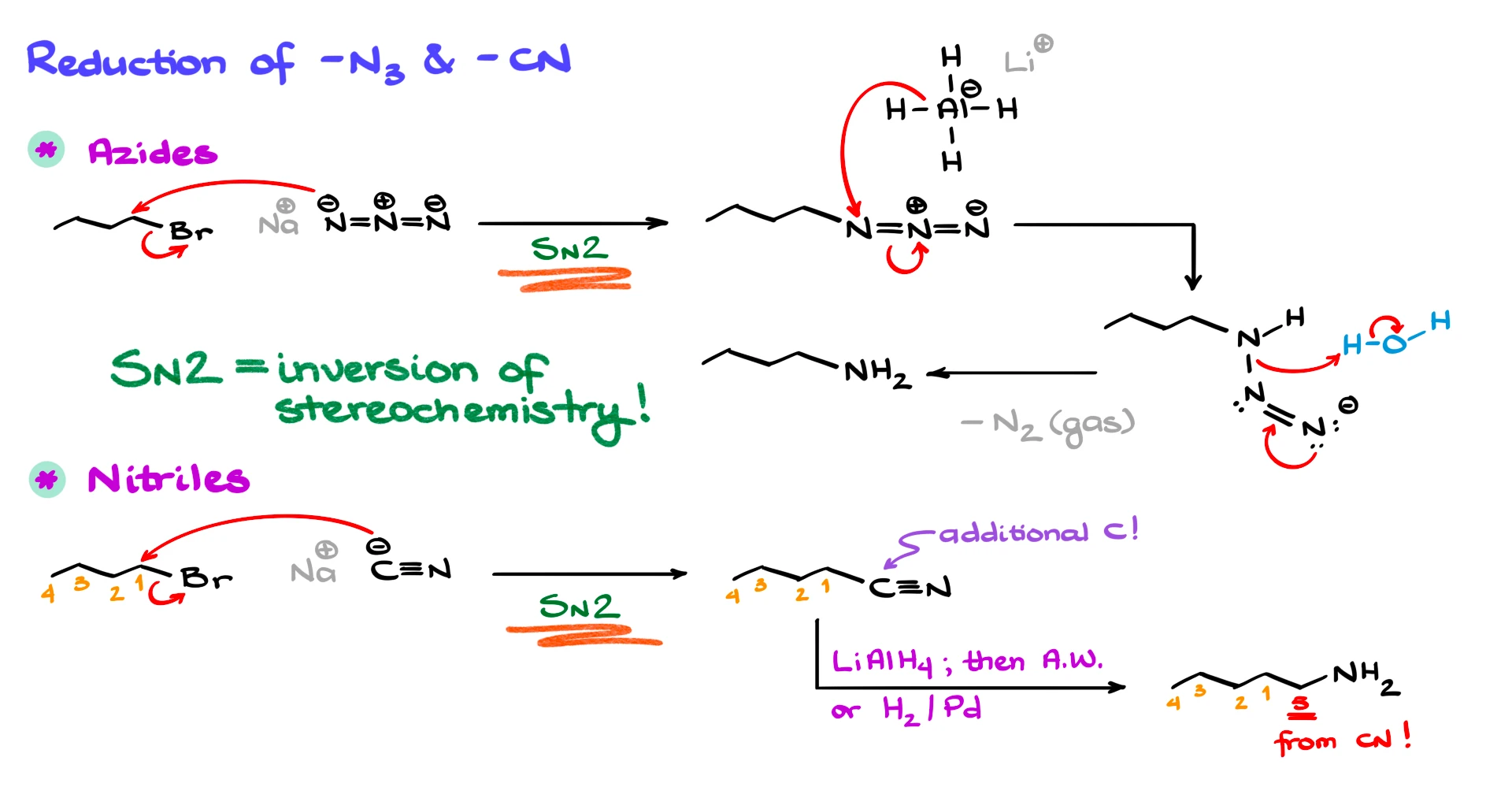
In the case of azides, let’s start with the same starting material as before, butyl bromide. We’ll react it with sodium azide in a fairly simple SN2 reaction, giving us the corresponding azide. These compounds are a lot of fun and see a lot of applications in chemistry, but for our purposes, we’ll want to reduce them with something like lithium aluminum hydride. The hydride does a nucleophilic attack on the nitrogen that’s connected to carbon, making an intermediate that, upon aqueous workup, grabs a proton from the media. That gives us the final amine, expelling nitrogen gas in the process.
The big minus of this method is that azides can be quite toxic and carcinogenic, not to mention they like to go BOOM if you look at them sideways, so you have to be very careful working with them.
Alternatively, we can use nitriles. If we take the same butyl bromide and react it with sodium cyanide, we get a simple SN2 reaction similar to the previous example, giving us the corresponding nitrile. And if we reduce it with either lithium aluminum hydride, or maybe even with just hydrogen on a heterogeneous catalyst, we’re going to get our final amine.
Now, here’s something important I want to point out about this reaction. If we number the carbons in the starting material and then find the same carbons in the nitrile, we can see there’s an extra carbon in the chain! This means we’re going to end up with an extra carbon in the final product as well. That extra carbon came from the CN. This is something you’ll want to keep in mind when planning your synthesis, because if you don’t, you’ll end up with an additional carbon in your molecule, which can be quite detrimental to your goal.
Another thing I want to point out about both of these reactions is that we introduce the nitrogen via an SN2 process. This is something you should also keep in mind, since SN2 reactions cause the inversion of the stereochemistry. So, if stereo is important, be careful with your choice of the starting material.
Synthesis from Carboxylic Acid Derivatives
OK, moving on, we have a family of reactions that can make amines from carboxylic acids.
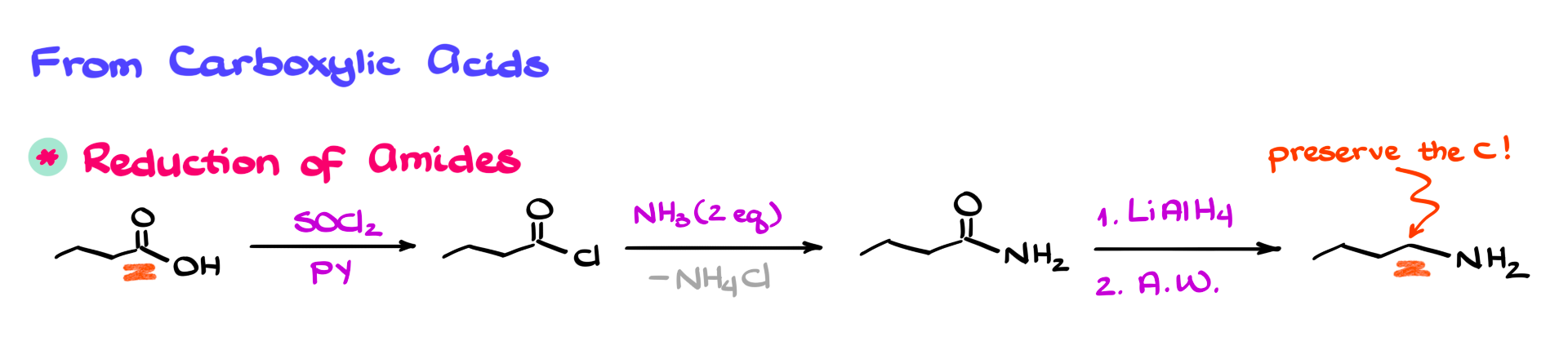
The first reaction is the reduction of amides. If we start with butanoic acid, we’ll first have to convert it into the corresponding acid chloride using thionyl chloride or another reagent like, maybe, PCl3 or something like that. Once we have our acid chloride, we’ll treat it with an excess of ammonia, giving us our amide. From here, we’ll typically reduce the amide with lithium aluminum hydride and get our free amine after the aqueous workup. Pretty straightforward.
Now, something I’ve seen many students forget is the carbon of the carboxylic acid itself. This sequence preserves that carbon, so make sure you don’t just erase the entire carboxylic acid and put an amine in its place. Count your carbons carefully!

The next reaction in this section is the Hofmann rearrangement. Let’s start with 2-methylbutanoic acid here for a change, and convert it into the corresponding amide using the sequence from above. If we now treat this amide with bromine in base, we’ll end up making the corresponding amine. Importantly, now we ARE losing a carbon in the form of CO2 gas. The carbon that was a part of our original carboxylate is now gone.
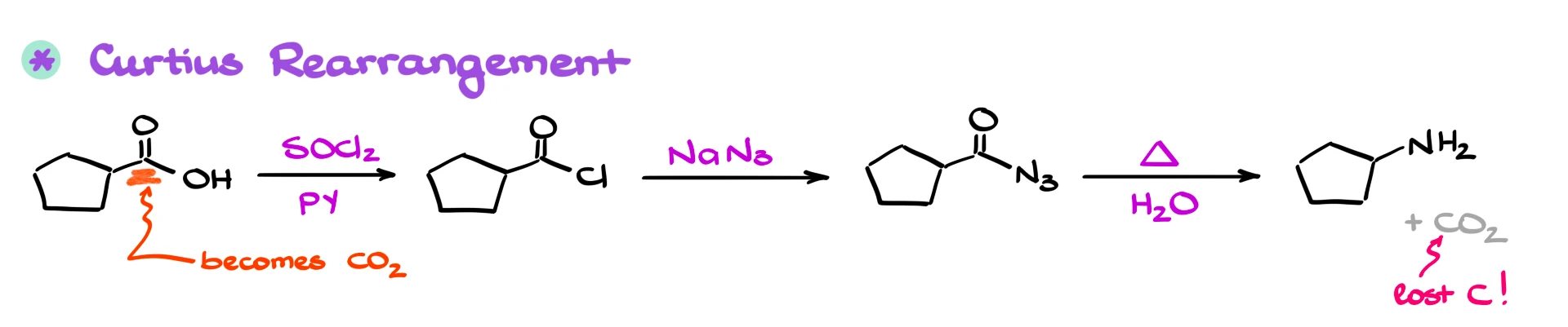
We see something similar with the Curtius rearrangement. Let’s start with cyclopentanecarboxylic acid. We’ll convert it into the corresponding acid chloride and react it with sodium azide, giving us the corresponding acyl azide intermediate. Now, these compounds are not particularly stable, so with some gentle heating, the molecule will undergo a rearrangement similar to the Hofmann example from a moment ago and give us the corresponding amine. In this case, that’s cyclopentylamine. And like in the previous example, we’re losing a carbon here as well: the carbon of the carboxylic acid goes away as CO2.
Not keeping track of your carbons is the most common mistake I see in these reactions when students come to my office hours. So, be careful.
Gabriel Synthesis
Alright, next in no particular order is the Gabriel synthesis.
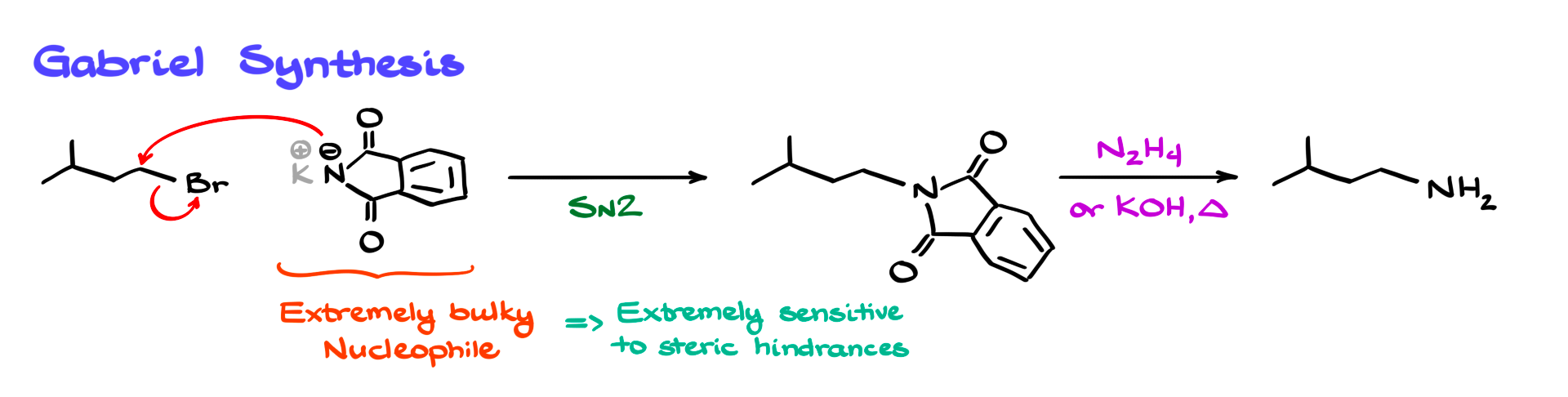
If we take a primary halide and treat it with phthalimide, we’re going to see a simple SN2 attack, resulting in the formation of a new compound with a carbon-nitrogen bond and the monstrosity of the phthalimide sitting on our molecule. Then, if we cleave it with either hydrazine or aqueous potassium hydroxide, we’re going to get our free amine.
Now, the problem with this reaction is that the phthalimide is an extremely bulky nucleophile, meaning that this reaction is going to be incredibly sensitive towards the steric hindrances in your molecule. It’s also quite moody, and the co-products that you get in this reaction are difficult to get rid of. So, the Gabriel synthesis is more of a historic reaction, and you’ll be hard-pressed to find any modern applications of this method.
Reductive Amination
The next method, however, reductive amination, is the bread and butter of modern amine synthesis.
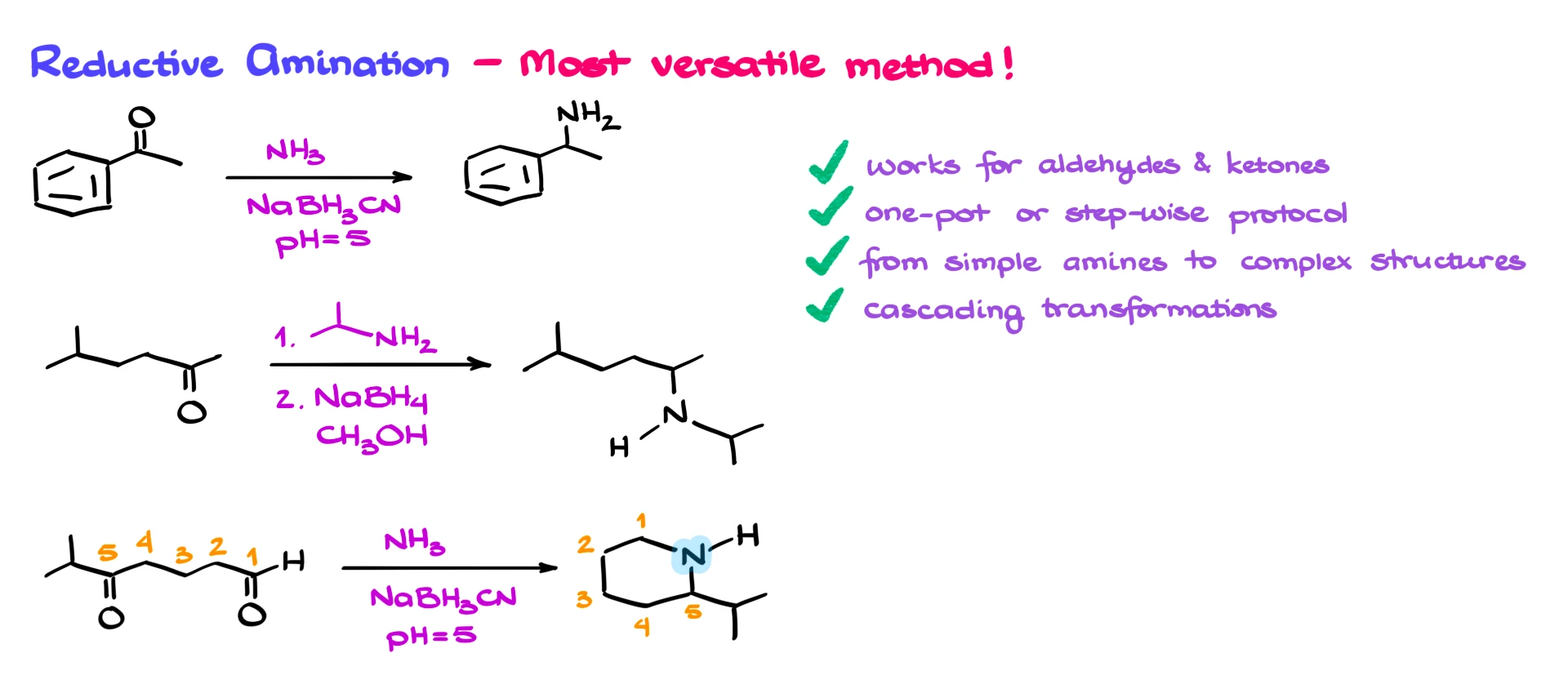
Generally, if we have an aldehyde or a ketone, like acetophenone, we can treat it with ammonia and a reducing agent like sodium cyanoborohydride, giving us our amine right away. This is an example of a single-pot or one-pot procedure. We can also do this reaction in two steps, where we first make an imine intermediate and then reduce it to the corresponding amine.
So, what are the benefits of this reaction? It works for both aldehydes and ketones. It can be done as a one-pot or step-wise procedure depending on your setup and compounds. It can make anything from simple to complex amines. And it can be used in cascading transformations, making complex systems and cyclic amines from acyclic starting materials.
For instance, if we take a dicarbonyl and treat it with ammonia using the single-pot procedure, we’re going to end up with the corresponding piperidine derivative in one synthetic step! Pretty cool, right? If we number the atoms in the starting material 1 through 5, we can find the same atoms 1 through 5 in the product, and the nitrogen becomes the 6th atom in the ring.
Synthesis of Aromatic Amines
And finally, I want to mention the synthesis of aromatic amines.

The most common approach starts with an aromatic compound. I’m just using benzene here for simplicity. We’ll perform a nitration reaction to add the nitro group, and then we’ll reduce it. Nitro compounds are incredibly easy to reduce, and there’s a whole bunch of methods that would work here. For simplicity’s sake, I’m using the iron + acid method. And since in this particular case we’re working in acidic media, we’ll need to neutralize our molecule to get the free amine.
Of course, this list is not exhaustive, but these are the most common sophomore organic chemistry reactions you’ve got to know.