
Fundamentals of Transition Metal Complex Reaction Steps
If looking at a reaction scheme like this makes you want to scream, this tutorial is for you.
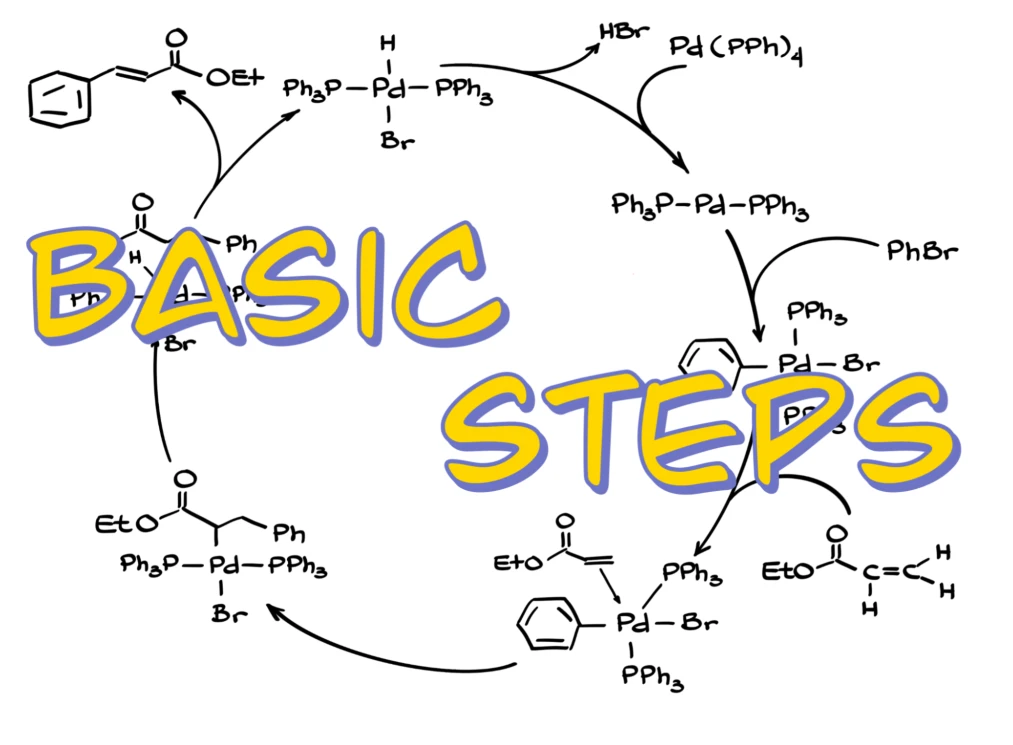
In this tutorial, we’re going to talk about the fundamental steps you’ll see in the reactions of transition metal complexes. It’s a lot like the basic steps you already know from organic reactions, where we have electrophilic and nucleophilic attacks, proton transfers, elimination, and rearrangement, except now we’re working with five characteristic steps: ligand dissociation and association, oxidative addition, reductive elimination, ligand insertion, and β-elimination. Let’s jump into the first one.
Ligand Dissociation and Association
Let’s say we have this tetrakis(triphenylphosphine)palladium(0) complex, Pd(PPh3)4. Here we have four triphenylphosphine ligands, and those ligands can comparatively easily dissociate, giving us a free ligand and whatever’s left of the complex. We started with an 18-electron complex, and we end up with a 16-electron one.
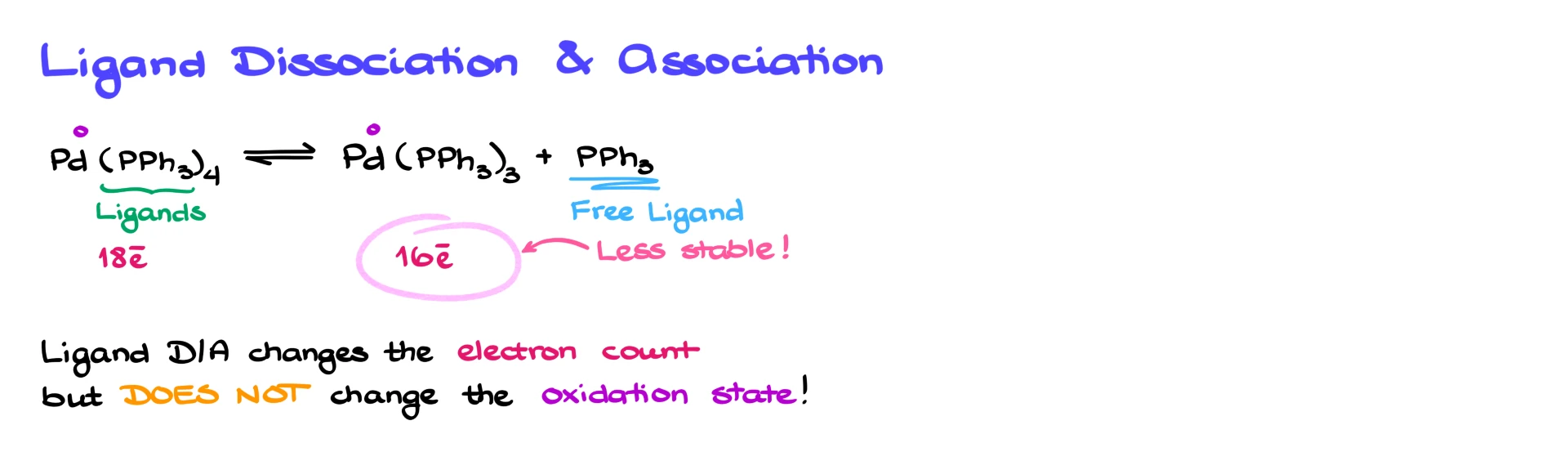
Notably, the loss of electrons due to ligand dissociation makes the complex less stable, so it will often try to either grab another ligand or undergo one of the other steps we’ll cover below. Another important point: the oxidation state of the metal stays the same throughout this step. We started with Pd(0), and we ended up with Pd(0) as well. So remember, ligand dissociation and association steps change the electron count, but they do not change the oxidation state of the metal.
What’s more interesting is that this dissociation-association behavior lets us swap ligands, in a variation of this step we often call ligand substitution.
Ligand Substitution
In a nutshell, ligand substitution is a sequence of ligand dissociation and association steps (or it can even happen all at once). In ligand substitution, neither the electron count nor the oxidation state of the metal changes; both stay the same.
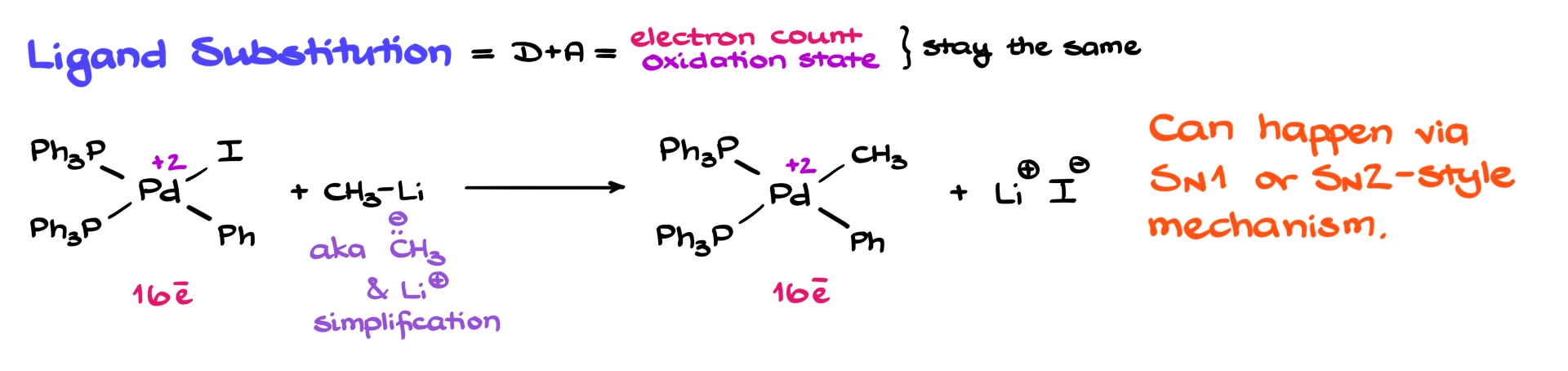
For instance, let’s say we have this Pd complex and react it with methyllithium. For simplicity’s sake, you can think of methyllithium as an ionic pair of a negatively charged methyl group and a positively charged lithium counterion. This is an oversimplification, but it makes it easier to see what’s going on if you treat these molecules as ionic pairs. In this case, we end up swapping the iodine on our Pd for a methyl group. Notice that Pd was (II) and is still (II); our original complex was 16-electron and is still 16-electron. Nothing has changed except the identity of that one ligand.
This kind of reaction can proceed by either an SN1- or SN2-style mechanism. Unfortunately, there’s no easy way to predict which one will occur, so we typically just describe the outcome as a ligand substitution without worrying too much about exactly how it happened.
Oxidative Addition
In this step, the metal essentially inserts itself into an X-Y bond, giving us a new complex with the metal in the middle. As a result, the oxidation state of the metal increases, shifting toward a larger positive number.
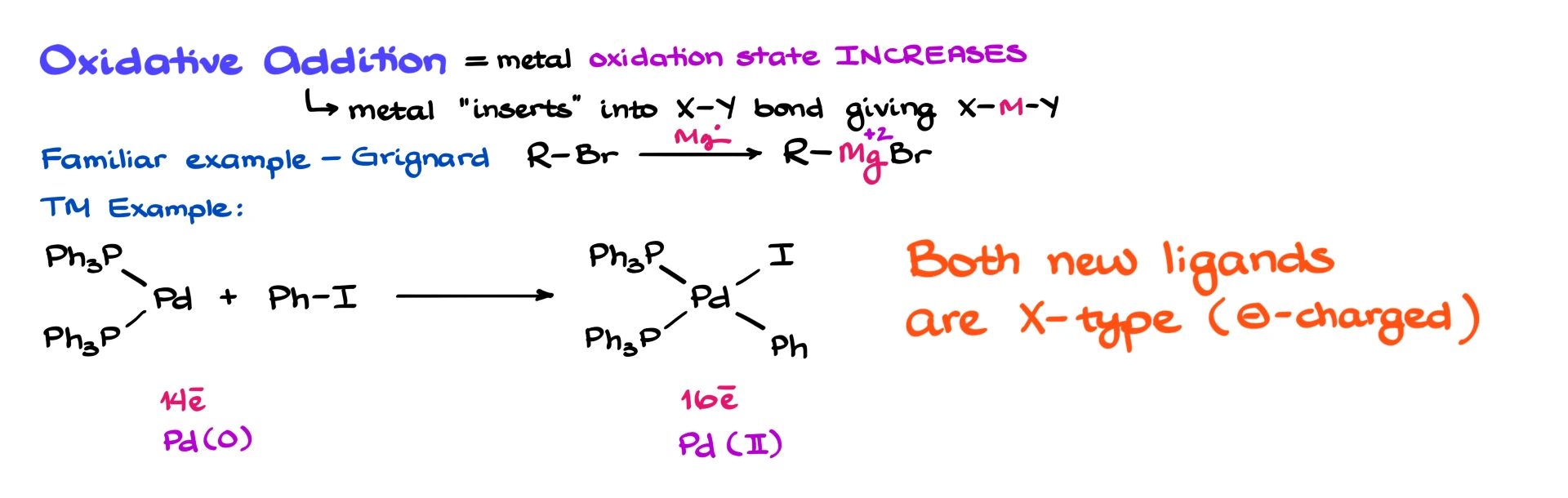
One example you’re probably already familiar with is the Grignard reaction. We start with an alkyl halide, treat it with magnesium metal, and end up with an alkyl magnesium halide. We start with Mg(0) and end up with Mg(II). Magnesium isn’t a transition metal, but this example illustrates the step using chemistry you’ve already seen.
Now for a transition metal example: let’s say we have this bis(triphenylphosphine)palladium(0) complex, Pd(PPh3)2. This is a 14-electron Pd(0) complex, which isn’t particularly stable and is quite reactive. When it reacts with iodobenzene, we form a new complex with both an iodine and a phenyl group as new ligands on Pd. This new complex is 16-electron, and the oxidation state of Pd went from (0) to (II). Notice that both new ligands are X-type (anionic) ligands. If you need a refresher on the ligand classifications and other fundamentals, I have it here.
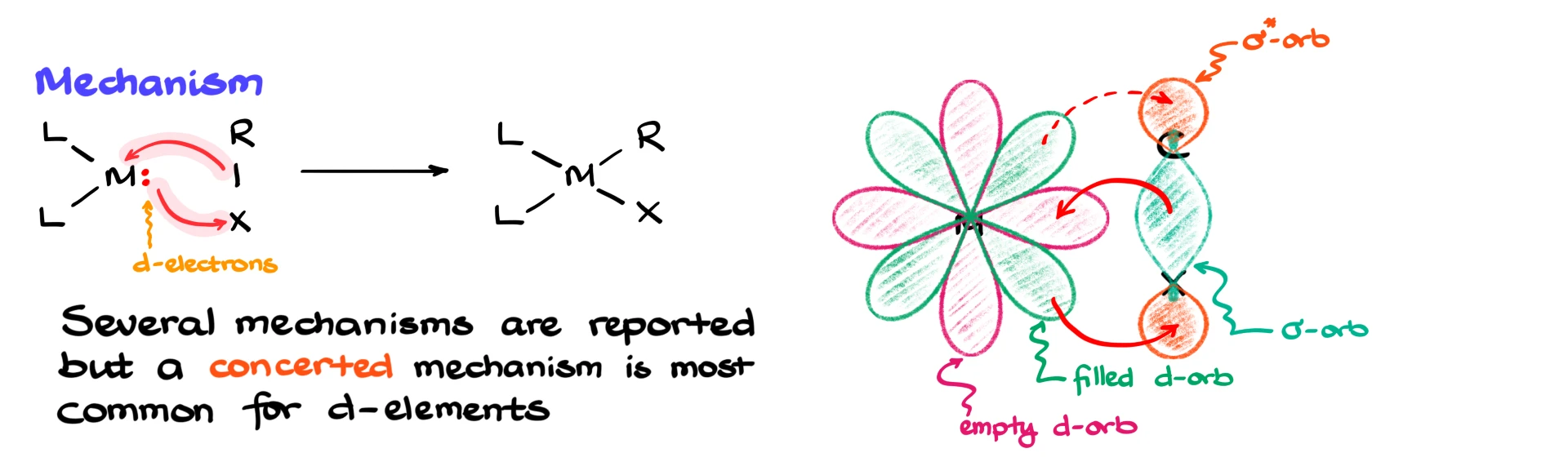
Mechanistically, this is a rather interesting reaction. Let’s represent our complex as a metal, M, with a couple of L ligands around it, and show the halide as R-X. Here’s the electron pair on the metal, representing the d-electrons (it’s a bit of a simplification to draw d-electrons as a single electron pair, but we’ll roll with it for clarity). One arrow runs from the metal’s d-electrons to the halide, forming the bond to the first new ligand. A second arrow runs from the R-X bond back to the metal, forming the bond to the second new ligand. Together, these give us the product complex.
The best part is seeing how this happens from an orbital perspective. Start with the metal, M, which has an empty d-orbital. Add the filled d-orbital on top of that, giving this d-orbital “flower” shape. Now bring in the carbon and halide, along with their σ-bonding orbital and σ–antibonding orbital. The interaction between the σ-bonding orbital and the empty d-orbital on the metal is what the first arrow represents, and the interaction between the filled d-orbital and the σ-antibonding orbital is what the second arrow represents.
Several mechanisms have been reported for oxidative addition, but this concerted pathway is by far the most common for transition metal complexes.
Reductive Elimination
Next, we’ll look at reductive elimination, which is just the opposite of oxidative addition. That also means the oxidation state of the metal decreases here, moving toward zero. If we have a metal sitting between groups X and Y, the metal pops out and we end up with a new X-Y bond; it’s quite simple.
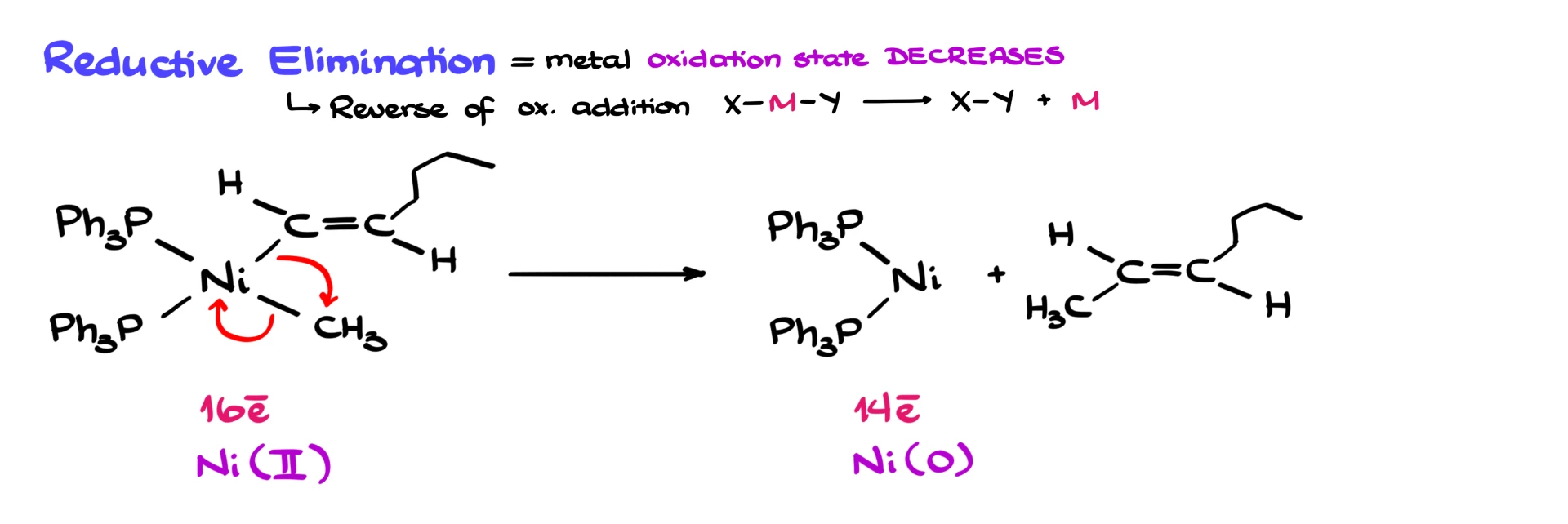
Let’s say we have this nickel complex. We move electrons between the metal and its ligands, forming a new bond between the methyl and vinyl groups, while the nickel, together with its remaining ligands, pops out as the reduced metal fragment. We started with a 16-electron Ni(II) complex and ended up with a 14-electron Ni(0) complex, so the oxidation state decreased and the metal was reduced.
It’s also worth noting that the stereochemistry of the substrates is typically preserved in this step. In this case, we started with a trans alkenyl ligand, and after replacing the Ni with the methyl group, we still have a trans alkene.
Ligand Insertion
Now for the real fun: ligand insertion. Here, we insert a new ligand between an existing one and the metal, essentially extending the ligand chain. Importantly, the metal’s oxidation state doesn’t change in this step. There are two common types of ligand insertion.
1,1-Ligand Insertion
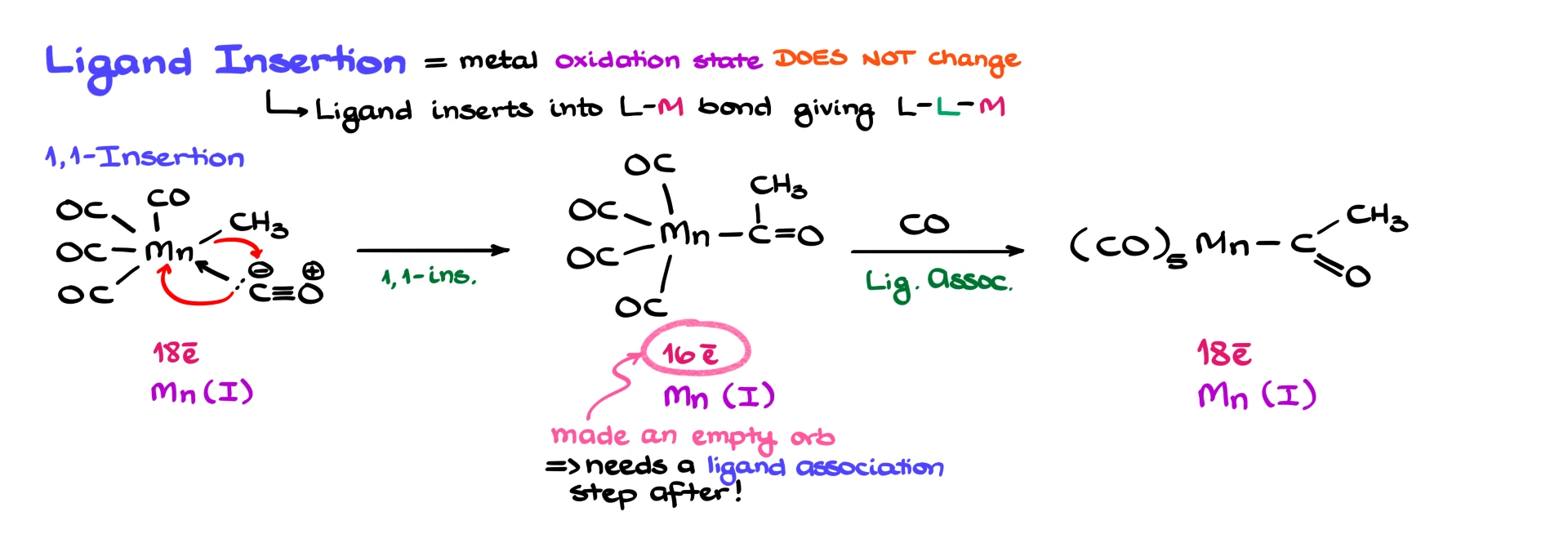
Let’s look at this Mn complex. This is an 18-electron Mn(I) complex, and one of the carbonyl ligands sitting on the Mn can wedge its way between the Mn and the methyl group, giving us the following intermediate: a 16-electron Mn(I) complex. Since we’ve created an empty orbital on the metal in this step, we need to follow it with a ligand association step to bring the electron count back up. We bring in an extra carbonyl ligand from the reaction mixture, and we’re back to an 18-electron Mn(I) complex.
1,2-Ligand Insertion
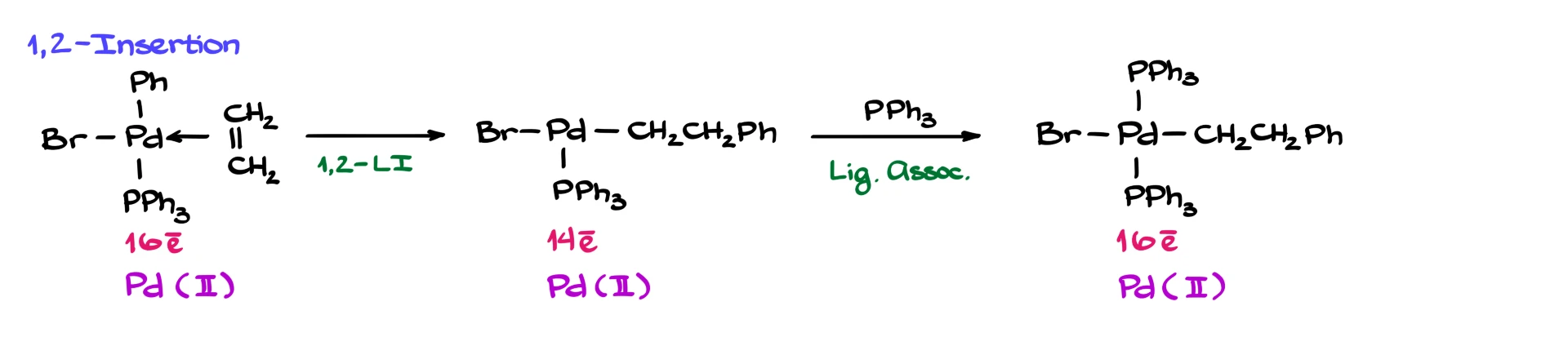
The second type of ligand insertion is what you typically see with substrates containing π-bonds, like this Pd complex. Here we’re looking at a 16-electron Pd(II) complex. As a result of the 1,2-ligand insertion, we wedge the ethyl group between the Pd and the Ph group, giving a 14-electron Pd(II) intermediate. This intermediate then grabs a triphenylphosphine ligand from the reaction mixture, bringing us back to a 16-electron Pd(II) complex.
Stereochemistry of 1,2-Ligand Insertion
Now here’s where things can get tricky: the stereochemistry of the 1,2-ligand insertion. The key thing to remember is that this step is stereospecific, giving the syn-addition product.
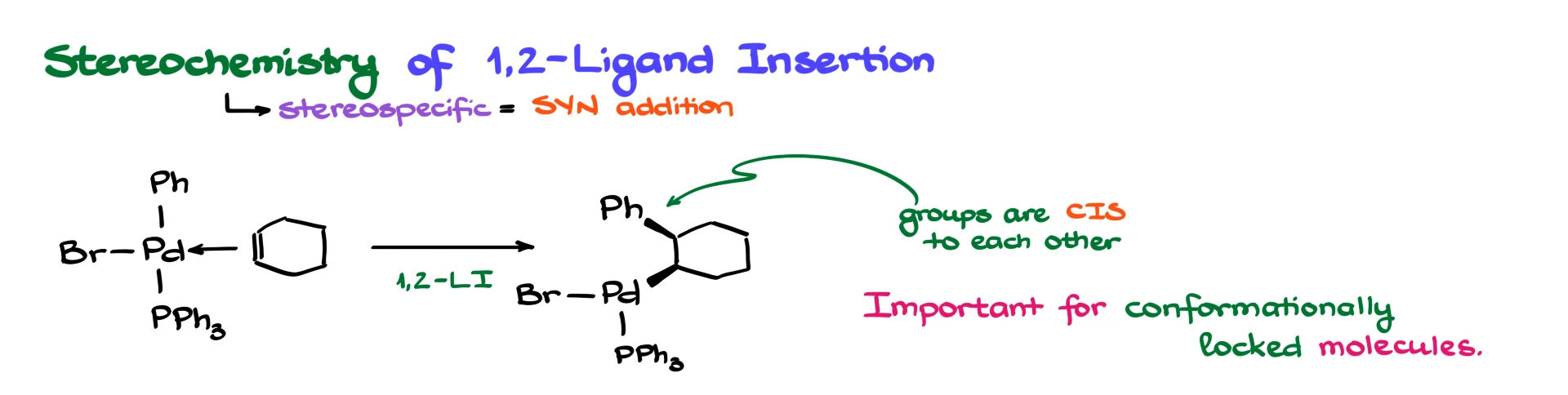
For example, if we look at this Pd complex with cyclohexene, the 1,2-ligand insertion produces a product in which the phenyl group and the Pd end up on the same side of the molecule, or cis to each other. This is an extremely important consideration for conformationally locked molecules, like rings, or molecules with bulky groups that prevent conformational changes.
β-Elimination
Just like every step we’ve covered so far, ligand insertion has an opposite step: β-elimination. It’s worth pointing out specifically that β-elimination is the reverse of the 1,2-ligand insertion, not the 1,1-insertion. As the name suggests, β-elimination forms a π-bond in the substrate.
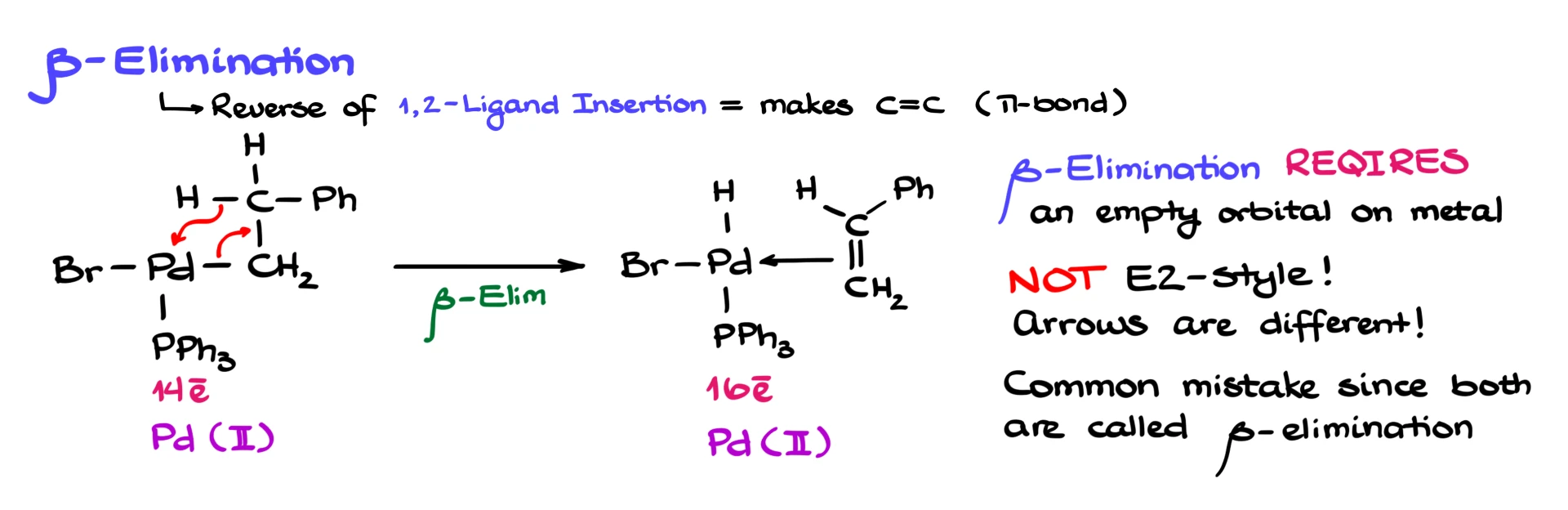
Let’s take another look at the Pd complex from the earlier example. It’s drawn here in a slightly awkward Lewis structure, but that will help us see the mechanism of the elimination. To begin with, this is a 14-electron Pd(II) species, and for β-elimination to occur, we need an empty orbital on the metal; if we started with a stable 18-electron complex, this step simply wouldn’t work.
The first arrow runs from the hydride to Pd, and the second curved arrow runs from the Pd-C bond toward the other carbon. Notice that this is not an E2-style elimination: the curved arrows here point in the opposite direction. This is a very common point of confusion, so if your instructor tests these mechanisms, make sure you know the difference. Just because both E2 and this step are called “β-elimination” doesn’t mean they’re mechanistically similar, even though both ultimately form a new π-bond.
The resulting complex is a 16-electron Pd(II) species. Notice that, just as with ligand insertion, the oxidation state of the metal doesn’t change here.
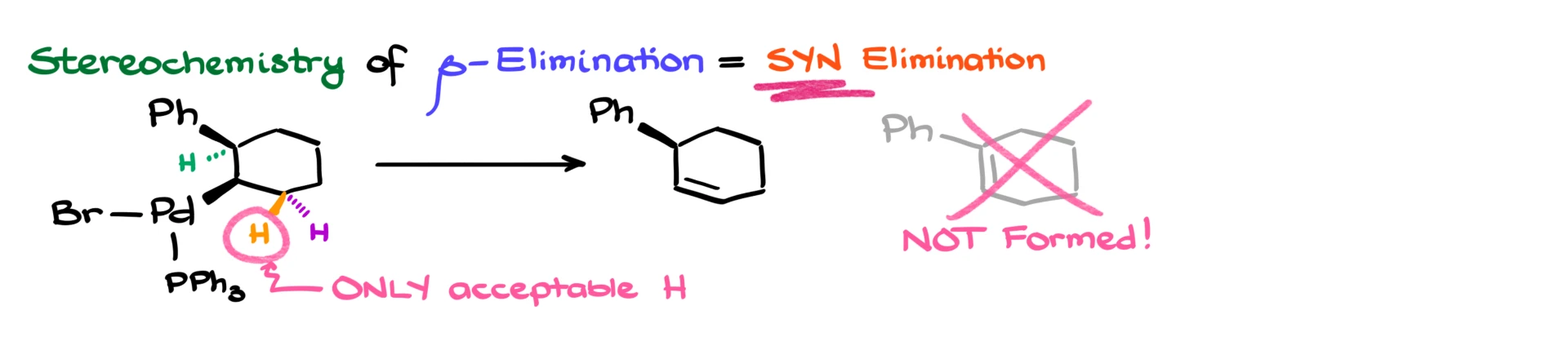
In terms of stereochemistry, this is a syn elimination, meaning the hydrogen and the metal must be on the same side of the molecule. This is extremely important for cyclic and sterically locked molecules. Take another look at the complex from the earlier example: it has a green hydrogen, an orange hydrogen, and a purple hydrogen. The only one that can participate in this elimination is the orange hydrogen, because it’s the only one that’s cis to the Pd. That means the correct product has the double bond on the side shown, not the one next to the phenyl group.
This is a must-know point, since it explains why the double bond sometimes appears to “shift” in these types of reactions. Pay close attention to the stereochemistry of both the 1,2-insertion and β-elimination steps so you don’t get tripped up on an exam.